Sewchet

Sewing, crochet, crafts, accessories, baking, tutorials,


33 Comments

How To Make A Child’s Teepee Wigwam

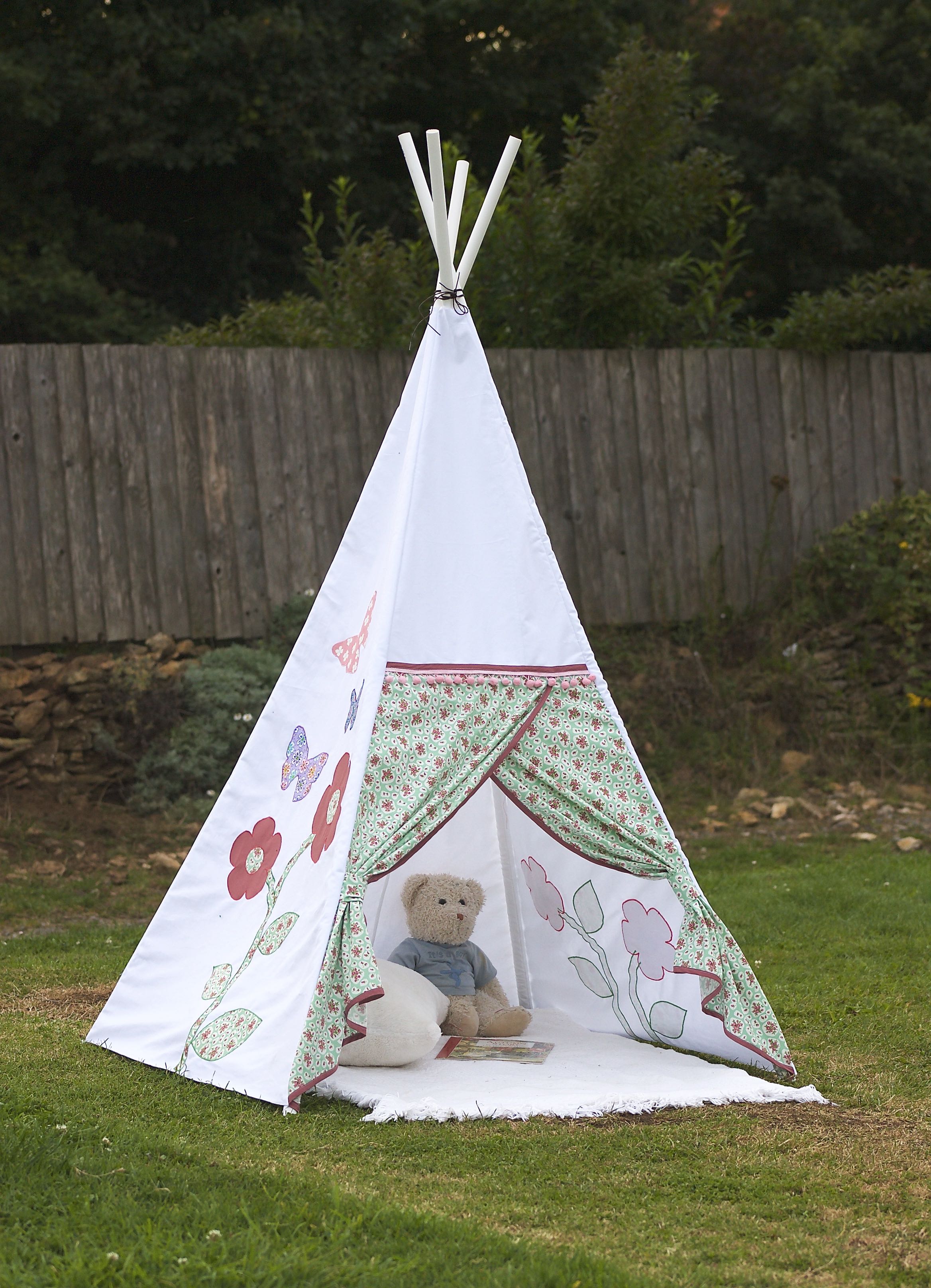
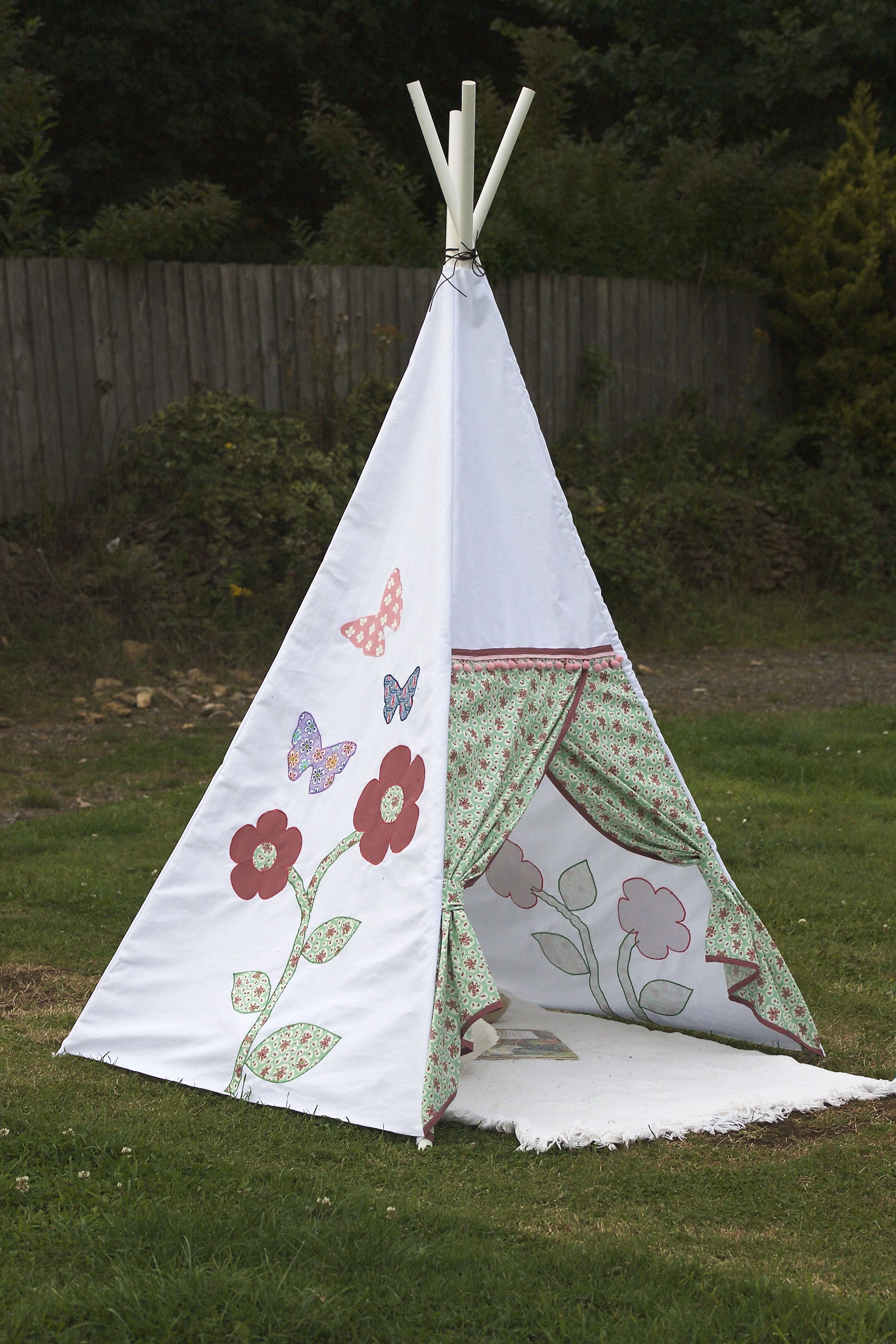
I know it’s bad form to utter the ‘C’ word while it’s still the school Summer holidays, but my August make for the Minerva Craft Blogger Network is this beautiful Teepee, which is indeed a Christmas present for a little girl in the family.

wigwam teepee tipi play tent

I have to admit that this is not the first Christmas present I’ve made this year as I tend to make them all year round, as and when an idea springs to mind, but it’s definitely my favourite so far.

Isn’t it sweet?

teepee wigwam play tent tipi

There are LOTS of tutorials out there showing many ways to make your own wigwam, but none of them were quite what I wanted, so this is my version which is suitable for a toddler – adjust the measurements upwards to make a larger tent for older children.

It is an amalgamation of several basic designs that I’ve come across which I have then personalised to suit the recipient using various appliquéd motifs and letters.

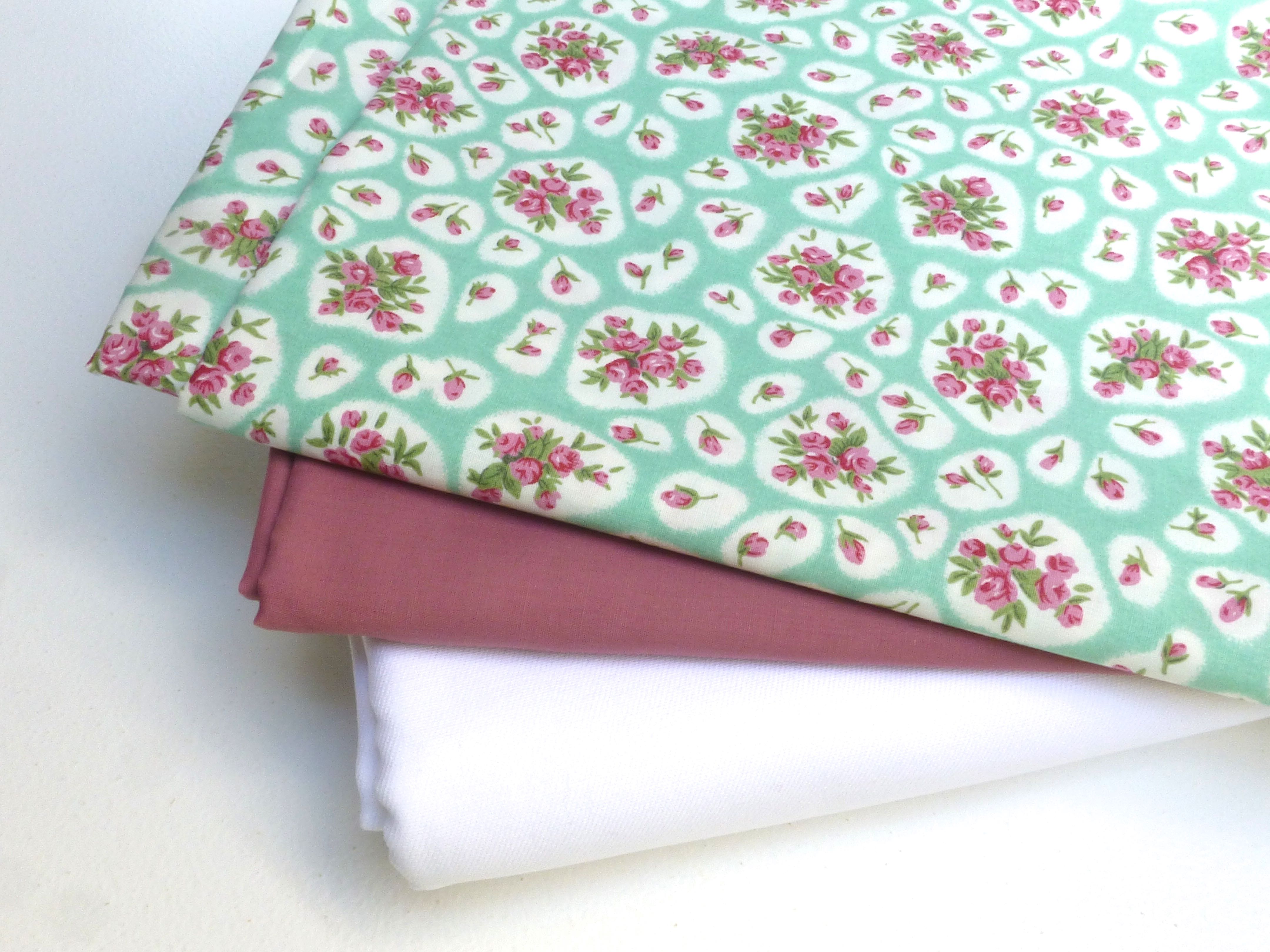
This lovely fabric bundle arrived from Minerva: –
P1060048

The white base fabric for the teepee is a thick cotton drill which makes a nice, strong tent. I also chose two contrasting fabrics which are lighter weight cottons; a gorgeous ‘Cath Kidston’ inspired floral cotton poplin and a dusky pink polycotton.

You will need: –

  • 2 1/2m of cotton drill
  • 1m floral fabric
  • 1m plain fabric
  • selection of scraps from your stash
  • 4 x plastic overflow pipe, each measuring 2.00m x 22mm (99p each from Wickes)
  • A leather shoelace or similar

Using the large diagram as a guide, fold your 2 1/2m of white fabric in half lengthwise and cut out as shown.

Cutting layout diagram

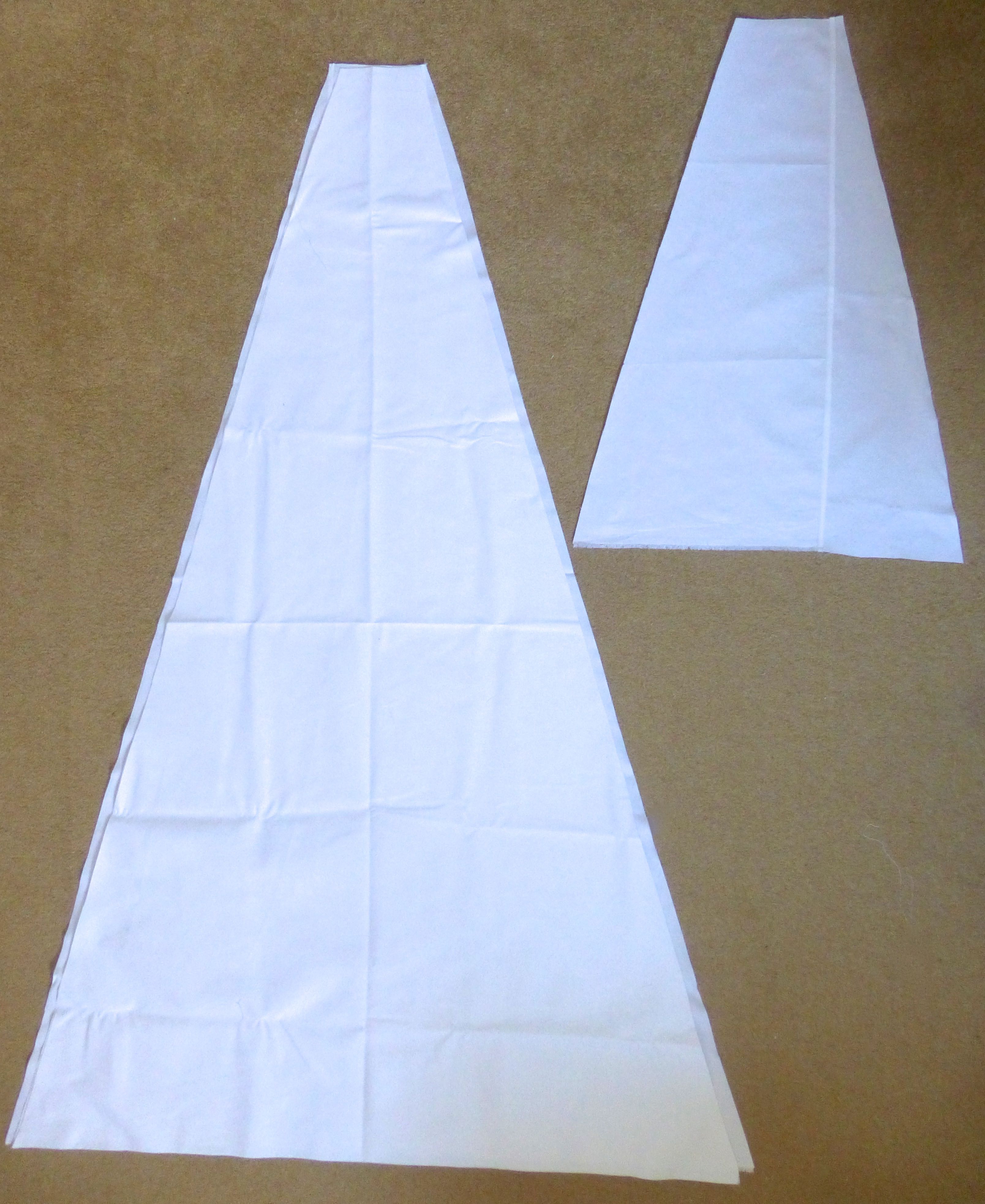
You should now have three equally sized triangles and two half-triangles. Stitch the two half-triangles together along the long straight edge with a narrow seam to make a single triangle. (I cut mine wrong, hence the off-centre seam!)
P1060052

The bottom edges can be hemmed if you wish, although I left mine as the selvedge forms the bottom.

Cut rectangles of fabric out of the contrast floral fabric as per the two smaller diagrams, then make about 4m of bias binding using your plain fabric.

(See my tutorial here on how to make bias binding).

P1060055

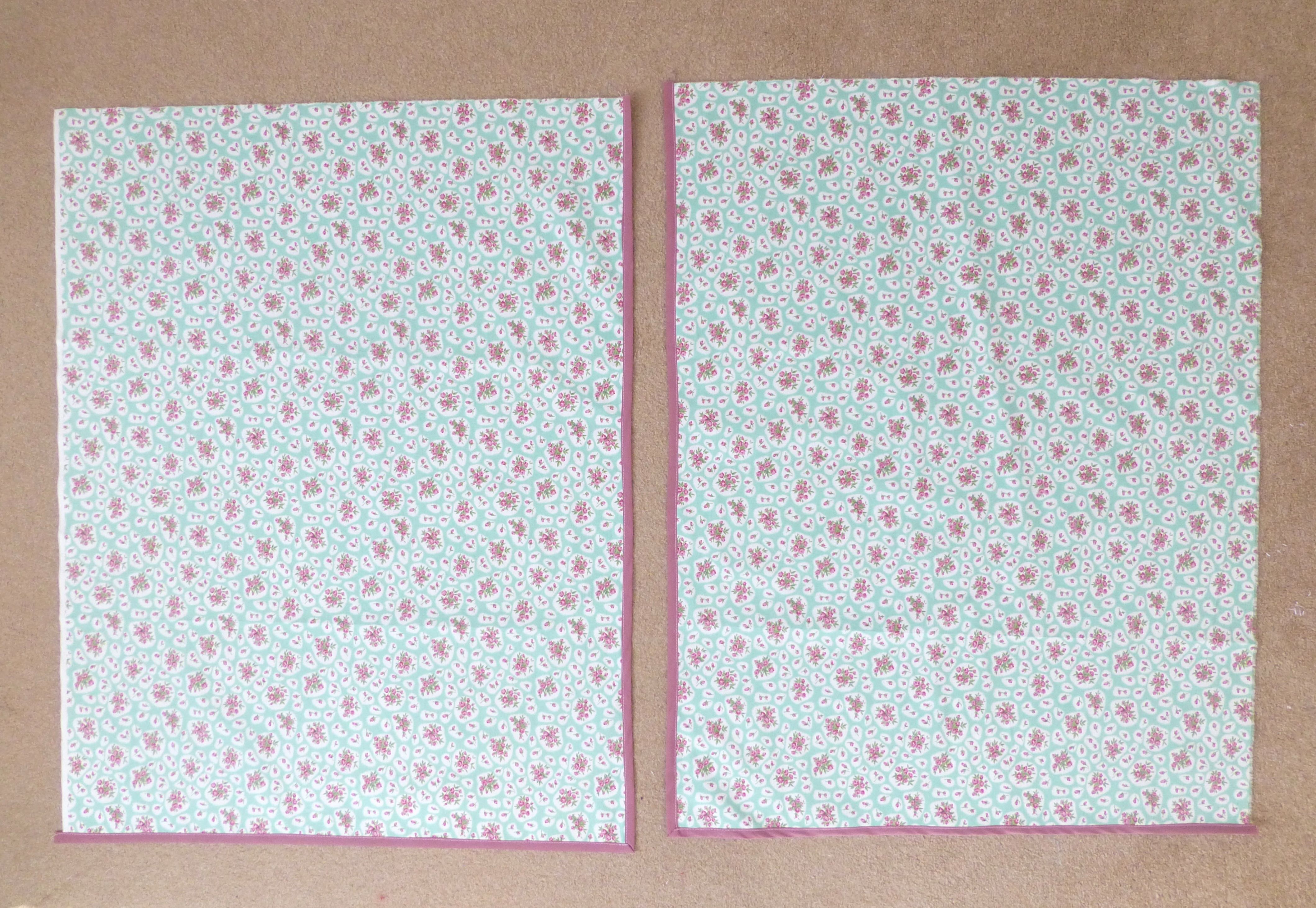
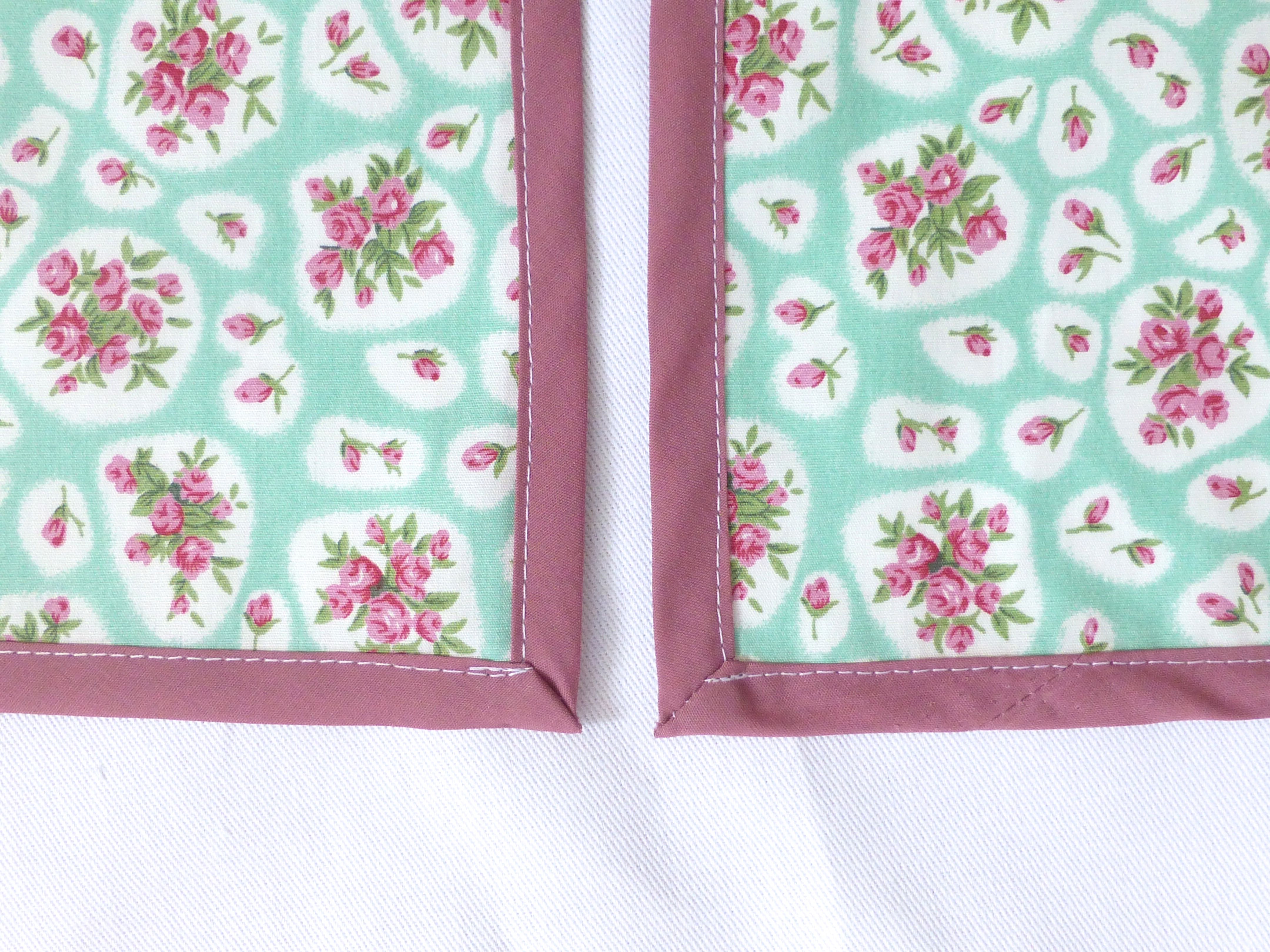
Apply bias binding to one side and lower edge of the two large pieces of floral fabric – these will form your front curtains.
P1060059

P1060060

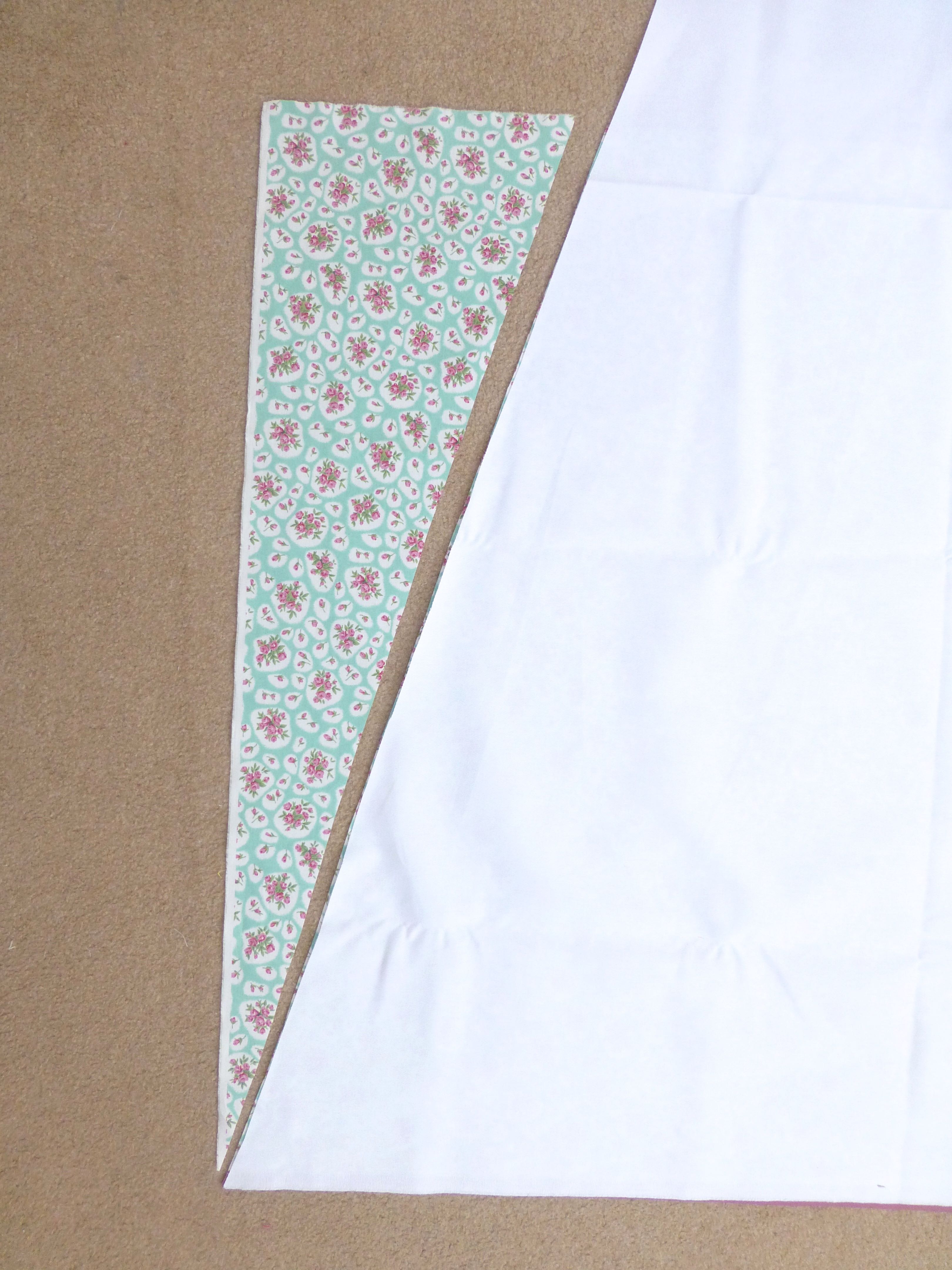
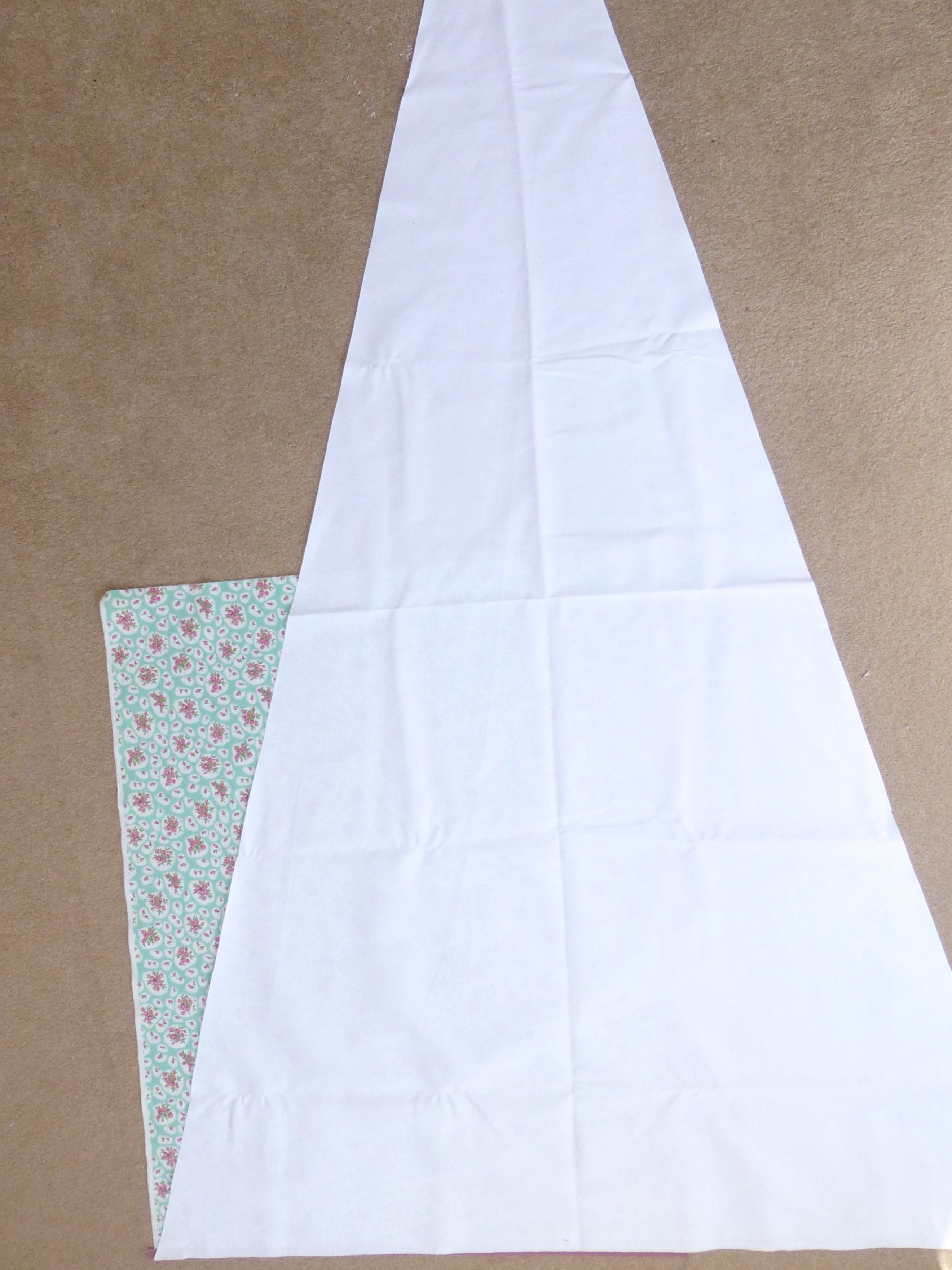
To shape the sides of the curtains to match the slope of the wigwam, place a large white triangle over the curtain, bottom edges matching and raw edges up the side. Your floral fabric will poke out beyond the edge of the triangle as seen below.
P1060061

Cut off the excess floral fabric.

P1060063

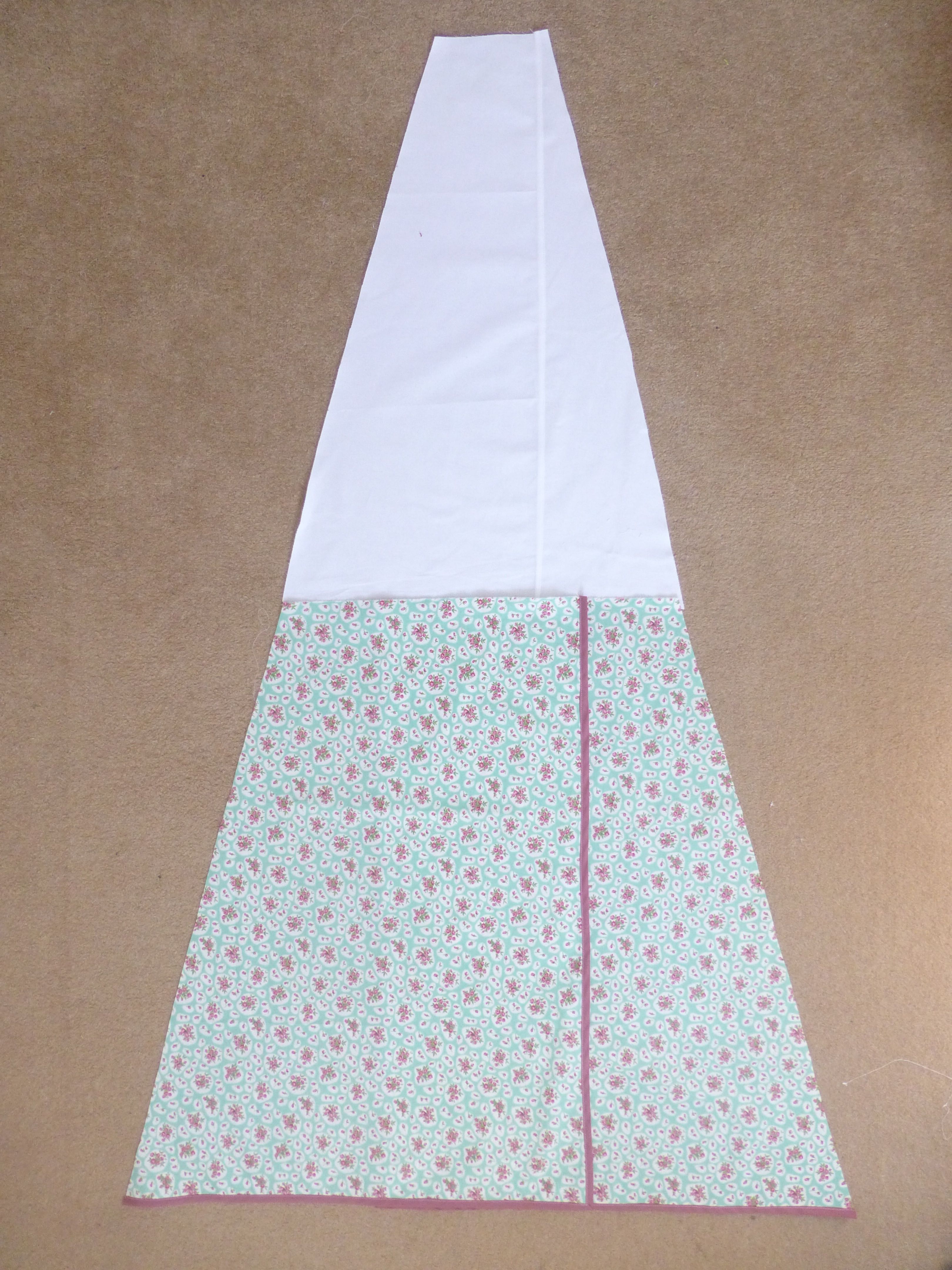
Take a curtain and pin the top edge to the bottom edge of your small white triangle, wrong sides together.

Take your other curtain and pin over the top of the first curtain.

It should now look like this.
P1060065

Sew together using a flat fell seam. (This previous post shows how to make a flat fell seam.)

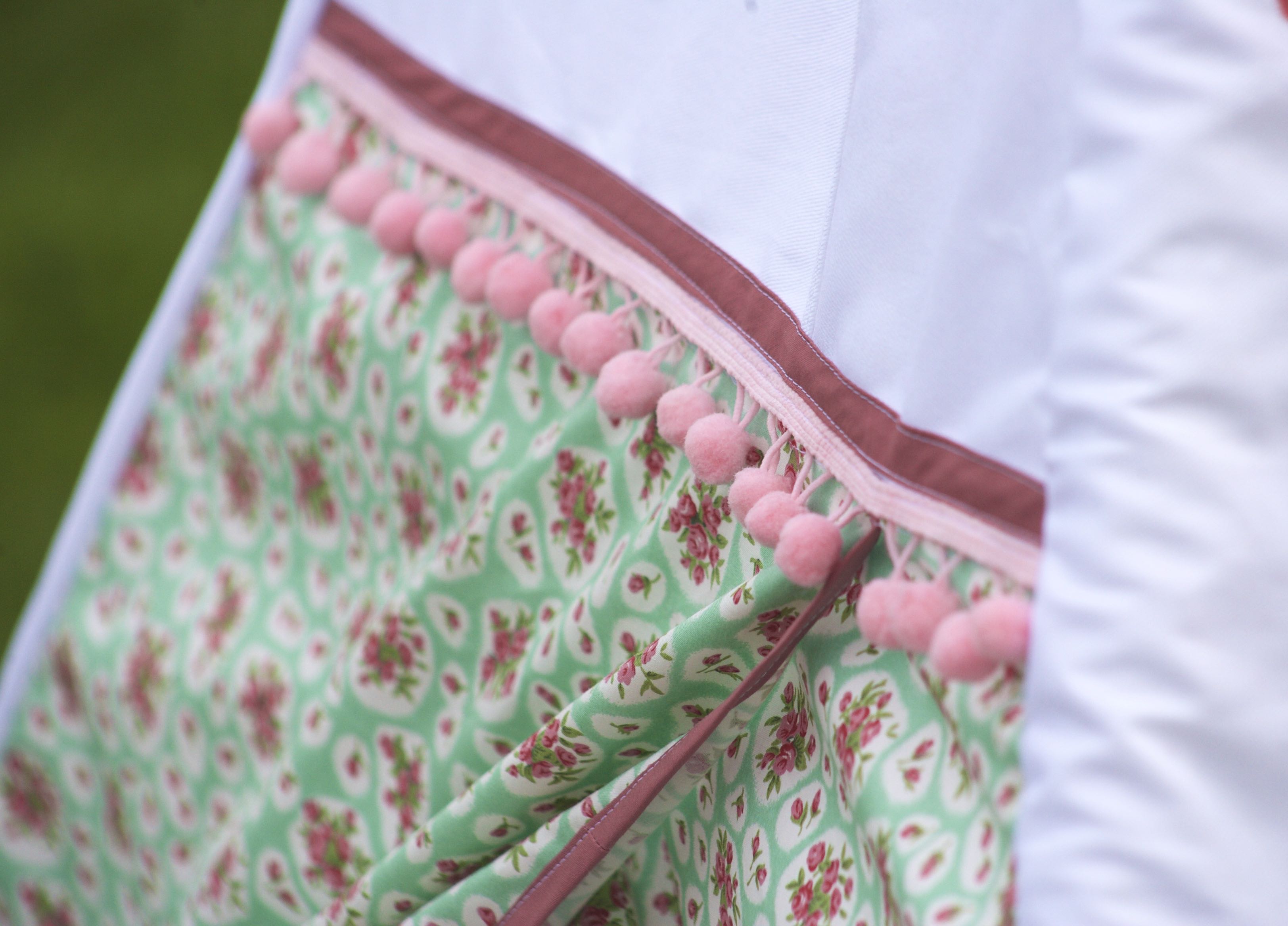
You can leave it plain as this type of seam leaves a nice neat finish, but I chose to decorate mine with a strip of bias binding and a row of pom pom trim from my stash.

Similar pompom trim can be bought here.

P1060070

Make the curtain tiebacks as follows.

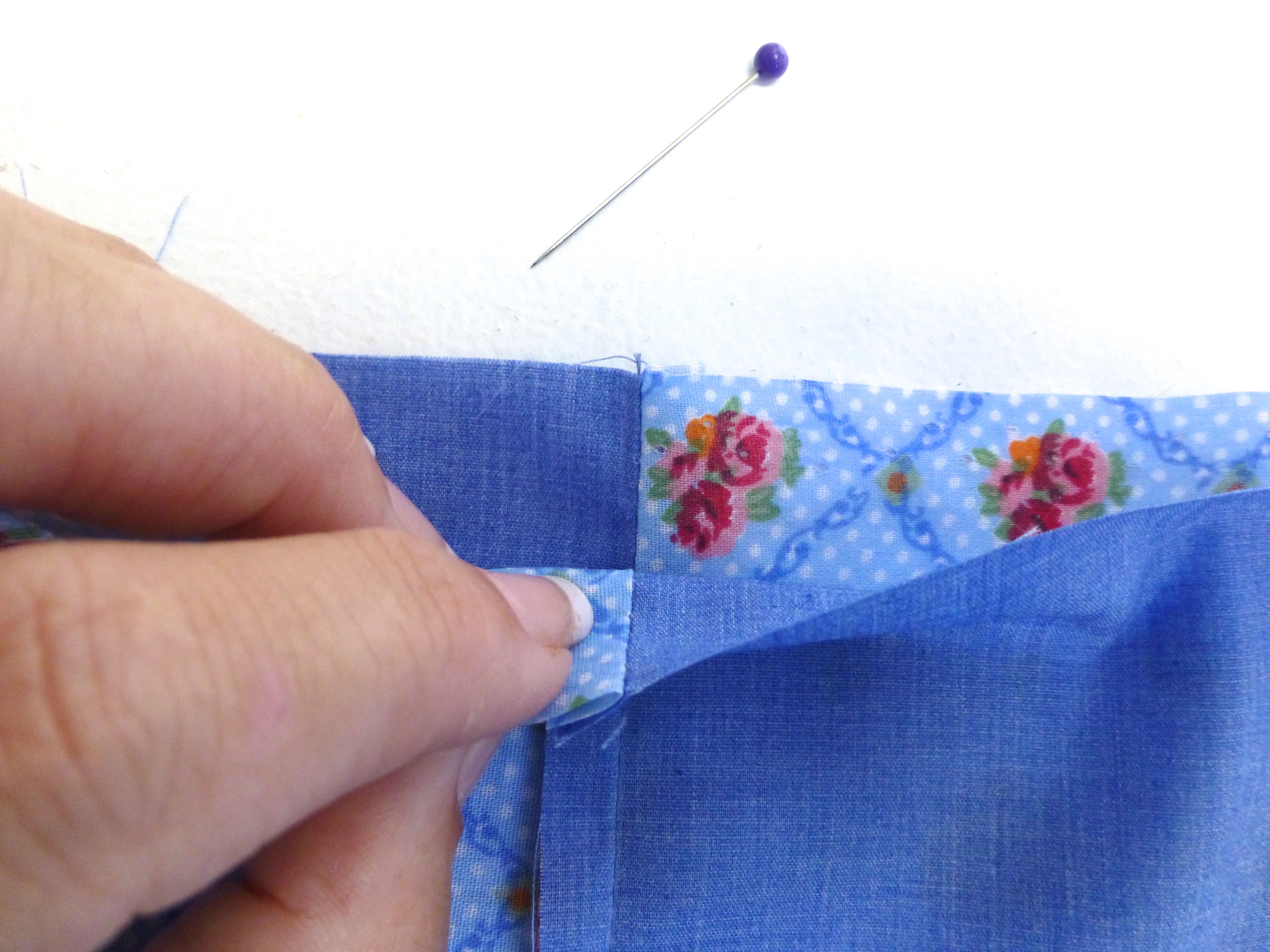
Fold the small floral rectangles in half lengthwise and stitch a small seam along one short and the long side.

Turn and press.
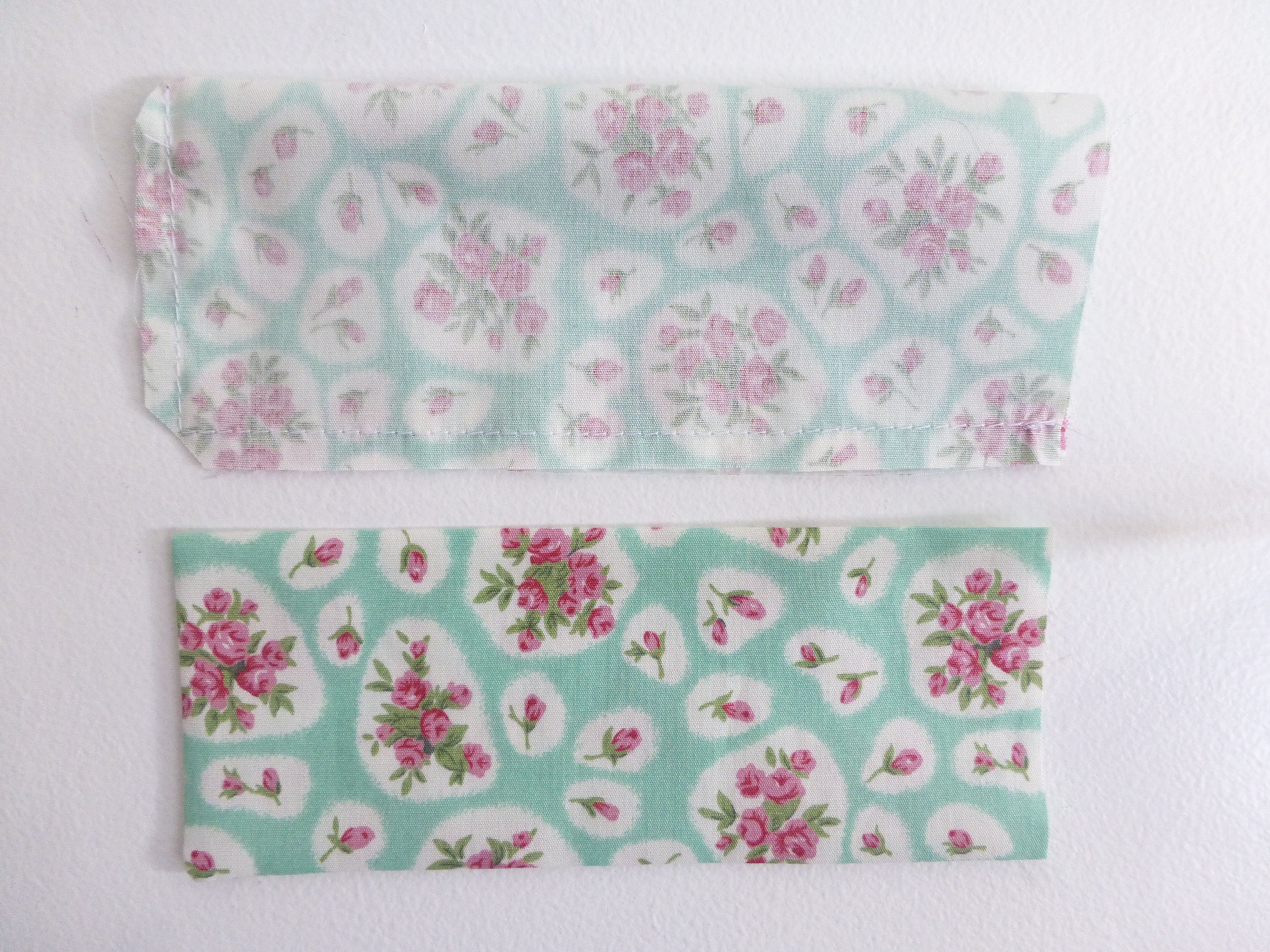
P1060073

With raw edges matching, pin and baste about halfway down the unfinished sloping edge of each curtain.
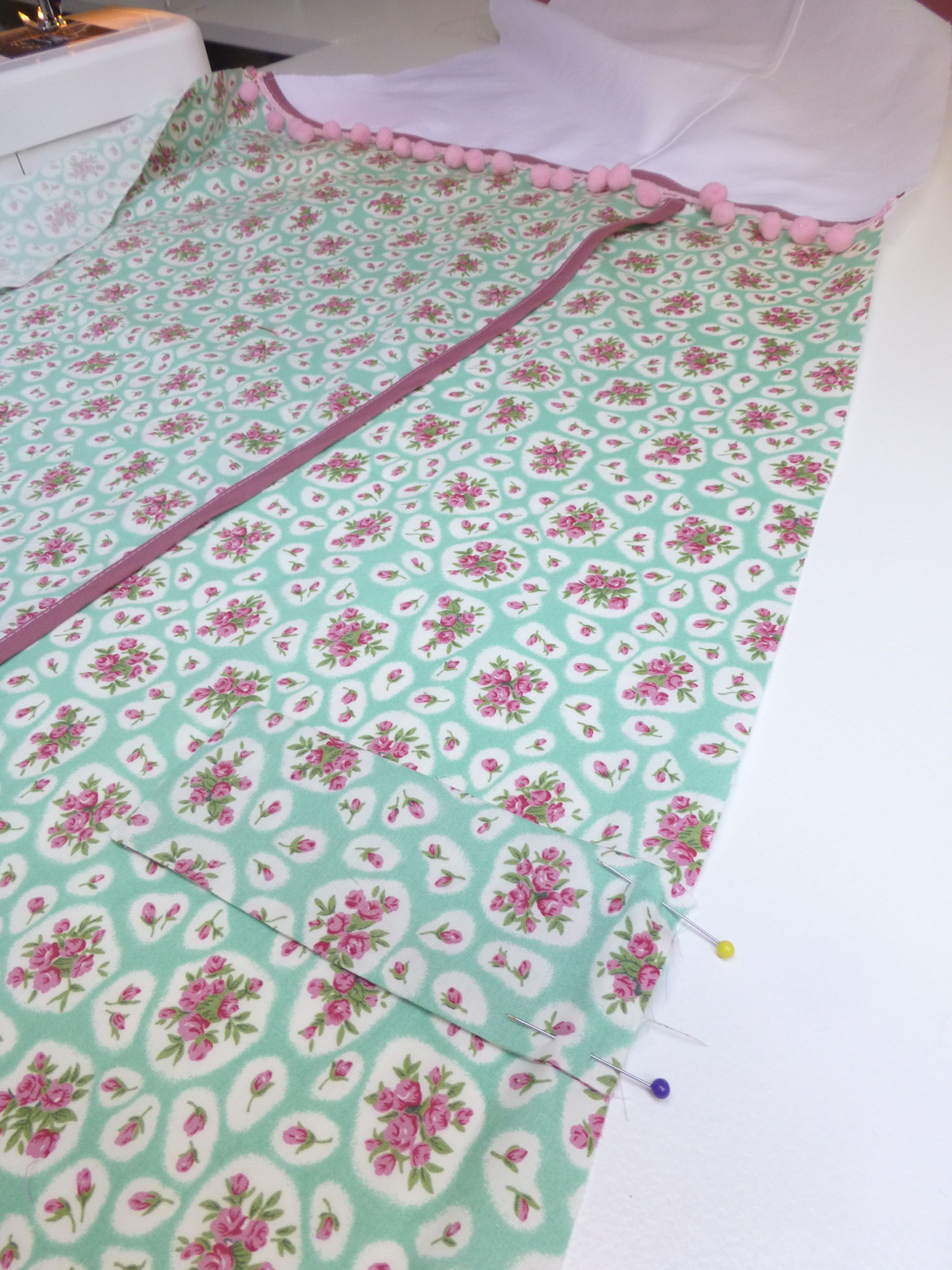
P1060075

Take a large white triangle and cut a 25 x25cm square for the window the base of which should be about 58cm up from the bottom edge.

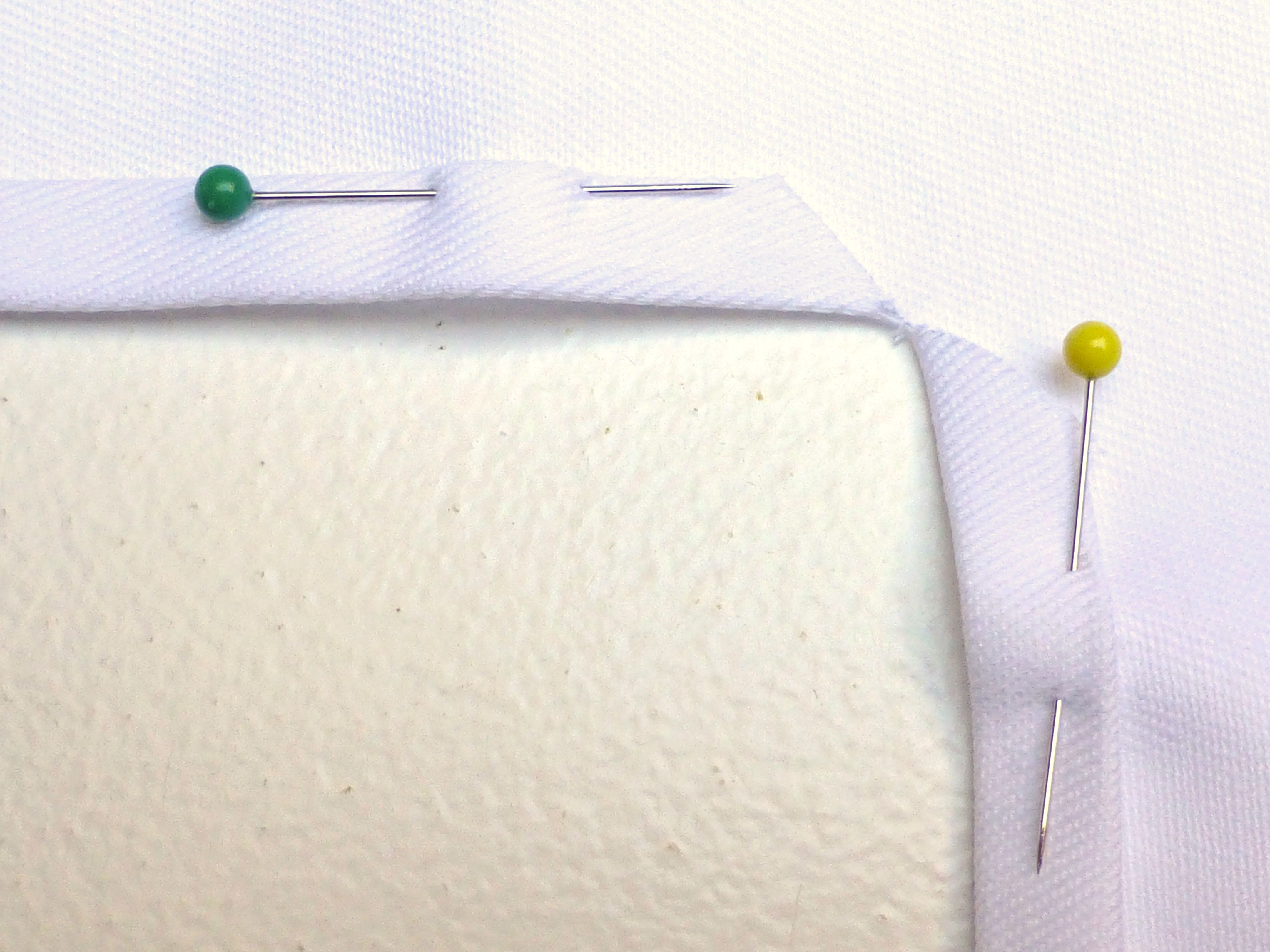
Snip diagonally into each corner by 1cm and fold in a 1cm double hem. Pin in place.

P1060099

P1060100

Stitch, sewing across corners as shown.
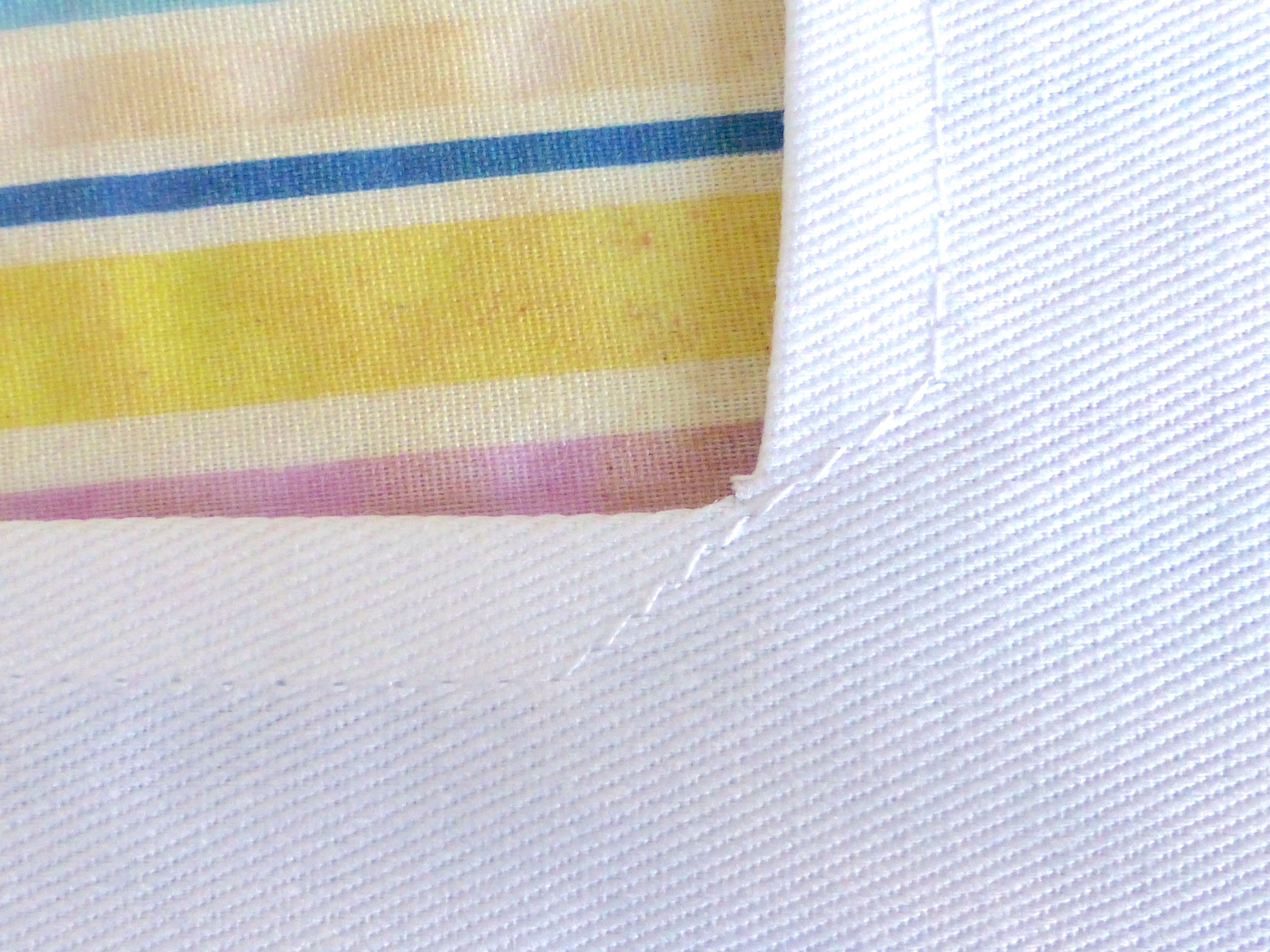
P1060101

Cut two little curtains, each one 15 x 27cm.

Hem all four edges and trim the opening edges with more pom pom trim.
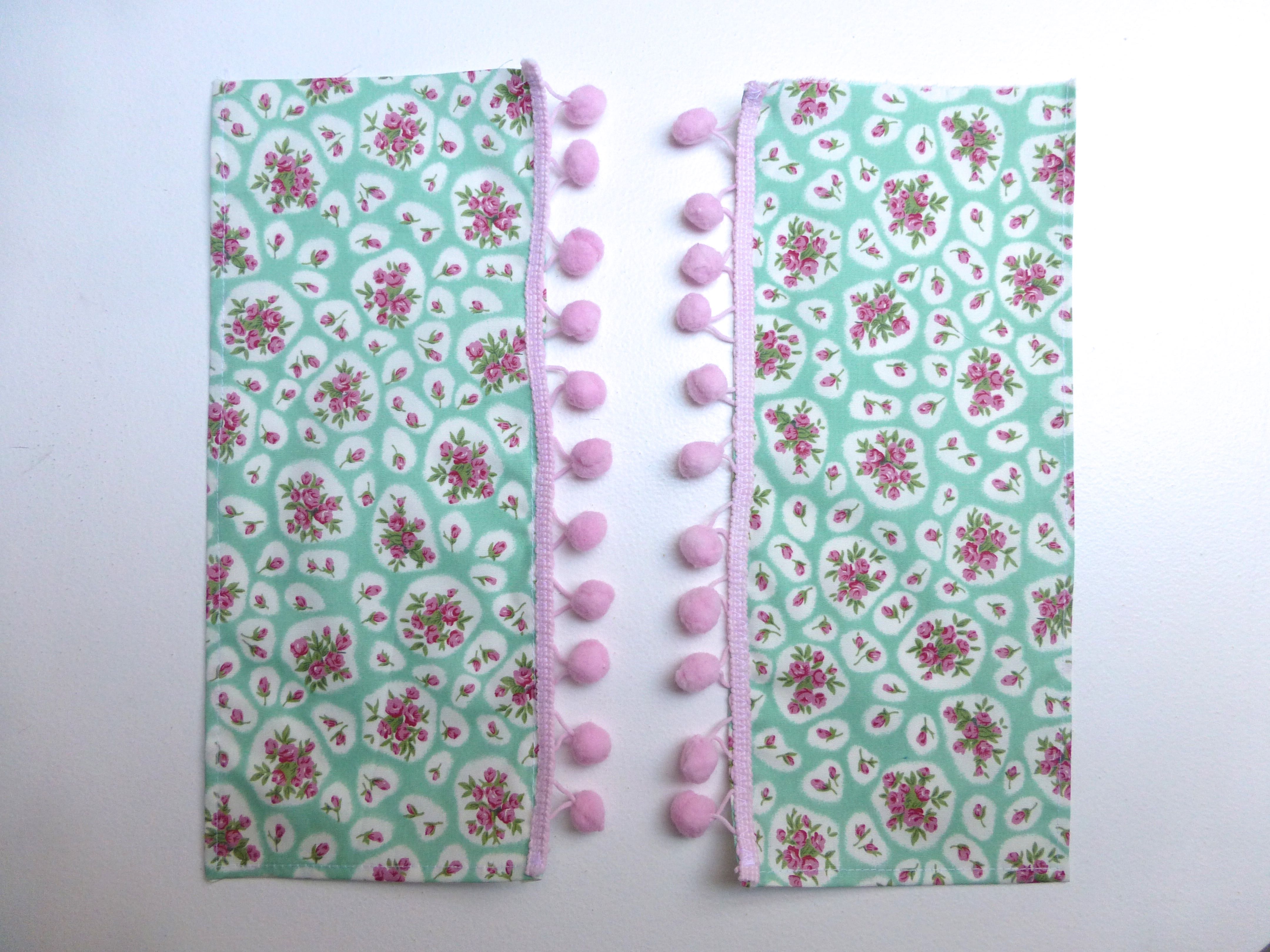
P1060103

Make two tiny curtain tiebacks: –

Fold a 10cm length of bias binding in half lengthways and stitch close to the edge.

Stitch a 1cm square piece of velcro to one end.

Pin curtain to window at top and side.

Insert tieback under curtain about 10cm up from the lower edge, velcro side uppermost as shown.
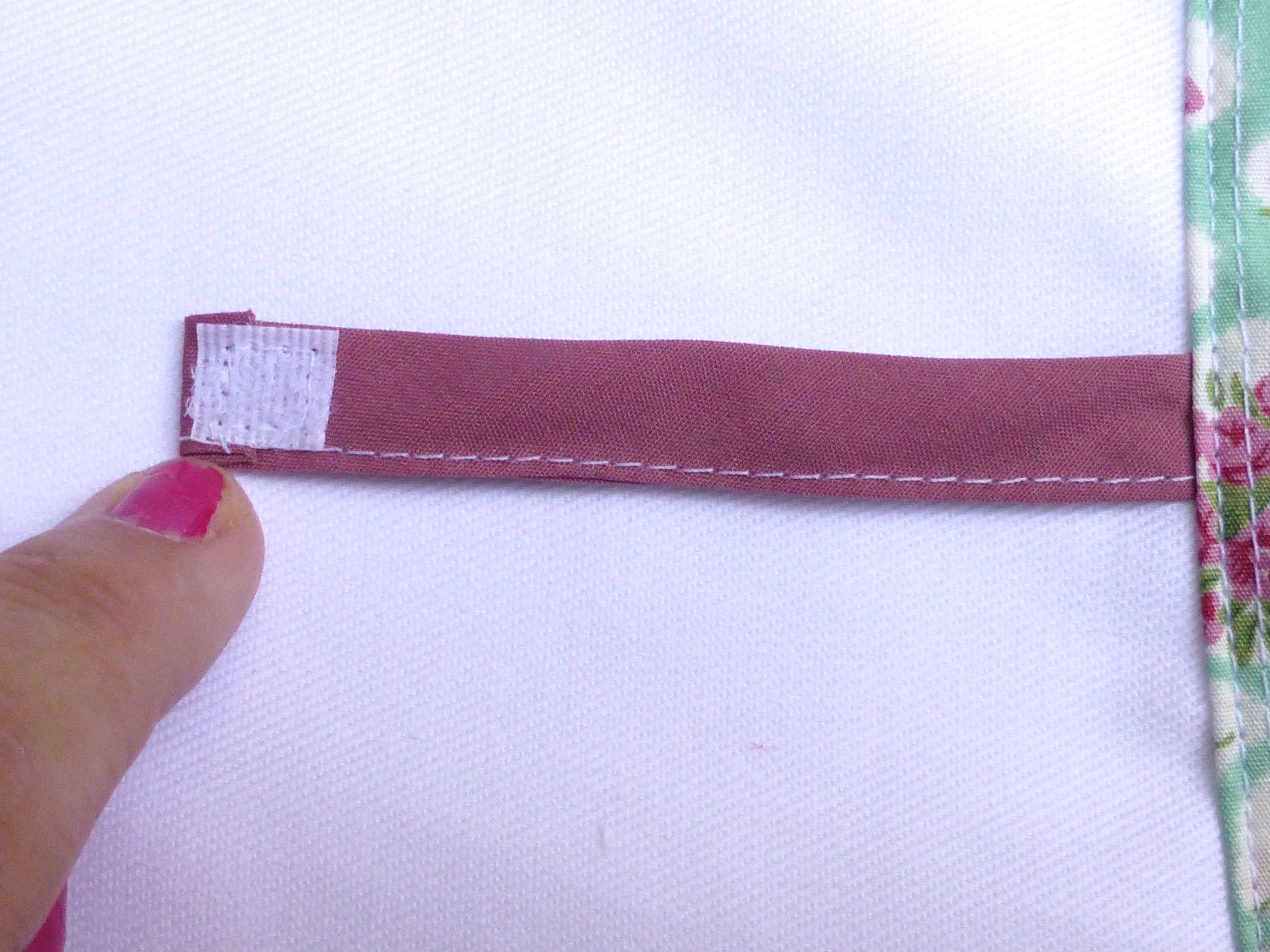
P1060107

Stitch curtain in place, catching tieback in seam as you go.

P1060105

Sew the other piece of velcro to the inside of the window.
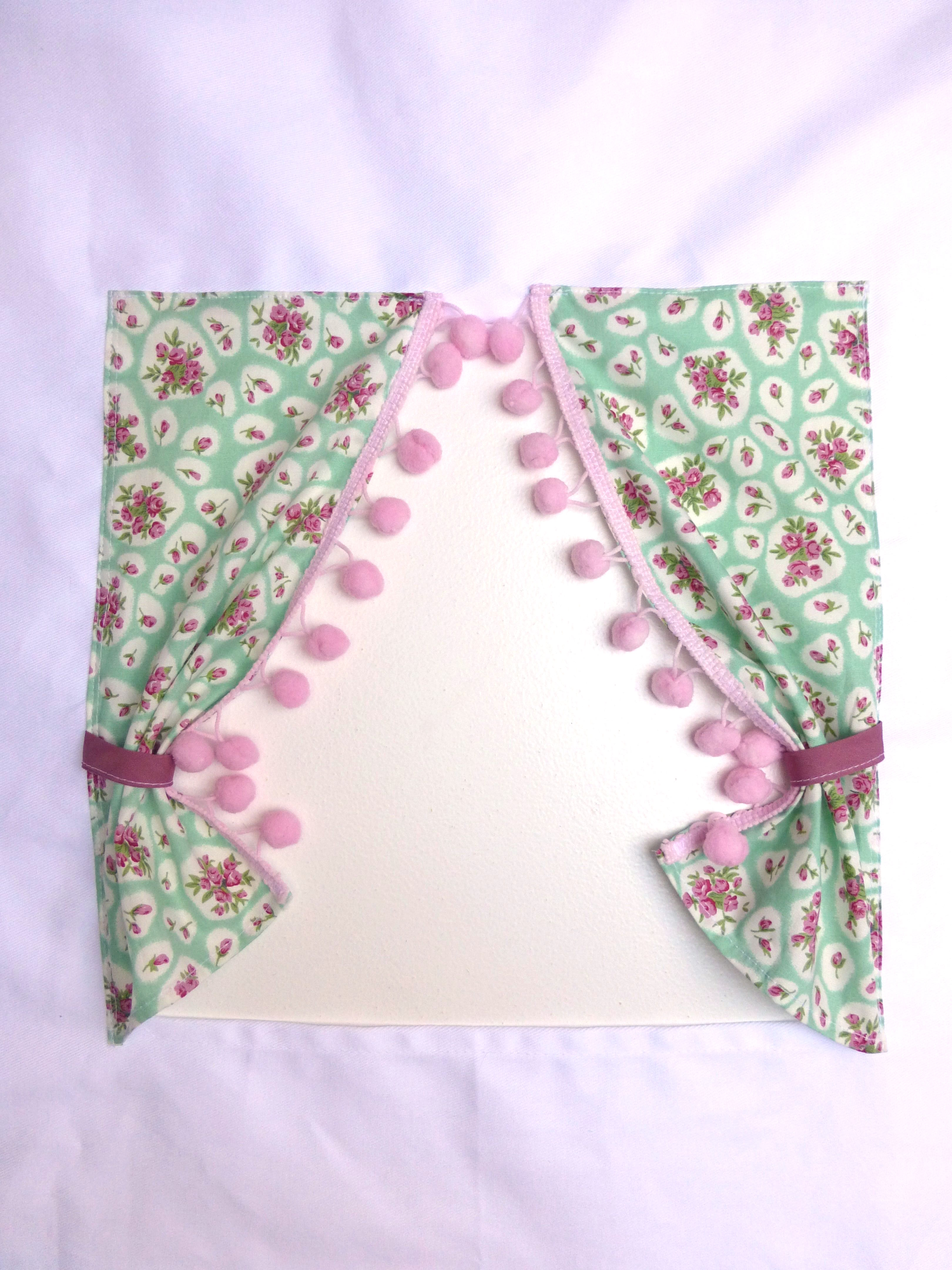
P1060109

P1060113

You can continue to decorate your teepee or just sew the sides together at this point – just scroll down to the relevant section.

I personalised this one with a name which I first printed out on card using Cooper std font in size 240pt. Separating the letters makes them easier to cut out. For best results use a craft knife.

P1060223

Fuse a piece of interfacing onto the wrong side of your contrast fabric and trace around each of the letters making sure you reverse them first.

(I have plenty in my stash, but you can buy interfacing here at Minerva.)

P1060226

Cut around each letter carefully using embroidery scissors for accuracy.

P1060227

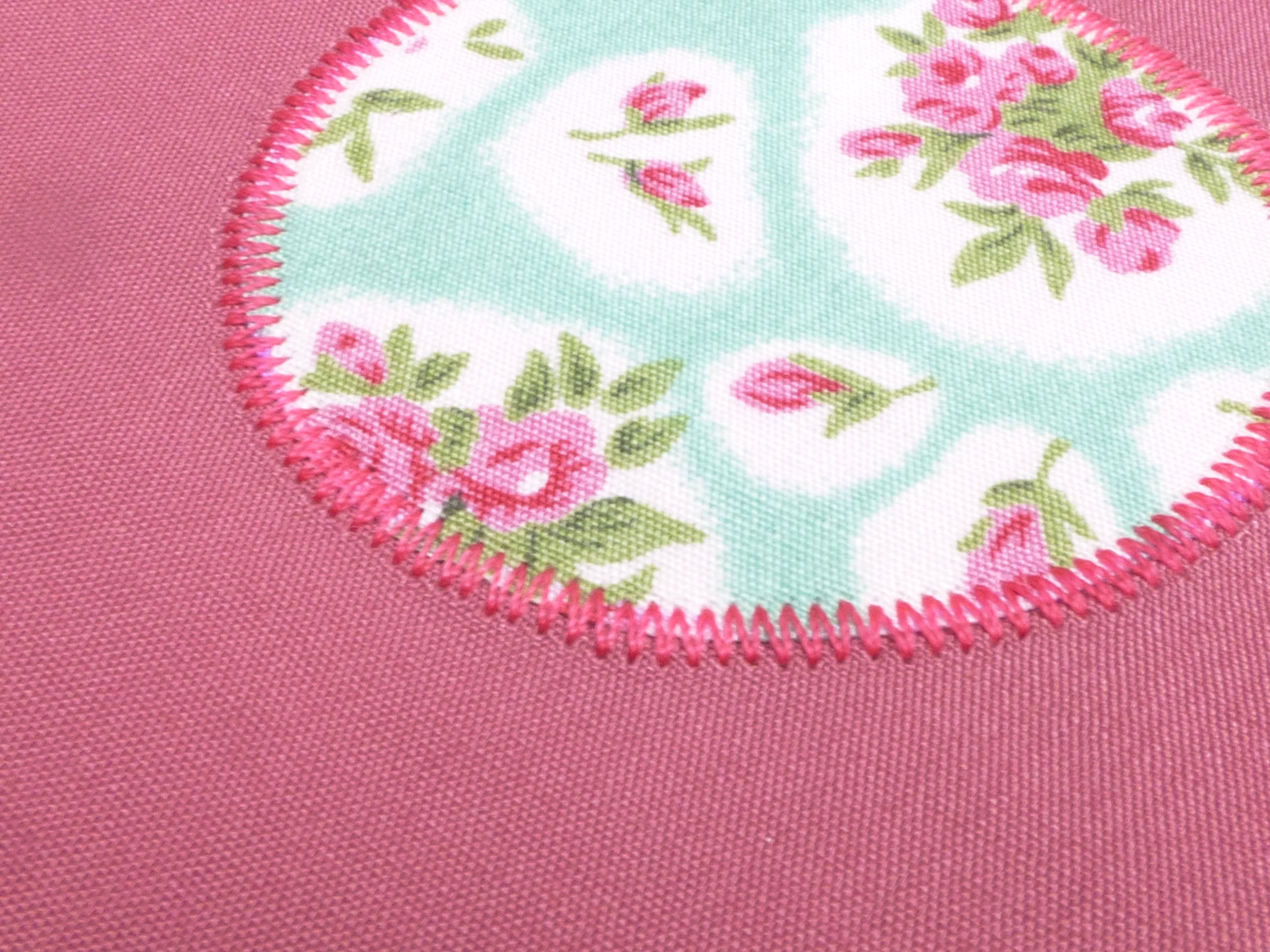
Pin the letters in place and sew above the window using a satin stitch on your machine.
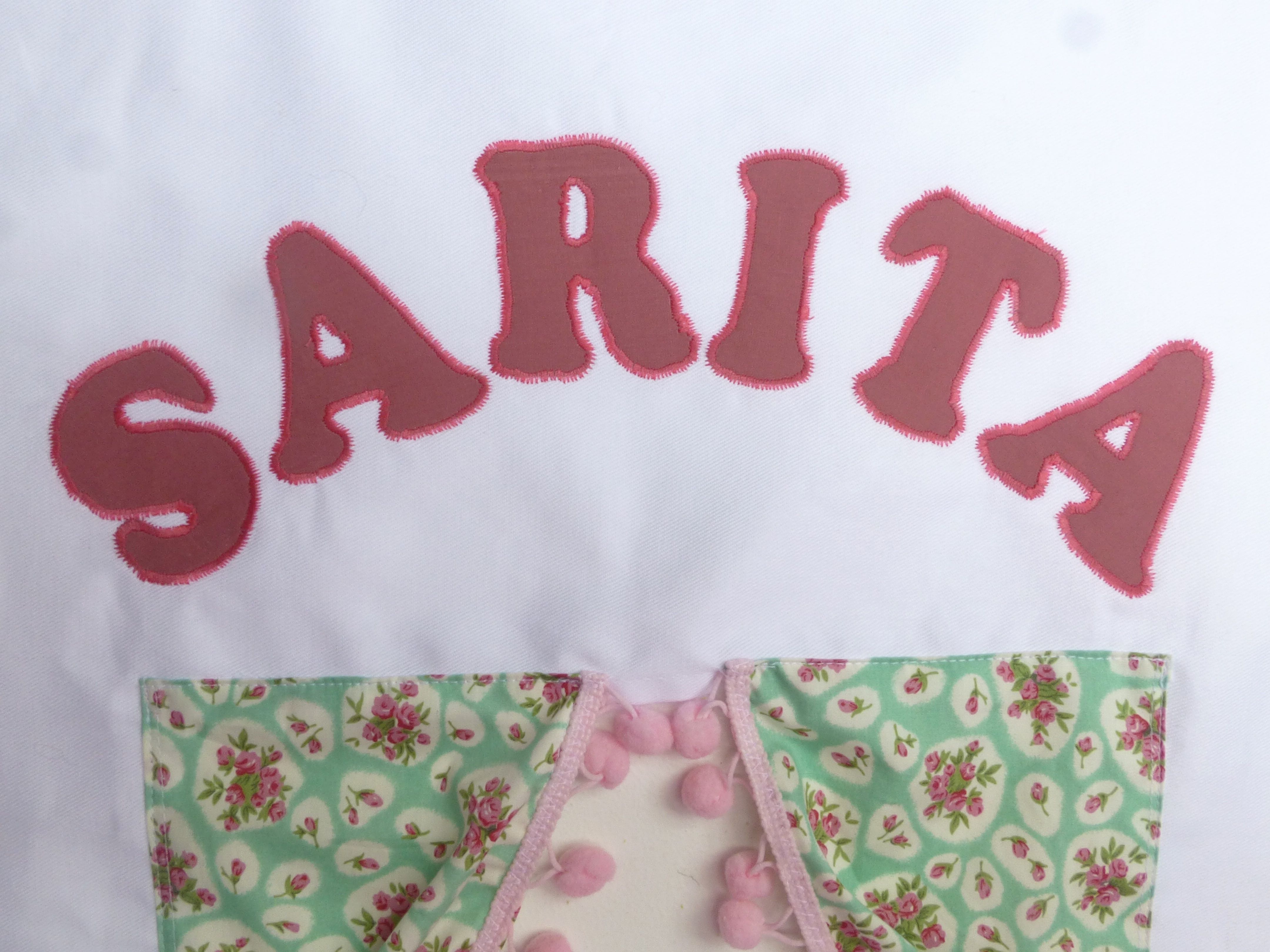
P1060232

P1060230

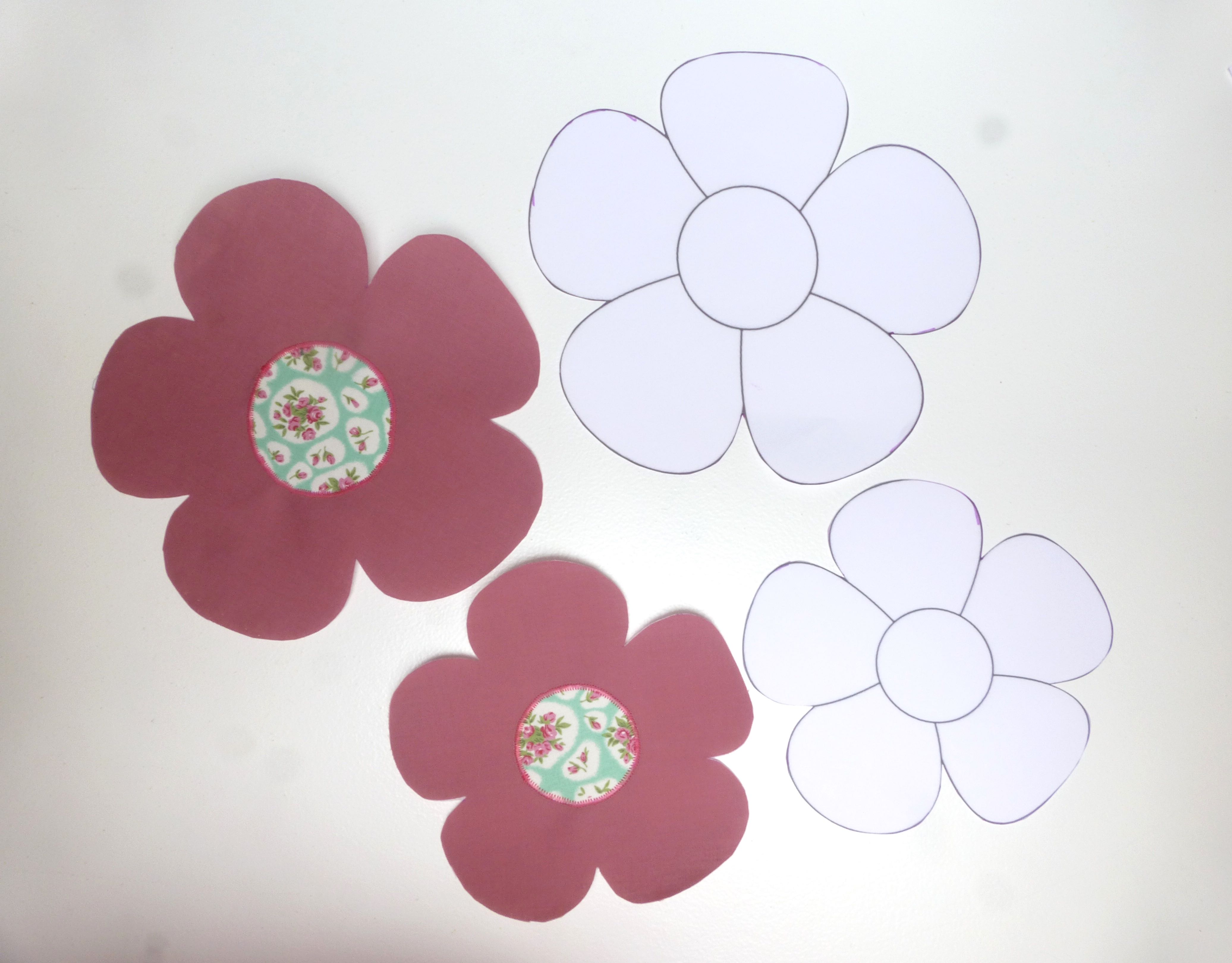
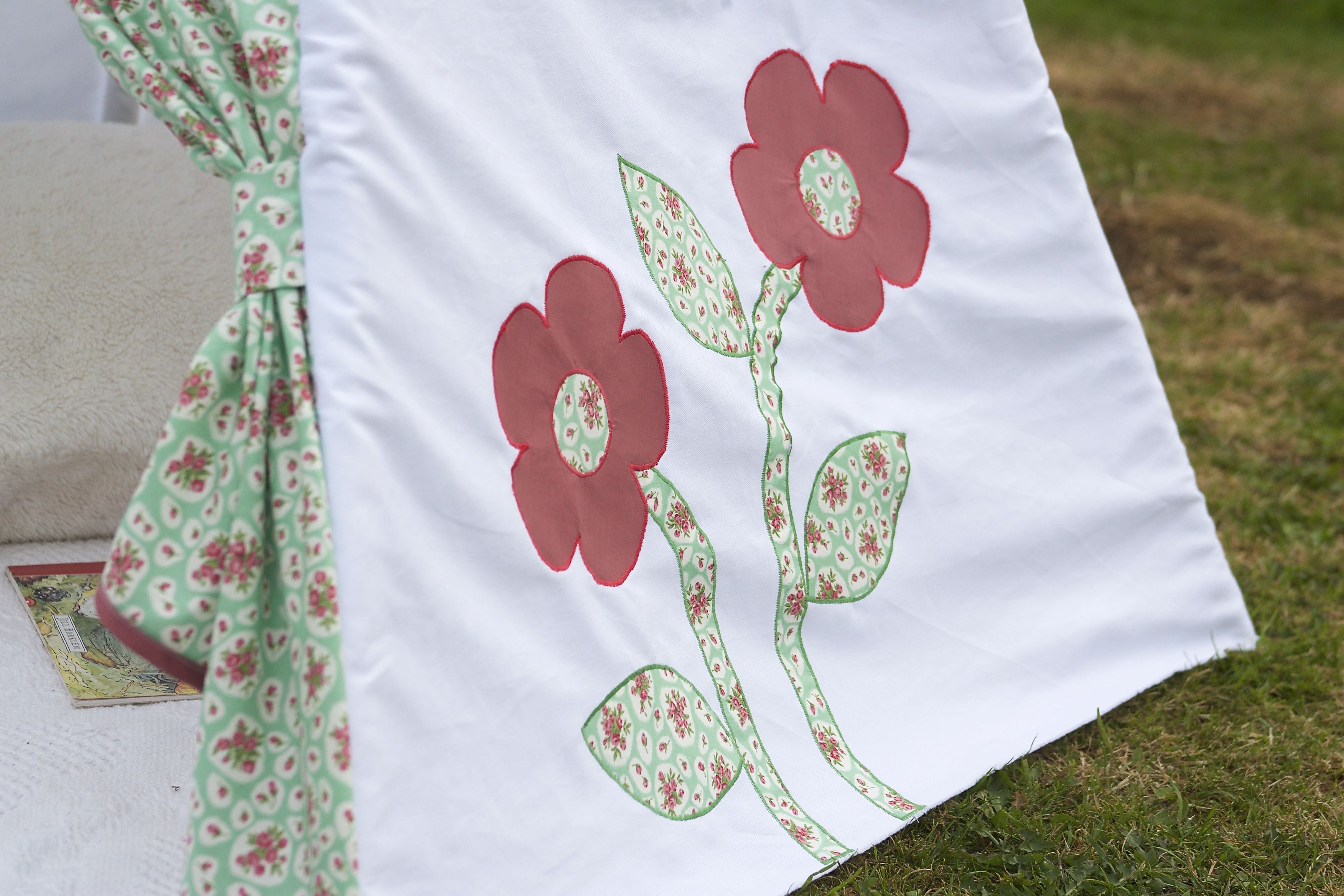
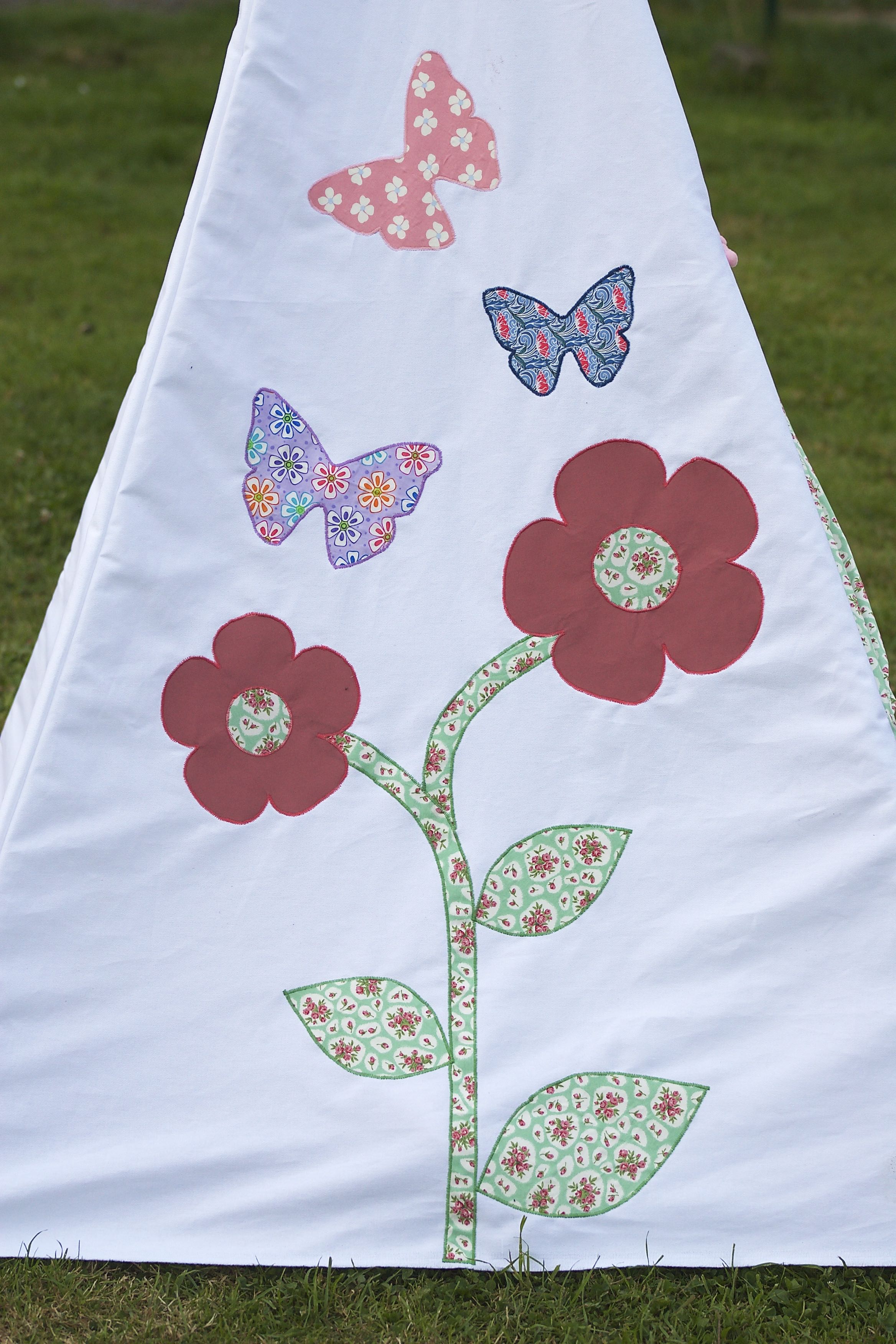
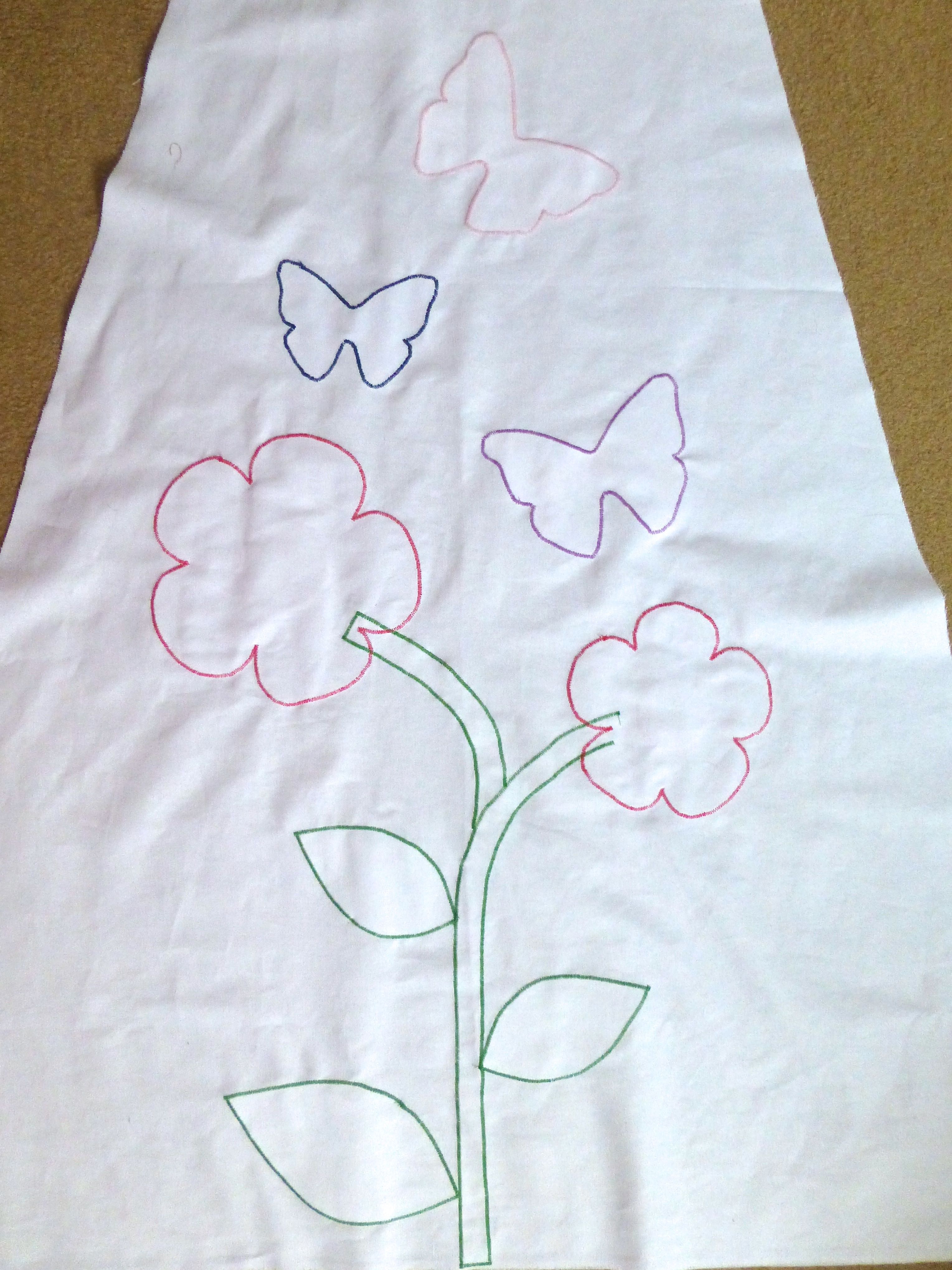
I decorated the sides of the teepee with a mixture of appliquéd flowers and butterflies – just click the links below to download the PDF for these.

Butterflies

Flowers

Each motif was interfaced before being cut out and sewn on with satin stitch as before.
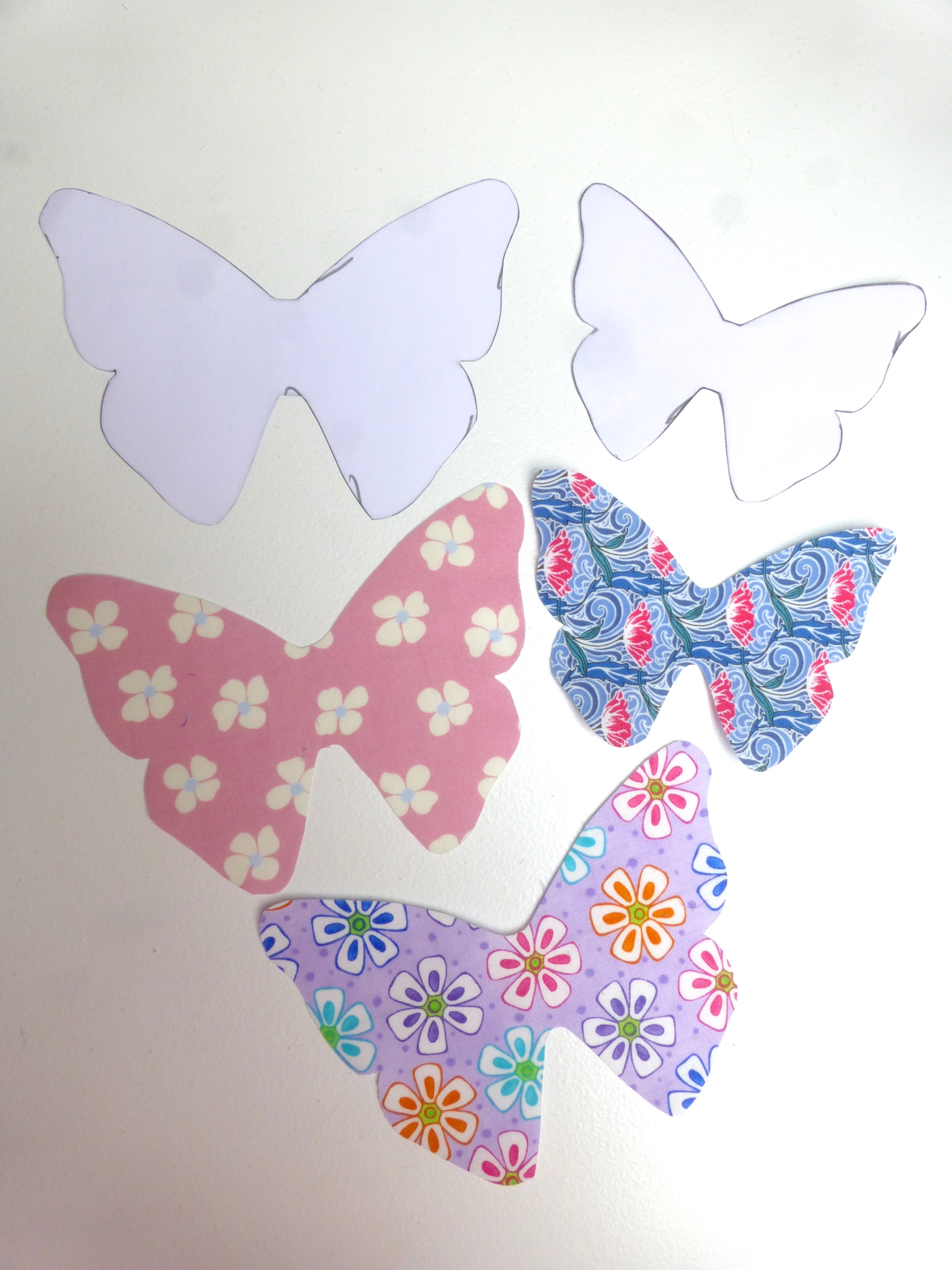
P1060236

P1060234

P1060238

P1060237

P1060235

They look quite nice on the wrong side as well!
P1060240

Now for putting the whole teepee together.

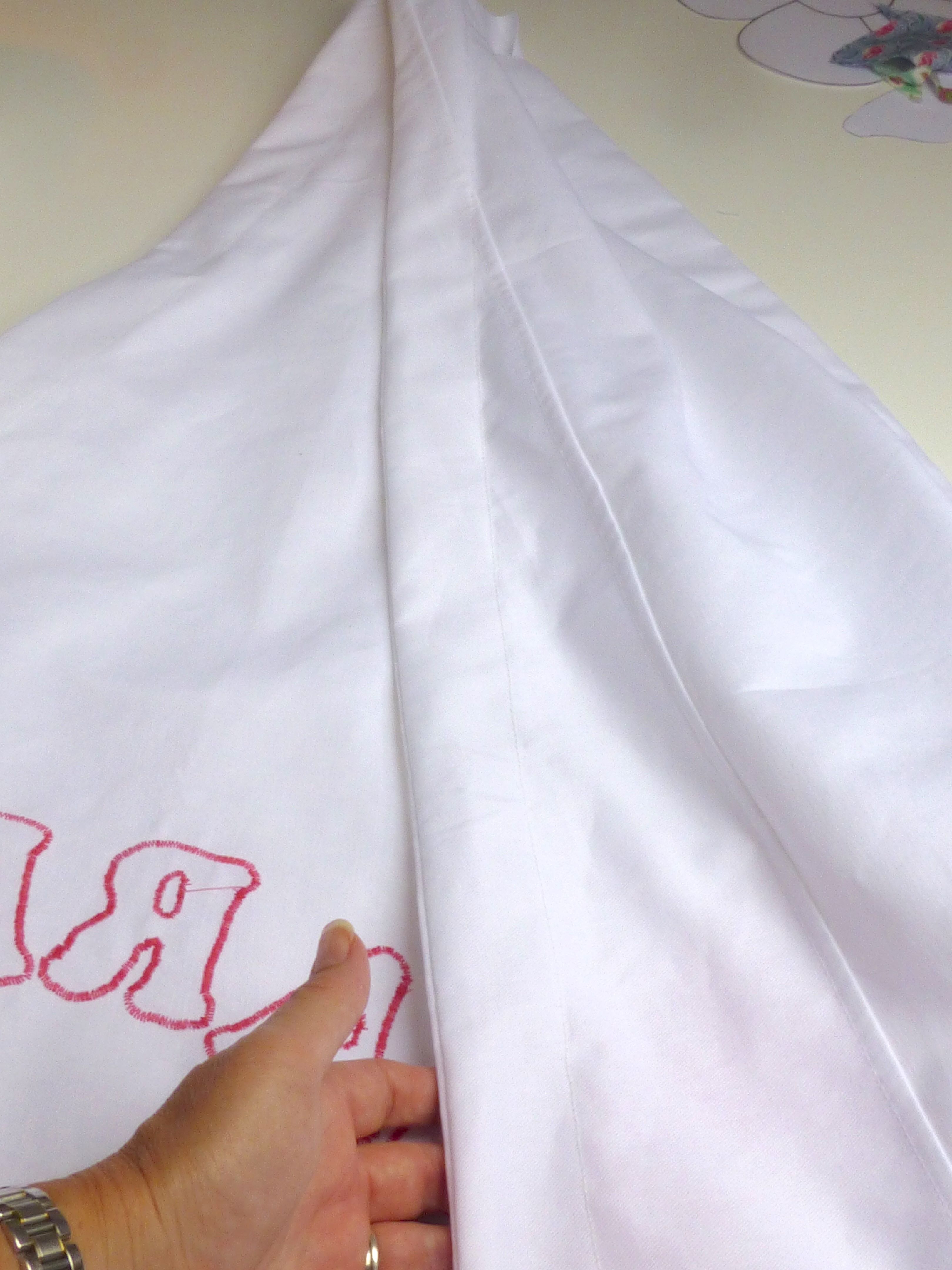
Start by sewing each of the four sections together at the side seams, wrong sides together, in a 1cm seam.

Turn so that right sides are now facing each other and sew a 4cm seam (effectively just a huge French seam) which will create the tubes through which your pipes will pass.
P1060241

Sew a small square of velcro onto the front door curtains in the same way as before, and a matching piece inside the curtain close to the seam.

P1060242

Cut the pipes to 1800mm in length and thread through the casings.

(You may have to trim an inch or two from the top of the teepee to make room for all the poles like I had to).

Tie a leather shoelace or other cording around the top of the tent to keep the poles in place.

OY4B9829_2

And that’s it!

OY4B9833_2

OY4B9832OY4B9830

OY4B9828

OY4B9816_2

OY4B9826_2

OY4B9825

OY4B9815_2

OY4B9819_2

OY4B9827

I had to get a photo with the chickens!

OY4B9822_2

Hopefully I haven’t ruined the surprise as I’m pretty certain this little girl’s mother doesn’t read my blog!

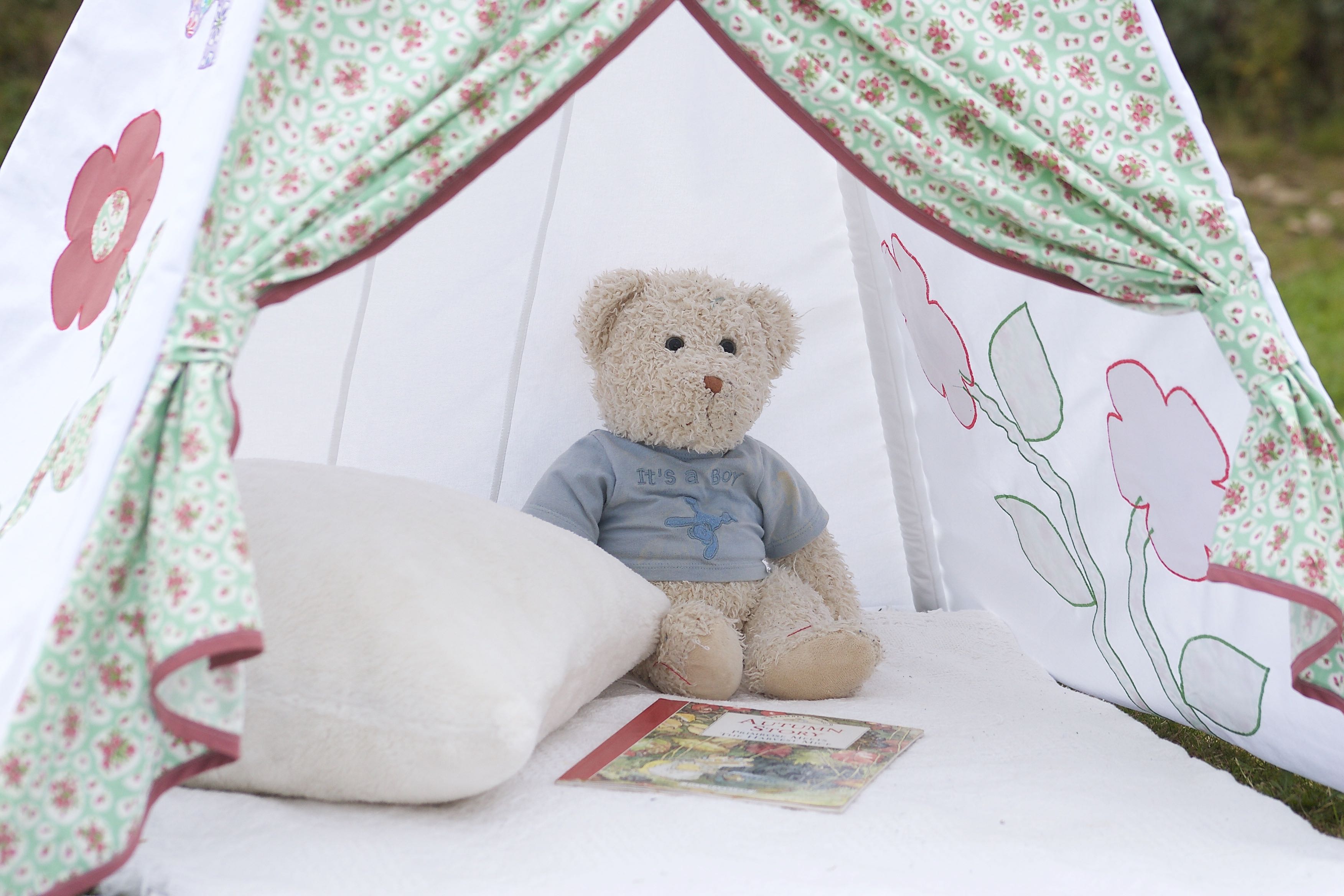
As this teepee only takes up about one square metre of floor space, it is ideal for indoor use and, I suspect, this one will live permanently in her bedroom as a quiet reading nook.

Teepees aren’t only for girls though – what little boy wouldn’t love his own pirate version using this pirate fabric from Minerva?

Or how about a unisex wigwam to suit a brother and sister with this gorgeous Kite print?

pirateskites

Wouldn’t it look lovely draped with fairy lights and bunting?

In fact I might just go and make some bunting now……


59 Comments

How To Make A Waterproof Patchwork Picnic Blanket And Carry Pack

Ah, the English Summer! What does it mean to you?

For me, it’s day trips to the coast, balmy evenings sat outdoors until after sundown, weekend breakfasts in the garden, outdoor concerts in the grounds of old ruins……in short – being outside.

And being outside is made all the more perfect if you take that most quintessentially English thing with you – a picnic. Dressed down with sandwiches and a flask of tea at the seaside, or glammed up with champagne and a candelabra for a classical concert, everyone loves a picnic, with a soft, warm, waterproof picnic blanket to relax on in comfort…….

……except we haven’t got one.

Well, we didn’t have until recently when I decided to take advantage of being part of the Minerva Crafts Blogger Network and make one.

I didn’t want to make just any old picnic blanket, oh no, I wanted the ‘deluxe’ version, something a bit special, so decided to make a patchwork blanket with a waterproof backing and a carry handle. As there are four boys in the house (if you include Mr H-L), anything too pink and girly was out of the question, but I thought I could get away with a small floral print if the main colour was blue.

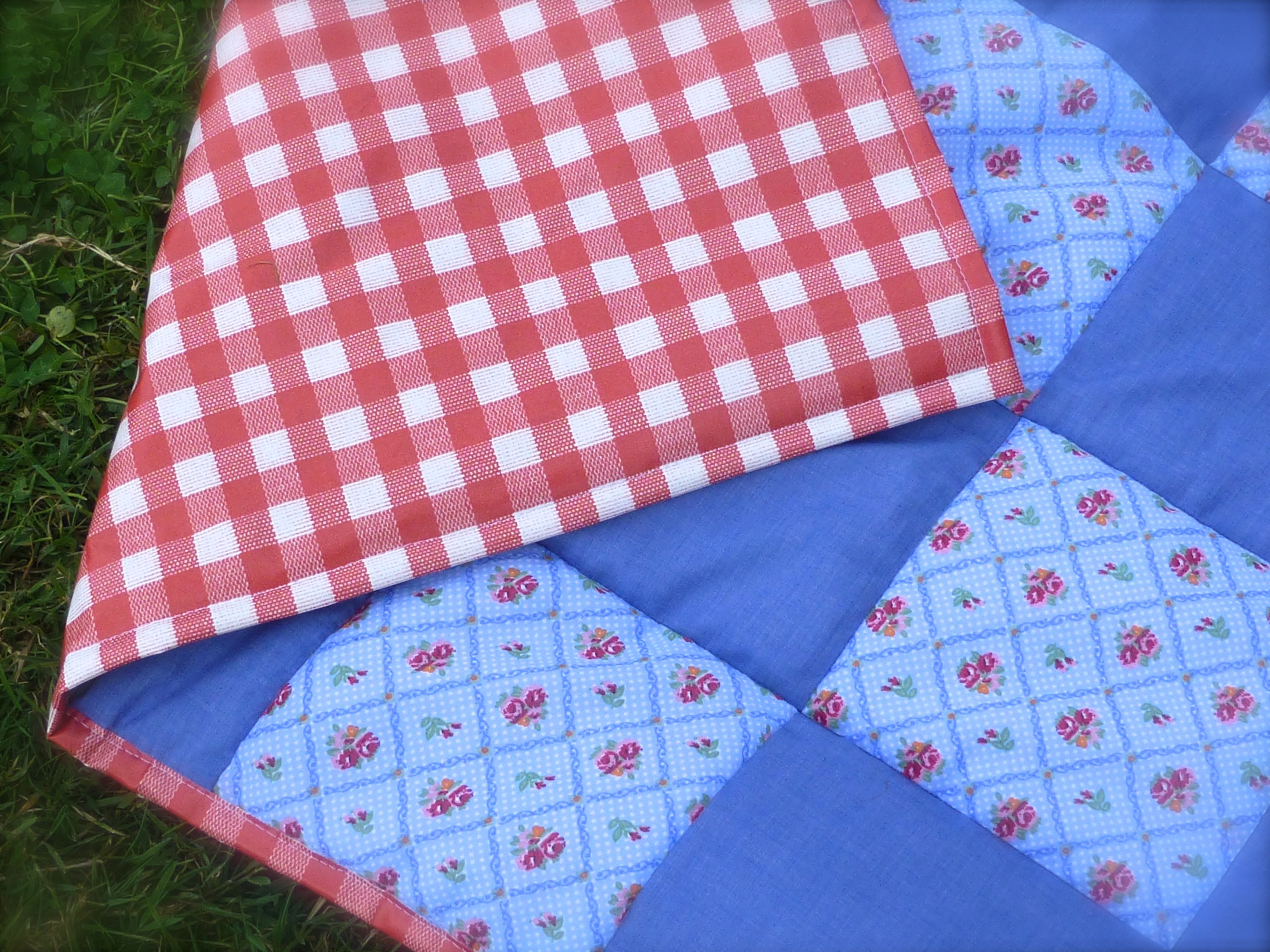
After much deliberation, this is what I finally ordered: – 1.5m each of plastic coated red ginghamfloral patchwork print polycotton, and denim blue polycotton. This makes a blanket approximately 1.25m x 1.25m.

P1050797

My Olfa Quiltmaking Kit came with this mat, rotary cutter and 6.5″ square ruler, so I kept things simple by cutting the patchwork squares the same size as the ruler.

P1050801

Cutting through folded fabric made short work of all those squares as I could cut through four layers at a time – using a rotary cutter and the quilting ruler ensured that they were accurately cut, which is essential in patchwork.

P1050798

In no time at all I had two piles of neatly stacked patchwork squares, 36 of the floral and 45 of the plain making 81 in total.

P1050799

The easiest way to keep accurate seam allowances is to line up the edge of the fabric with the edge of the machine foot, the needle in the central position. On my machine, that means a seam allowance of 1cm throughout.

P1050802

Whilst it may sound obvious, there is a quick way to whizz through all those squares.

Start by sewing them in pairs, each floral with a plain, right sides together. You will need to make 36 pairs which should leave you with 9 spare squares – 5 plain and 4 floral.

Don’t bother reversing your stitching at the beginning and end of each set, cutting the thread and repeating with the next pair – just keep feeding the pairs through the machine one after the other as shown below.

P1050804

When all the pairs of squares are sewn, snip the joining stitches to separate them.

P1050805

P1050806

Repeat this process with the pairs of squares…
P1050809

….until you have rows of 4….

P1050810

….then sew the rows of 4 together to make rows of 8. Now add one of your left over squares to the end of each row.

You should now have 9 rows of 9 squares.

Press all the seam allowances to one side.

P1050814

To minimise any bulk at the seams, you may wish to alternate the direction in which you press them flat.

P1050821

Join these rows along the long edges, matching and pinning the seams as you go.

P1050815

P1050816

Continue until all your strips of patchwork are sewn together into one large square.

P1050817

P1050823

As I reached this stage, I made the spontaneous decision to add a layer of wadding between this top layer and the bottom layer. (I had plenty in my stash, but you can buy it here.)

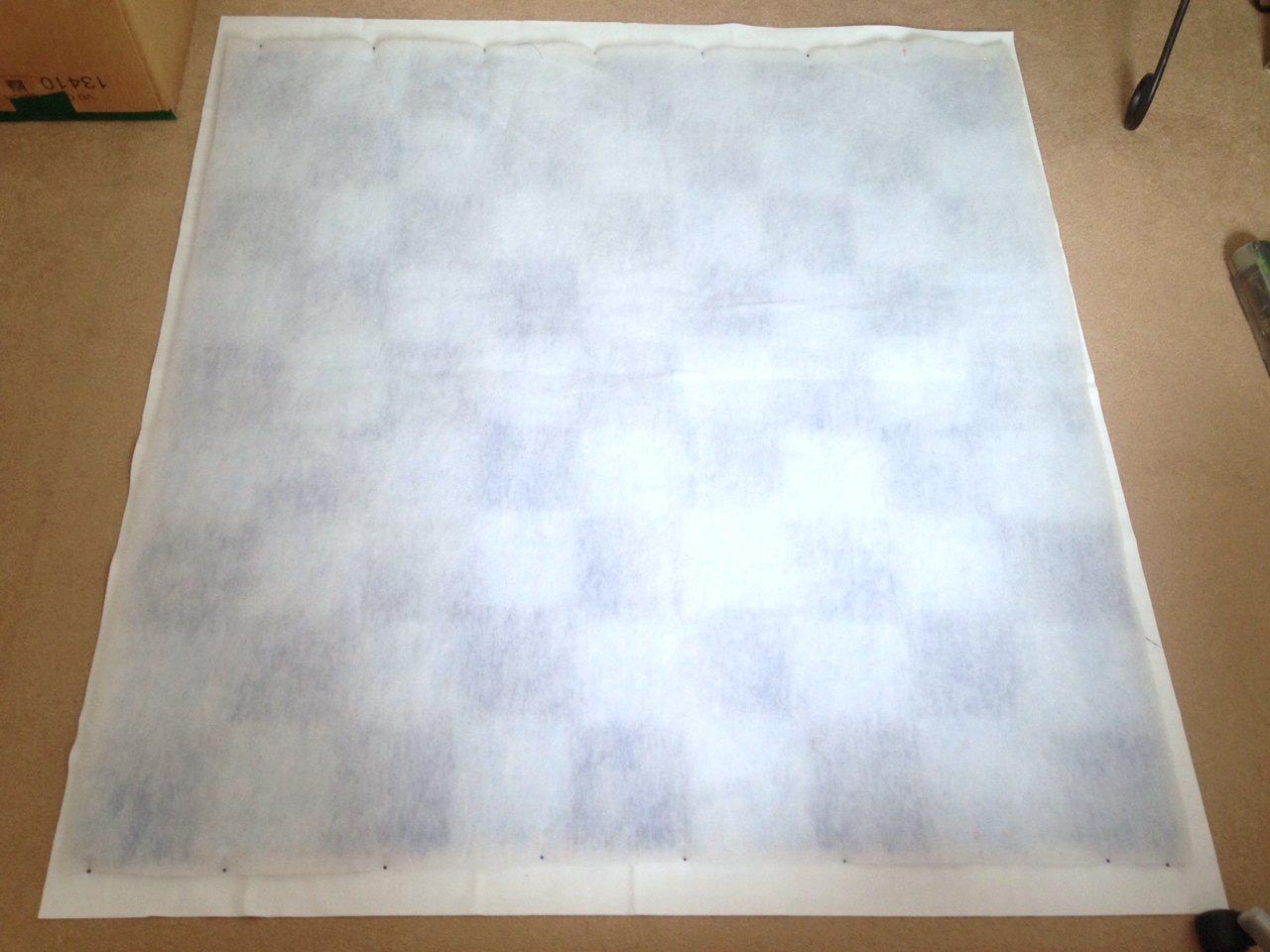
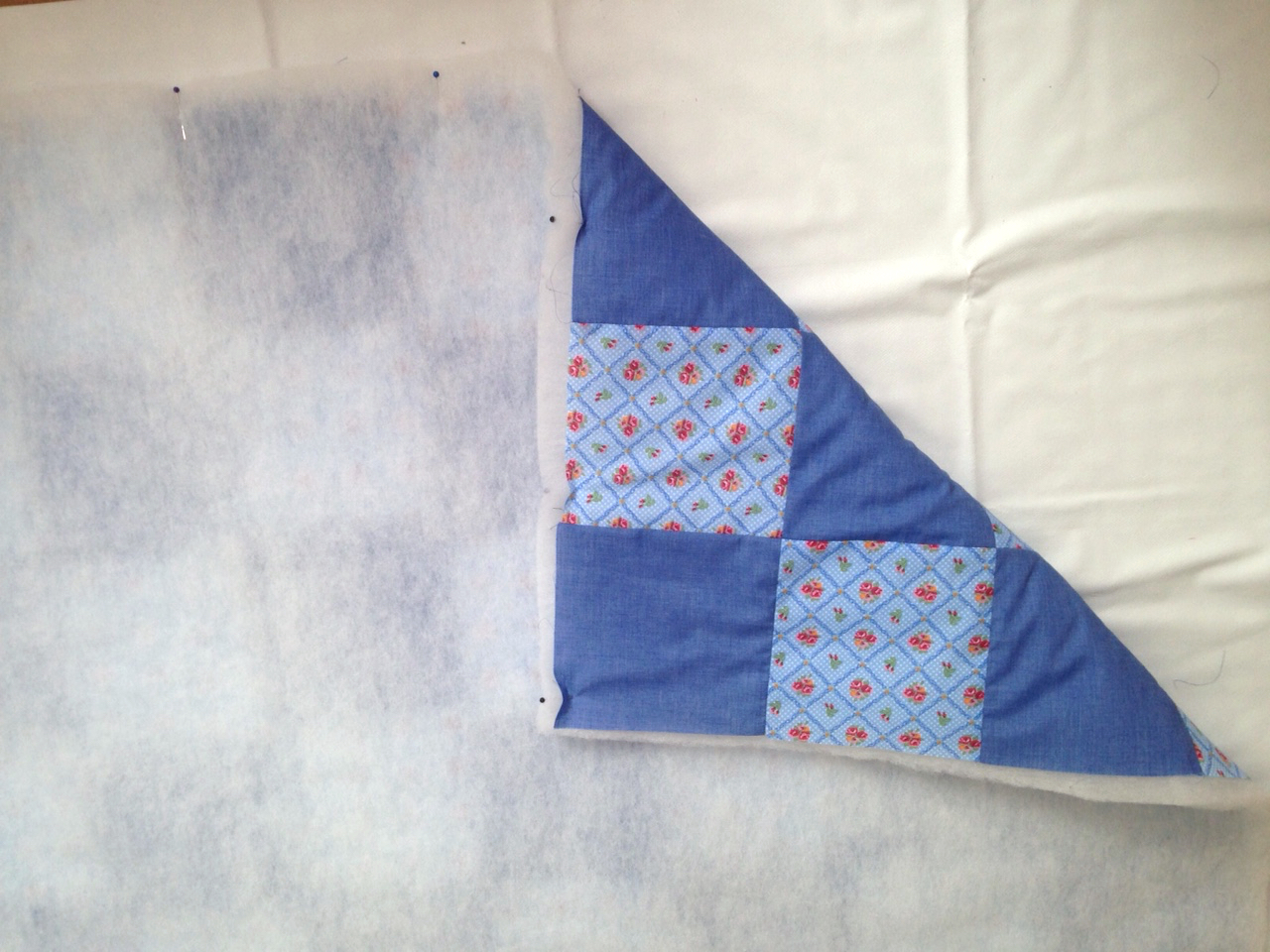
I cut a square of wadding slightly larger all the way around than the patchwork piece, laid it on top of the wrong side of the patchwork and pinned it around the entire edge.

IMG_2039

IMG_2040

Stitch close to the raw edges all around the outside and trim the excess wadding as shown.

IMG_2046

Now the wadding is secured, you can use large tacking stitches through both layers to stop them shifting whilst quilting.

Stitch in the ‘ditch’ using a long stitch length until the whole blanket has been quilted along the seam lines.

IMG_2041

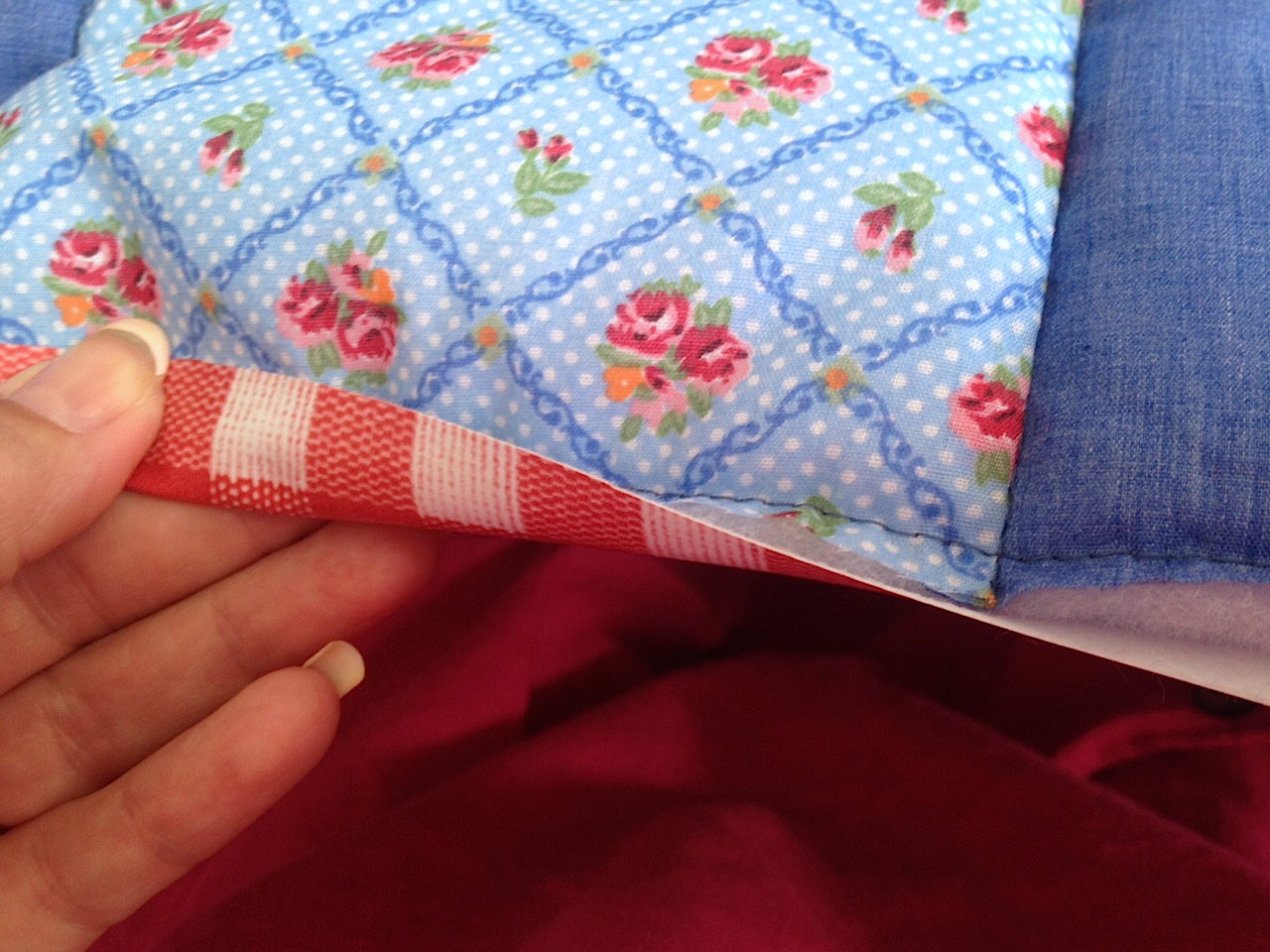
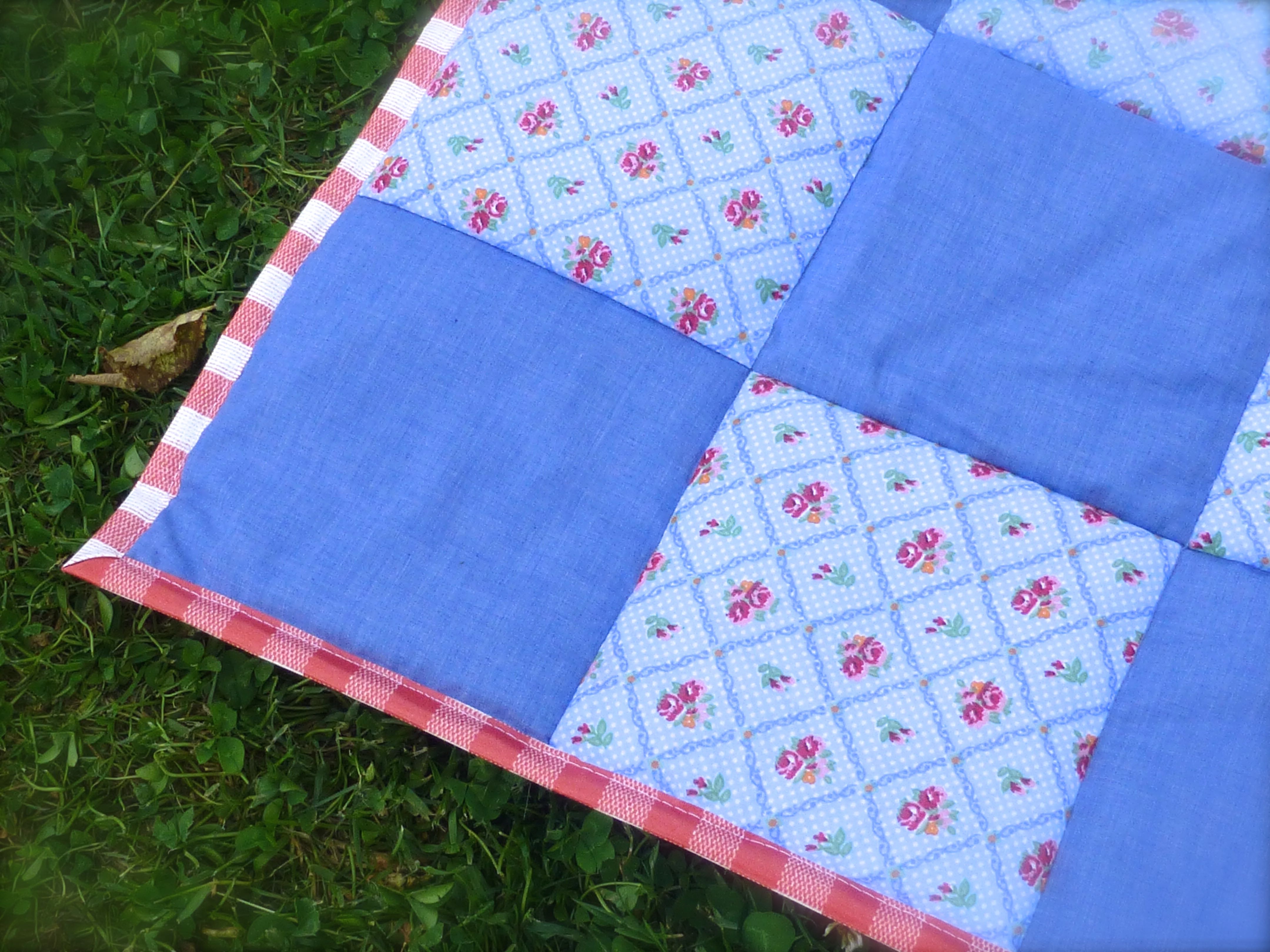
Place the quilted layer onto the vinyl backing, wrong sides together, and trim the backing so that it is 1.5cm bigger than the top all the way around.

P1050823

Using clips, fold the excess vinyl over to the right side of the blanket and secure in place.

IMG_2049

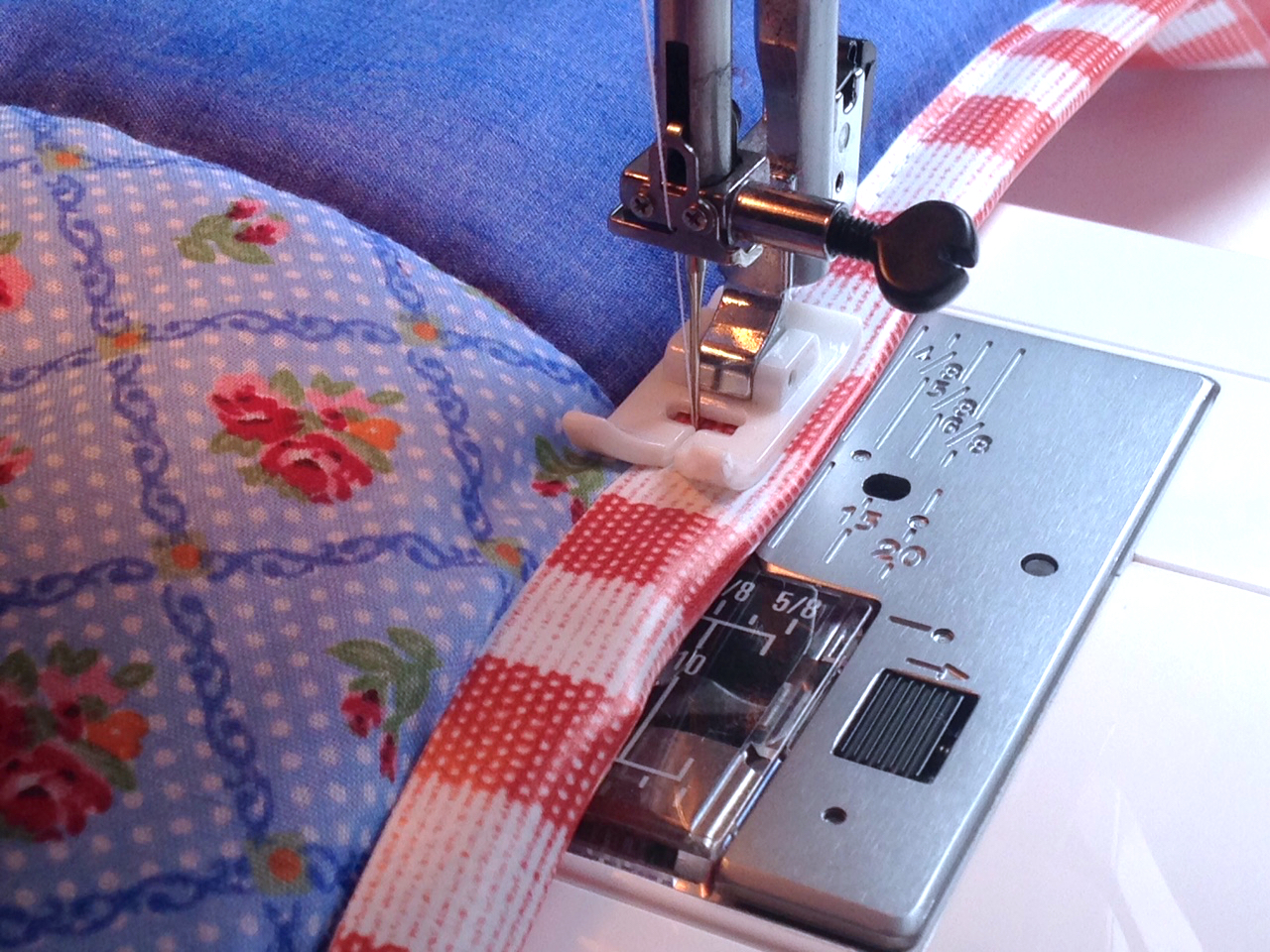
A teflon foot makes the vinyl move smoothly through the machine, and a leather needle with its wedged shape will stop any skipped stitches (discovered through trial and error!)

IMG_2051

A simple long straight stitch close to the raw edge of the vinyl is all that is needed.

IMG_2047

Mitre the corners as you go for a neat finish.

IMG_2050

I was left with a few scraps of fabric and vinyl, so I also designed a fabric roll to act as a carry pack for the blanket.

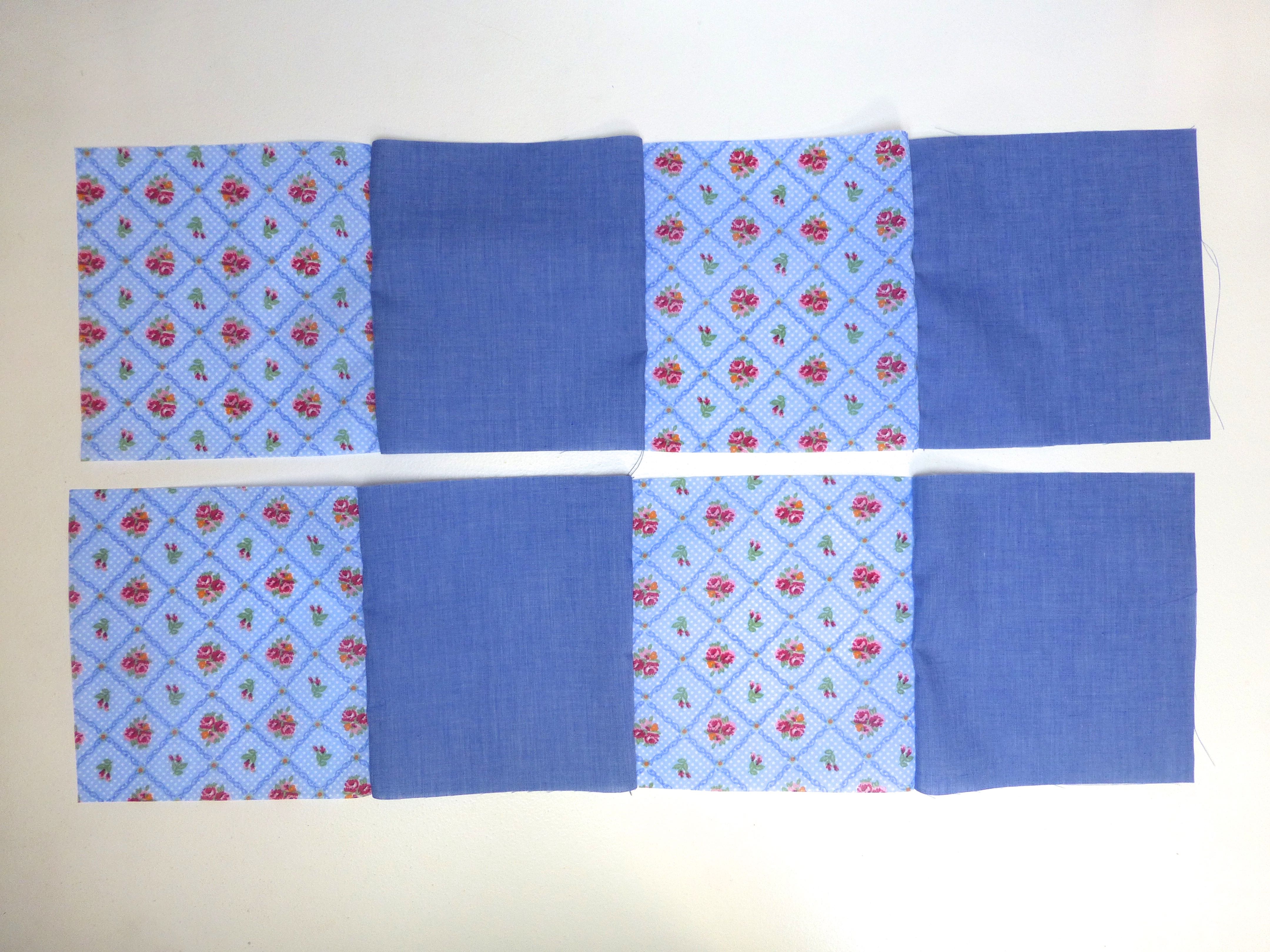
For the carry pack, cut 3 floral and 2 plain squares the same size as before and sew them all together in a single row. Press.

Cut a piece of spare vinyl 1.5cm smaller than the patchwork strip and place in the centre of the strip, wrong sides together.

IMG_2054

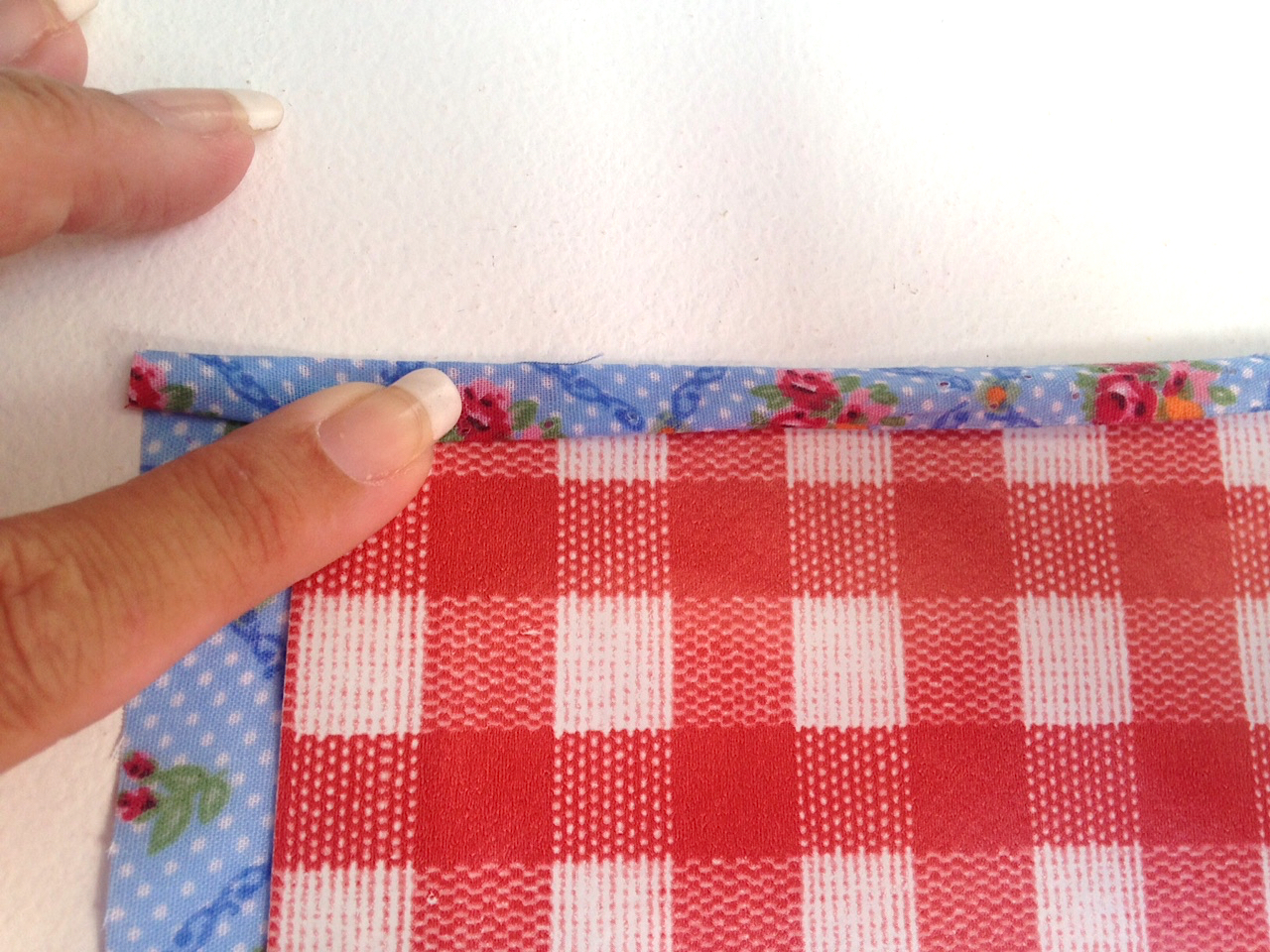
Turn a narrow hem…..

IMG_2055

IMG_2057

….and stitch in place close to the inner folded edge around all 4 sides, mitring the corners as you go.

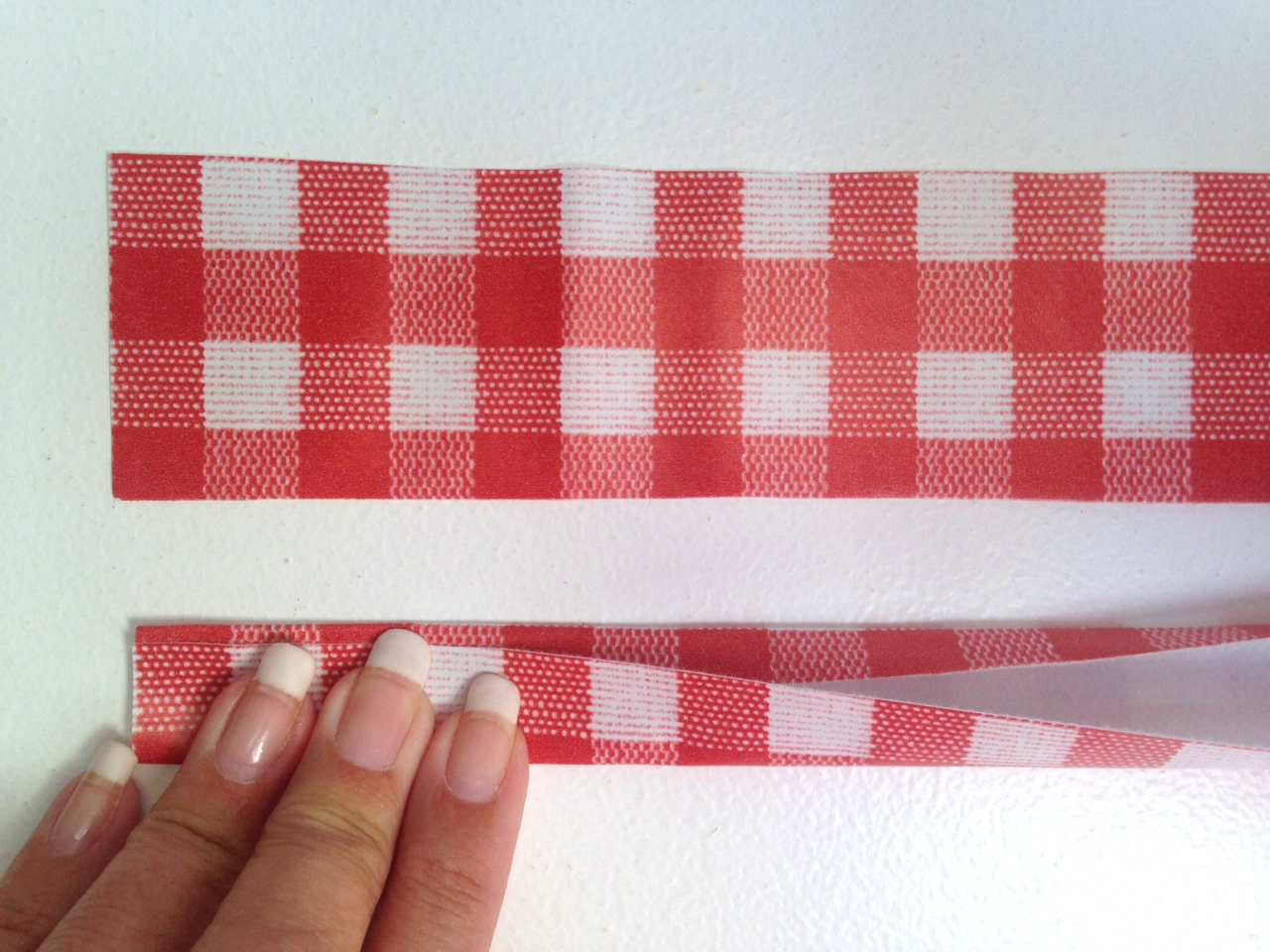
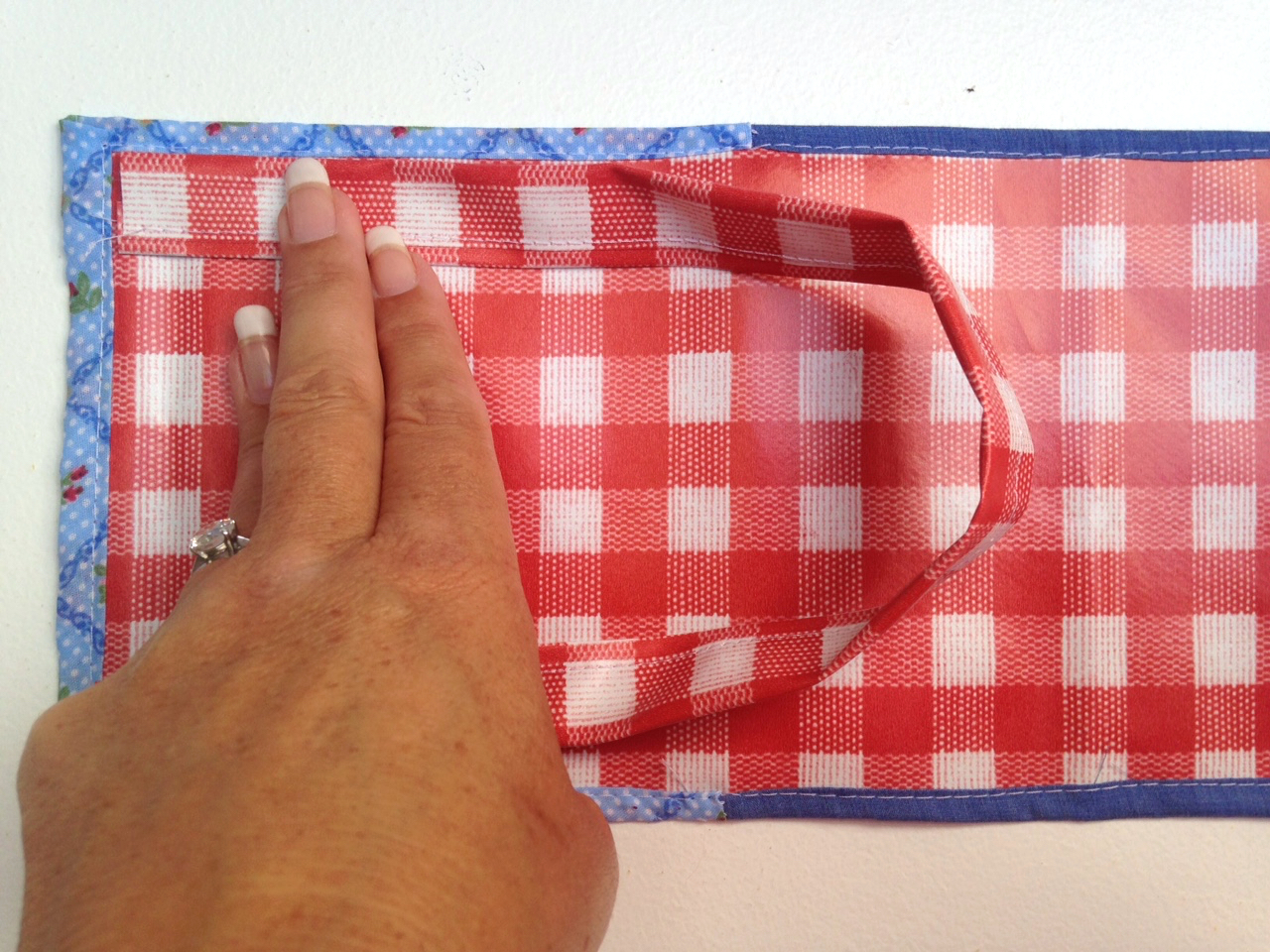
Cut two pieces of vinyl for the handles, each measuring 20cm x 5cm.

Fold the long upper edge in to the wrong side by 1cm, and bring the lower edge up to meet it, overlapping a little to encase the raw edge as shown below.

IMG_2060

Stitch close to the raw edge.

Repeat with the second handle.

IMG_2061

Position the two ends of the handle in the corner of the carry pack using the photograph as a guide.

IMG_2063

Stitch in place with a 1cm seam.

IMG_2064

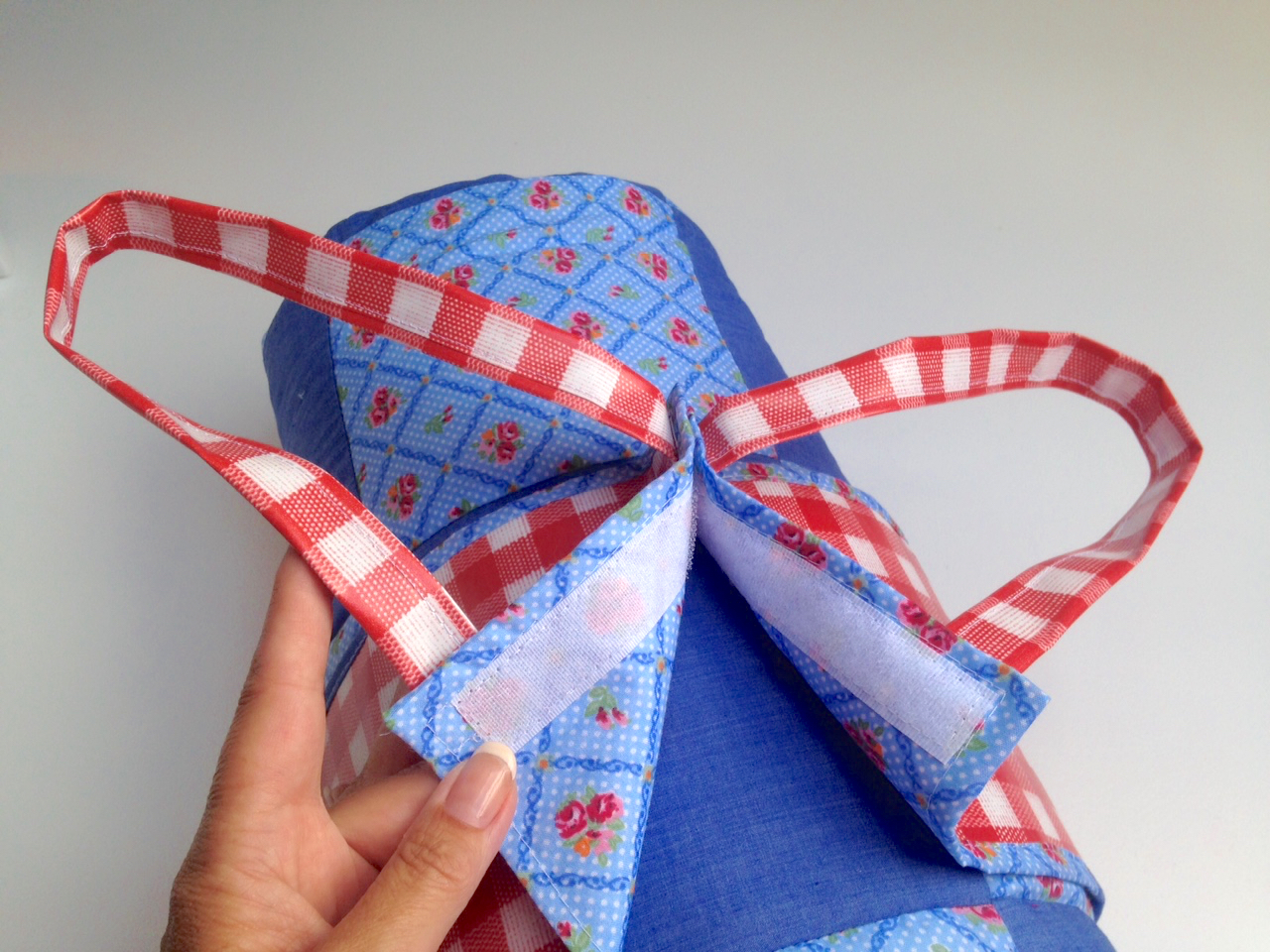
Fold the handle to the outside and turn over, vinyl side down.

Cut a 12cm strip of velcro hook and loop fastener and sew the hook side to the fabric side of the carry pack, being sure to catch the handle in the ‘up’ position, securing it in place at the same time.

Repeat with the loop side at the other end of the carrier.

IMG_2065

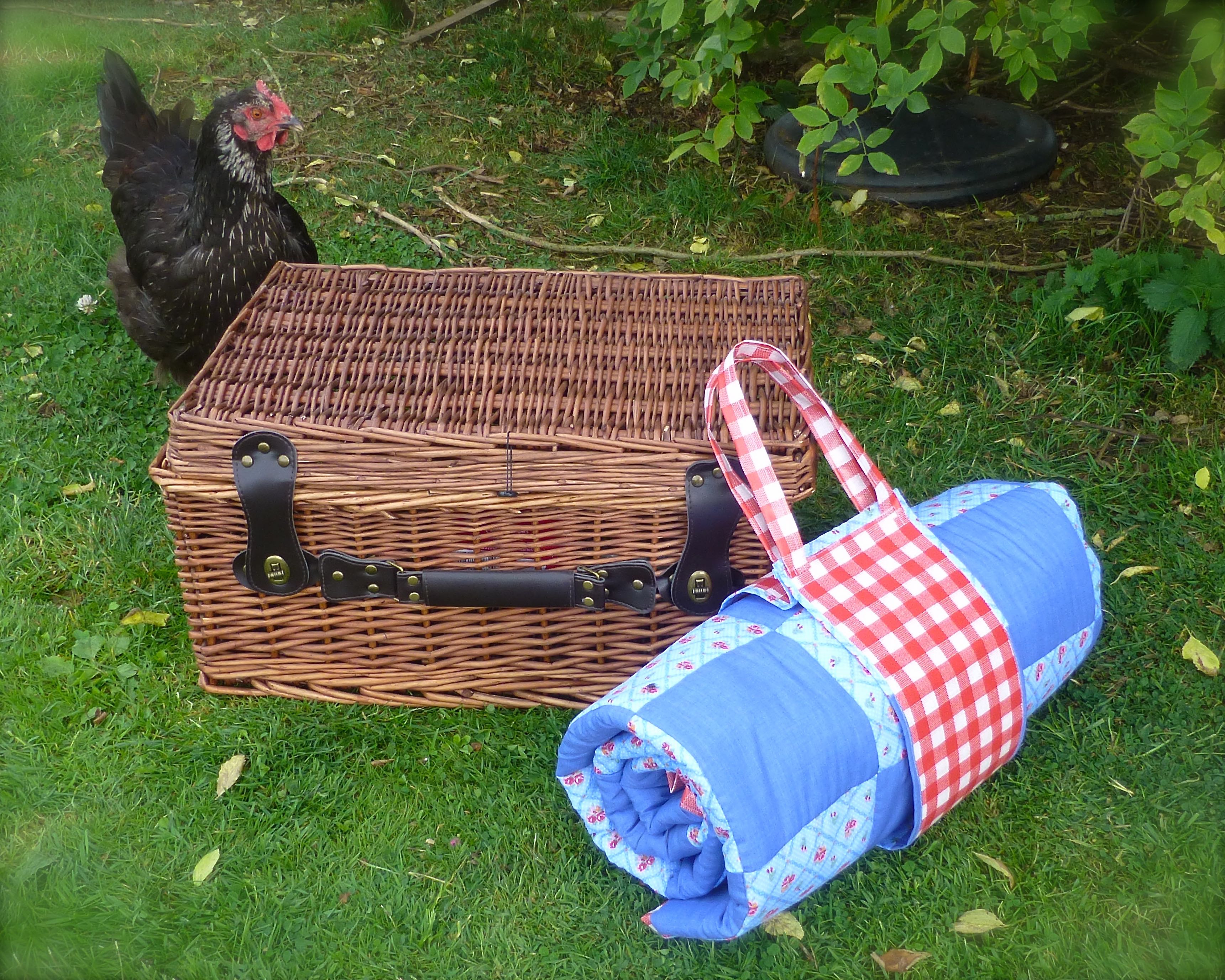
When the blanket is rolled up, wrap the carry pack around it and press the velcro strips together.

IMG_2068

IMG_2066

For a picnic in the garden (or anywhere), just add bunting, a squishy cushion and a hamper full of goodies.

P1050901

Sun is a bonus for a picnic, but not when taking photographs (too much contrast)…

P1050886

The perfect fusion of girl/boy styling that anyone would be happy to sit on.

P1050903

No more damp bums!

P1050904

A lovely layer of wadding for added comfort.

P1050907

The carry pack with handles means that it’s compact and easy to transport.

P1050914

Marley was interested to see what was going on – sometimes our hens are just a little bit too friendly!

P1050911

P1050909

Now all we need is for Summer to return so we can actually use our lovely new picnic blanket!!


43 Comments

Bellville Sassoon Dress For Ascot

Well, I’ve had a wonderful two days virtually locked away in my studio, only surfacing for the occasional fuel break – No.1 Son has even been making sure my G&T levels didn’t drop below a critical level!

What have I been so immersed in?

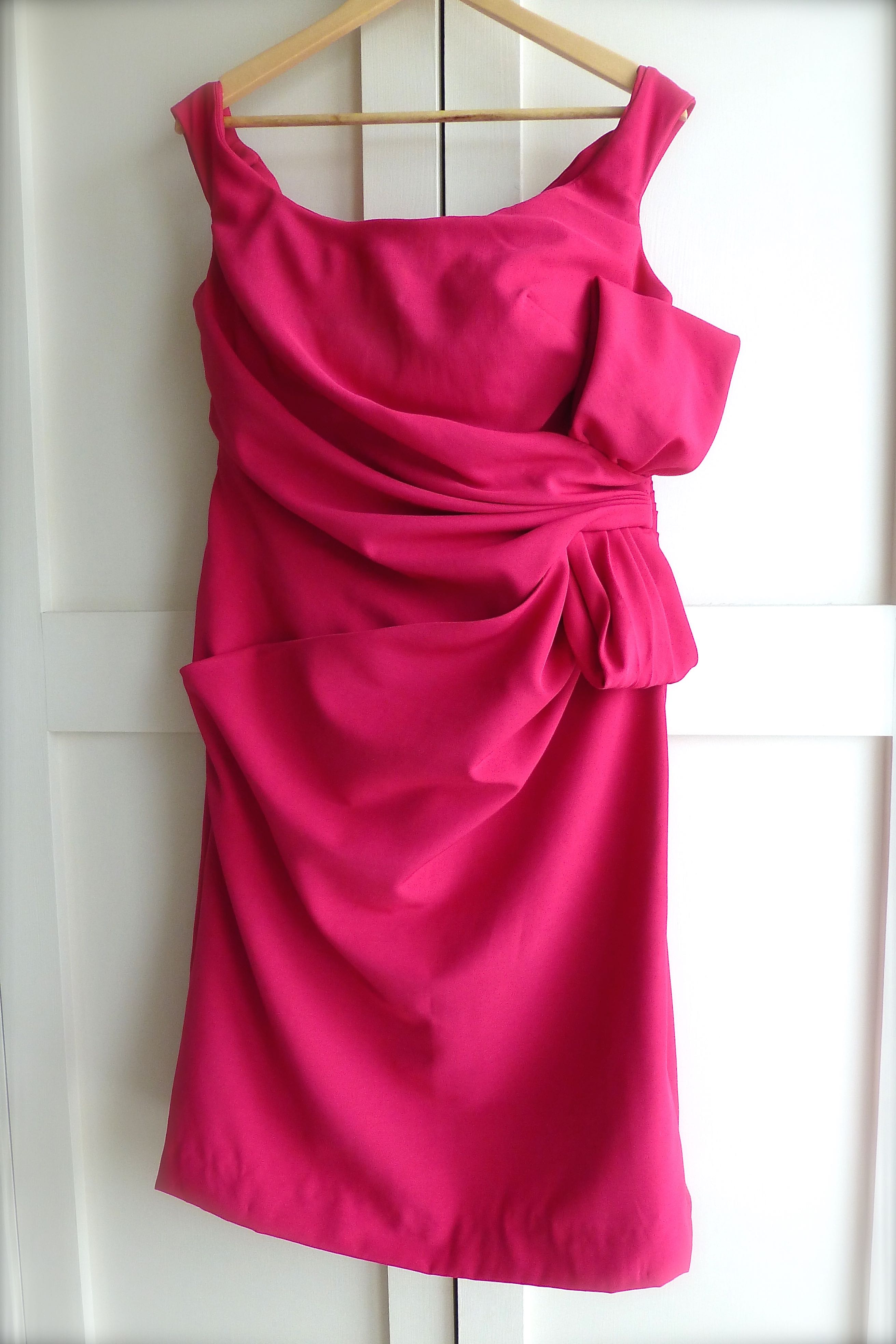
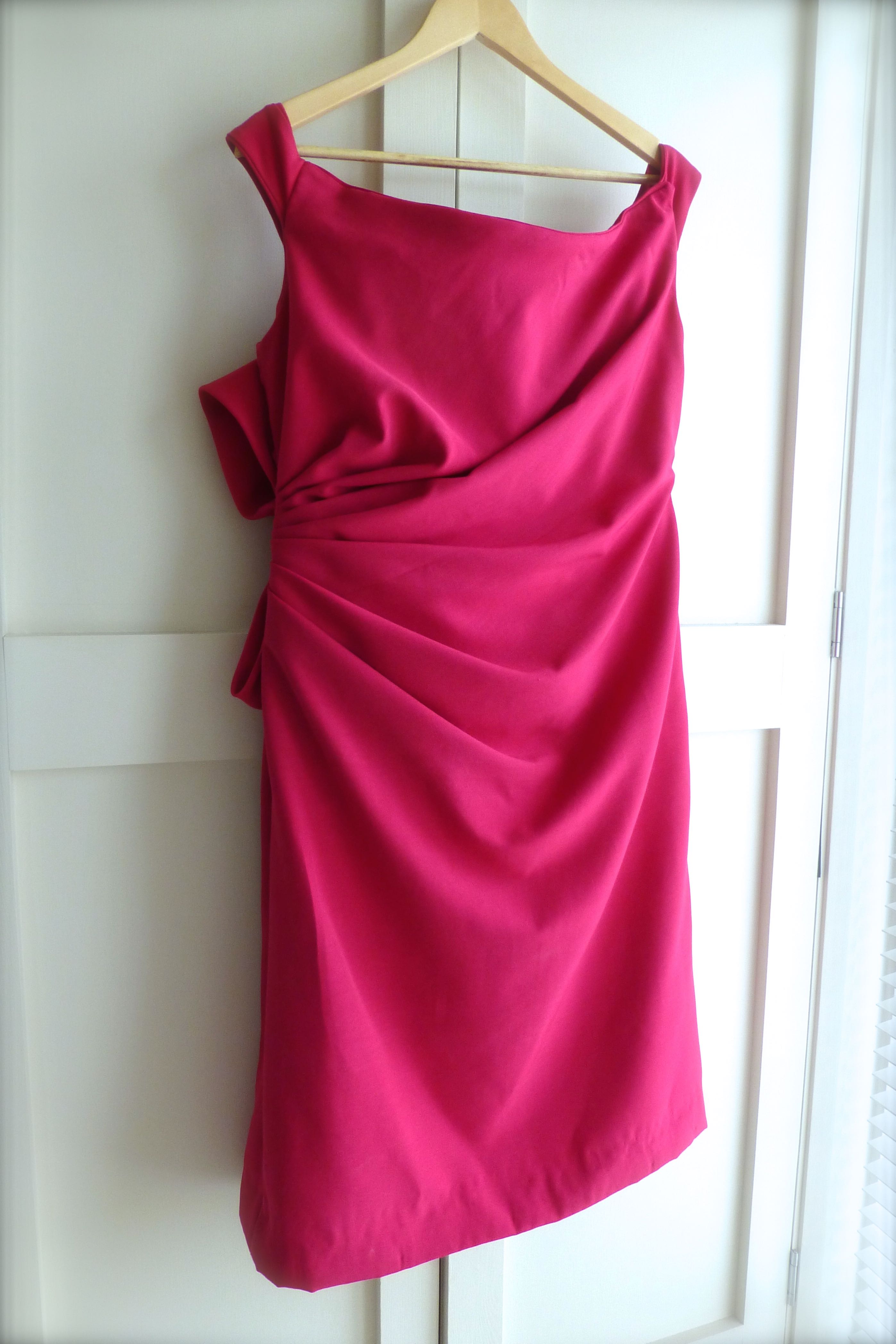
This year’s dress for Ascot – Vogue 1108 by Bellville Sassoon.

P1050598

It has been BRILLIANT getting my teeth into a proper Couture make again.

Don’t get me wrong though, I love quick and easy dressmaking projects but, once in a while it’s just fantastic to challenge myself with something a bit more meaty, so to speak.

Vogue classify this as an ‘Average’ make in terms of difficulty, and I agree – I have made much more complicated dresses than this.

I love the labels that come with each designer pattern for you to sew into the garment:)

P1050602

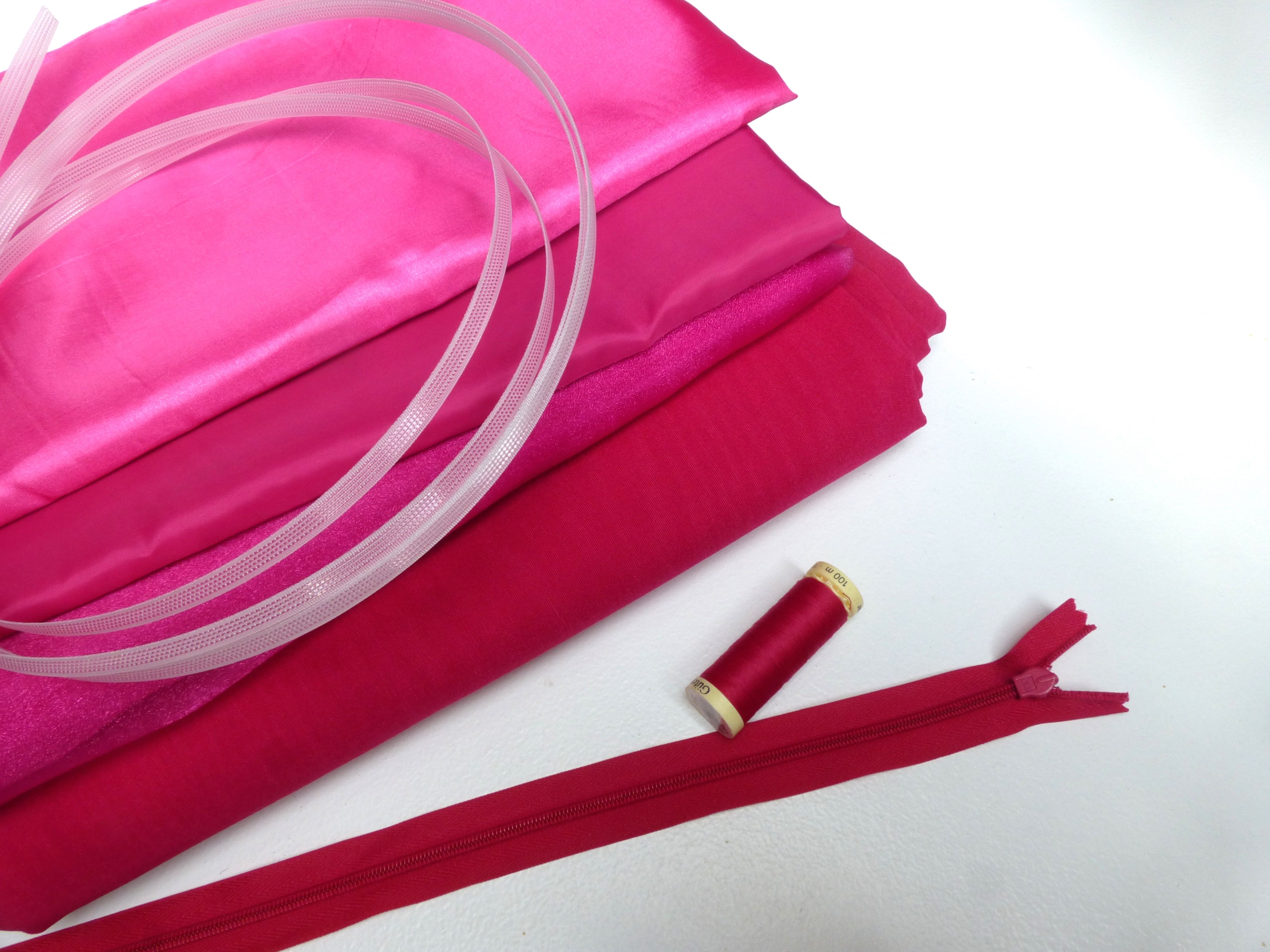
This bundle of fabric arrived from Minerva Crafts – several different types of fabric in a glorious shade of Fuschia: –

P1050597

There was Bengaline for the main body of the dress, organza for interfacing, lining and habotai for the foundation layer and, yes, that is boning you see sat on top of the lot!

Let me tell you now that there are over SIXTY pieces of fabric holding this dress together and only FIVE are visible from the outside!

That is a hell of a lot of construction hidden inside and I used up two entire 100m reels of thread in the process!

I love a good puzzle and this pattern had a few to solve, such as all those pleats on the left front:

P1050606

I won’t take you through much of the process because that would take up more space that any blog post should do – I’ll just whizz through the main bits.

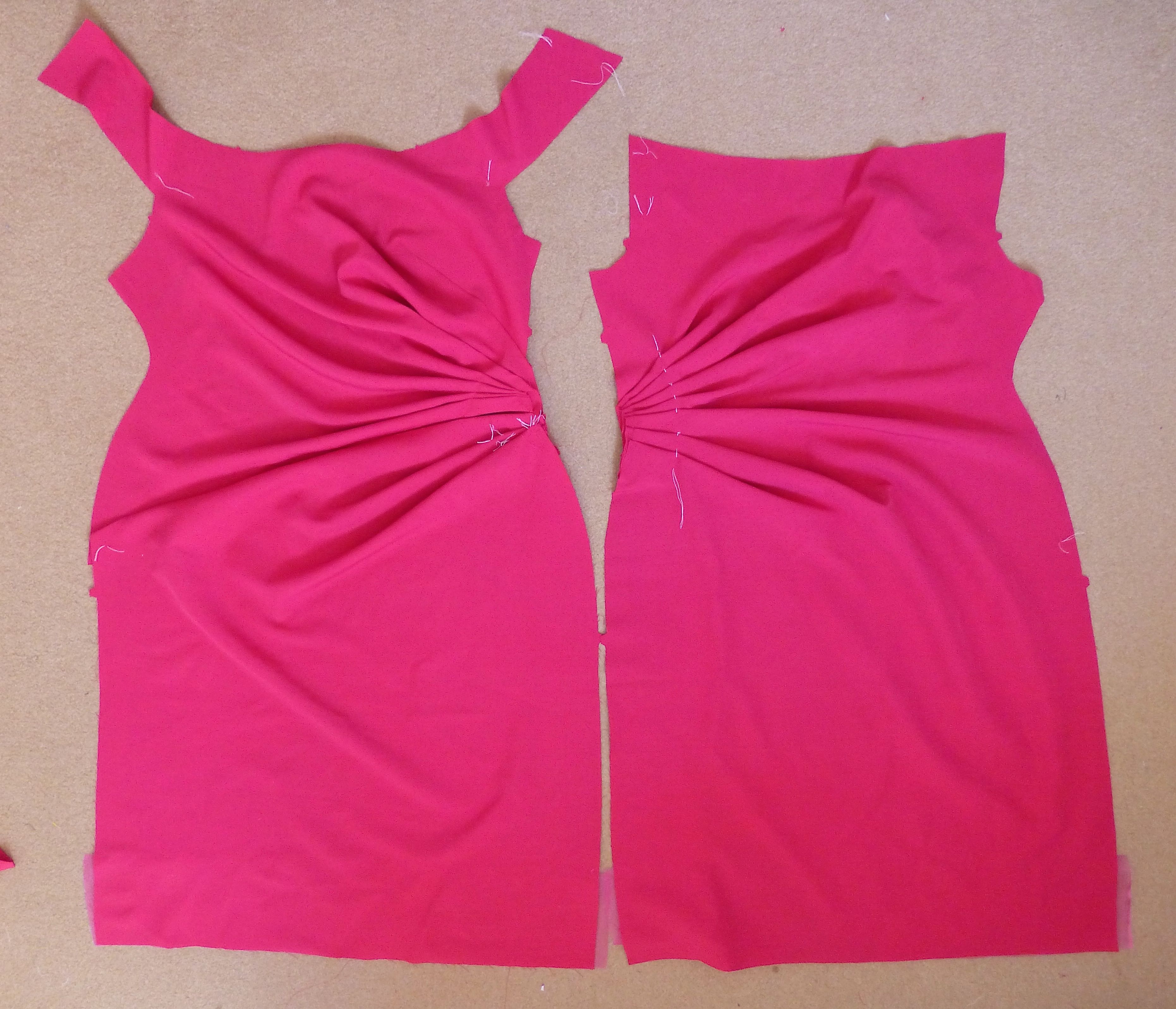
First, you make the pleats and darts in the front and back sections.

P1050629

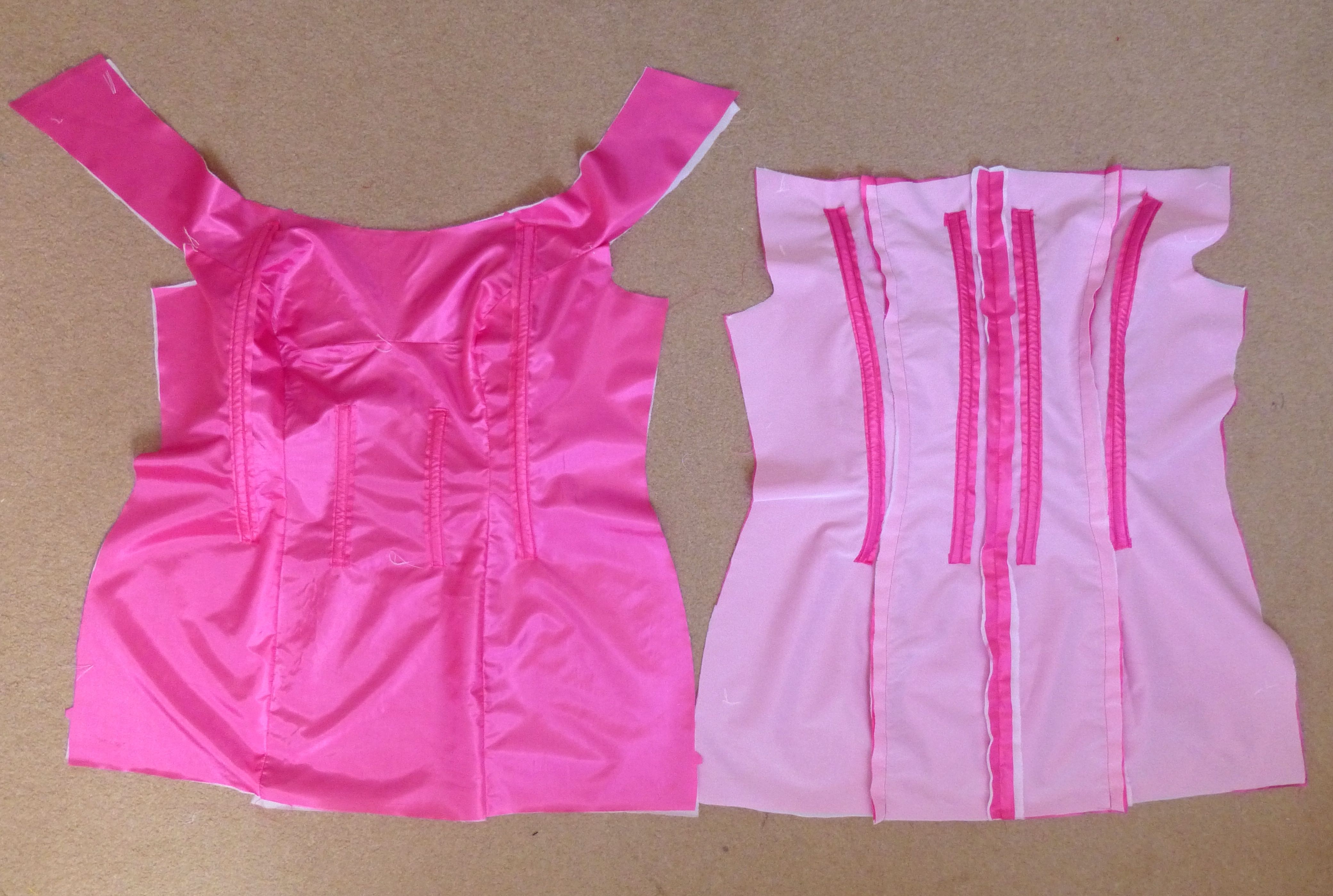
Next, you make the foundation which is the middle bit of the dress sandwiched between the outer dress and the lining.

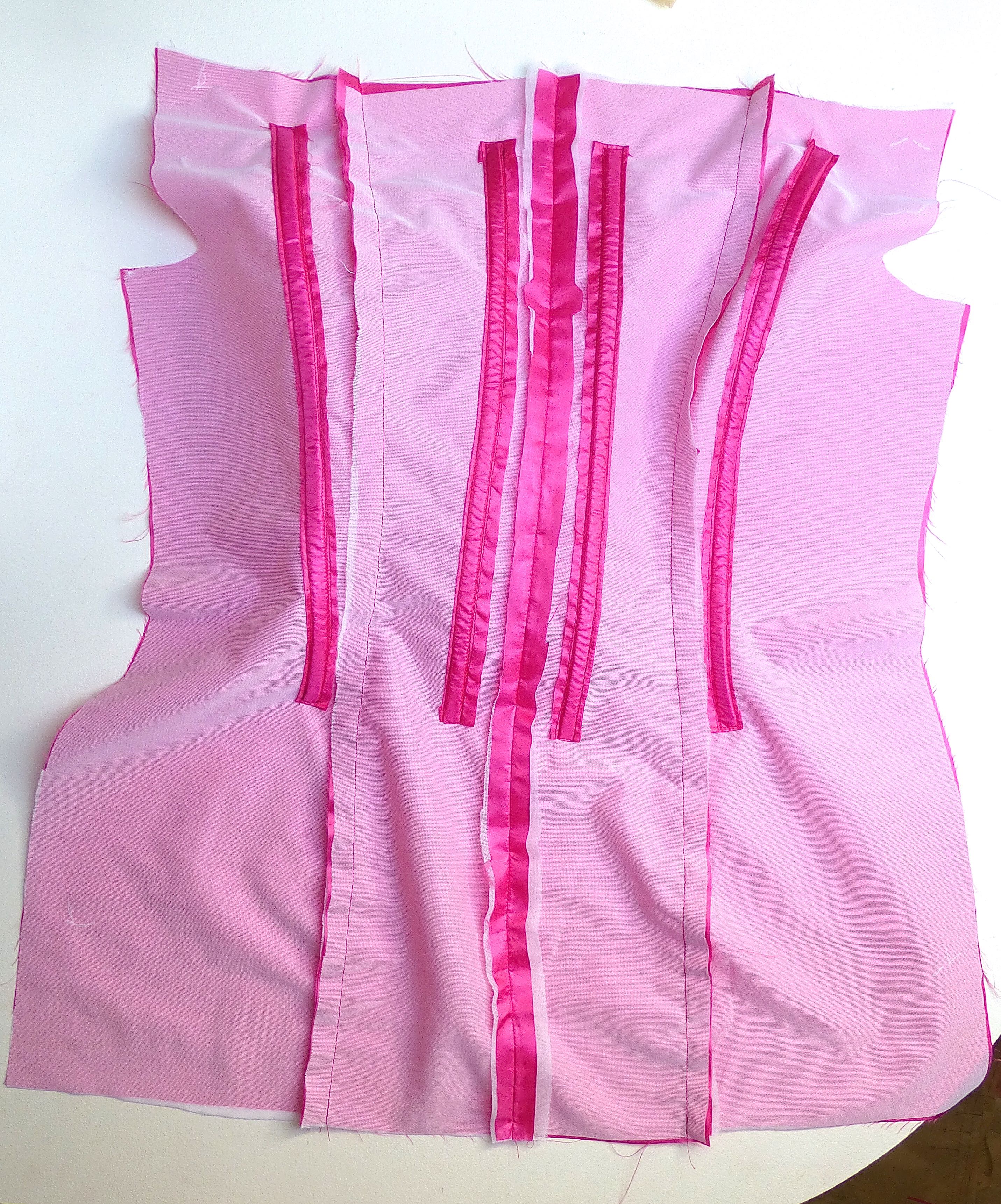
It consists of a lining layer, fully interfaced, which has the boning sewn to it.

P1050630

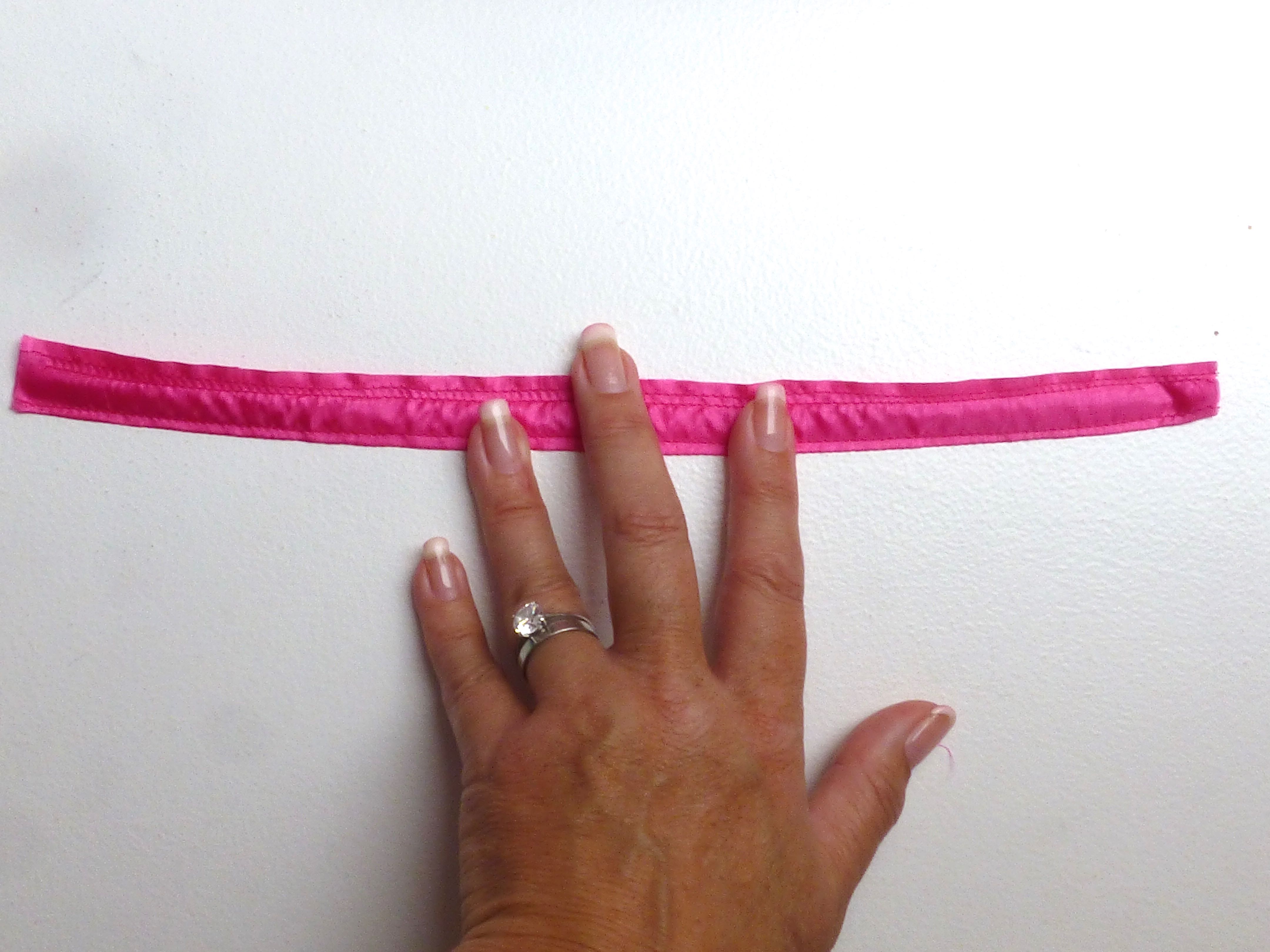
The instructions called for boning in its own casing but, as I couldn’t get any, I made my own using normal boning and some offcuts of habotai.

P1050614

Voilà!

P1050619

This is the inside showing the boning in place….

P1050627

….and this is what it looks like from the right side.

P1050625

Very nice.

It’s almost a shame that all this beautiful work will be completely hidden from view:)

The foundation sections are then sewn to the body of the dress….

P1050631

….and the front is stitched to the back at the side seams, leaving an opening for the zip.

P1050640

Now, I have never used a dedicated foot to insert invisible zips, I learned to sew them using a normal zipper foot and don’t find it an issue.

I don’t know if you can see, but I open the zip up and sew really close to the teeth in the same way a specialized foot would do.

P1050636

There, pretty invisible, wouldn’t you agree?

P1050637

The zip needed shortening which is just a case of sewing a new stopper from thread and cutting off the excess below.

P1050639

P1050638

Now, onto the lining.

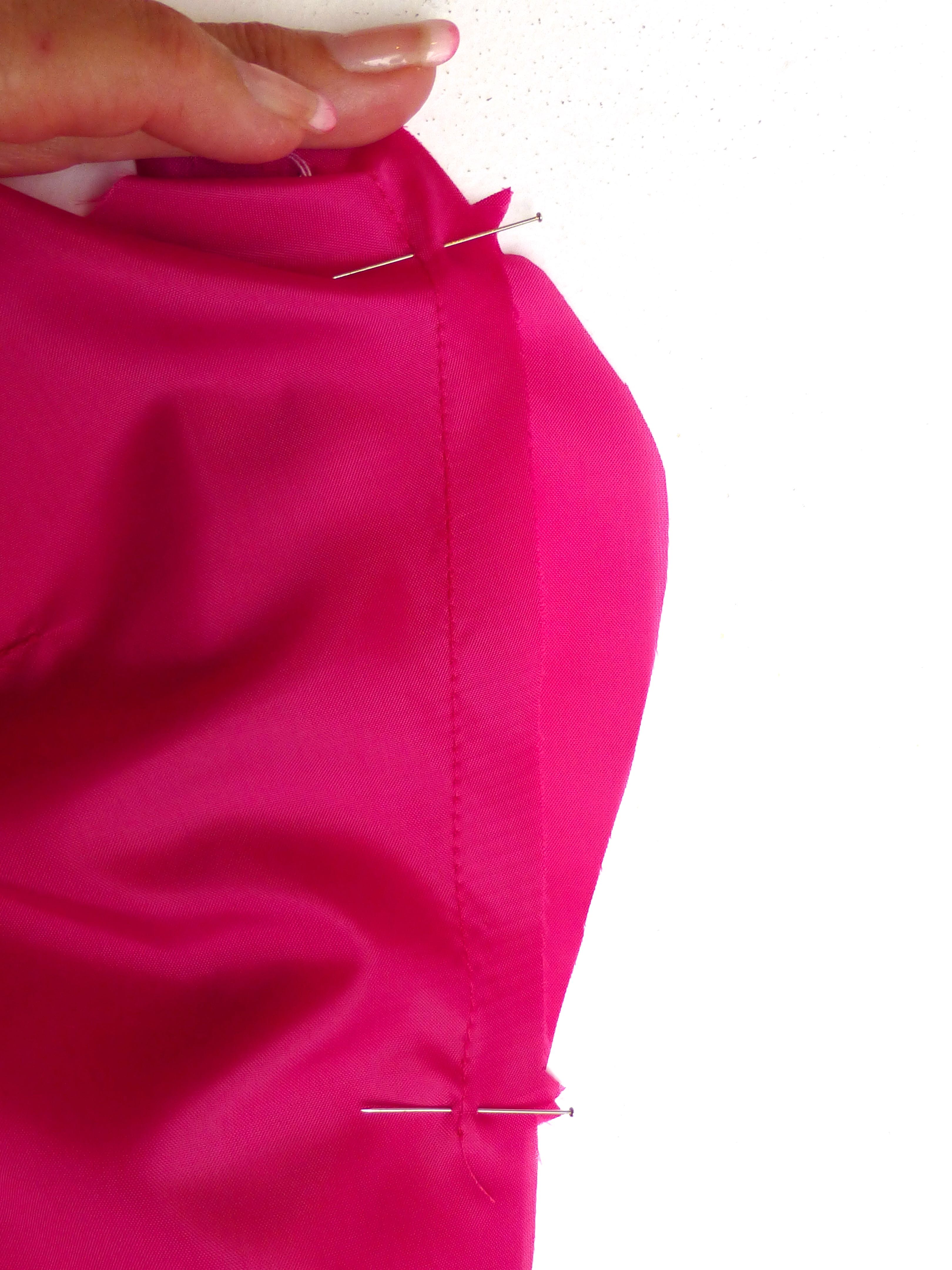
Of course, all the way through we’re sewing princess seams – isn’t it a little bit of magic when you fit the fabric around the curve? Like fitting a square peg into a round hole, it doesn’t seem possible at first.

P1050641

A few clips to the stay-stitching and job done!

P1050643

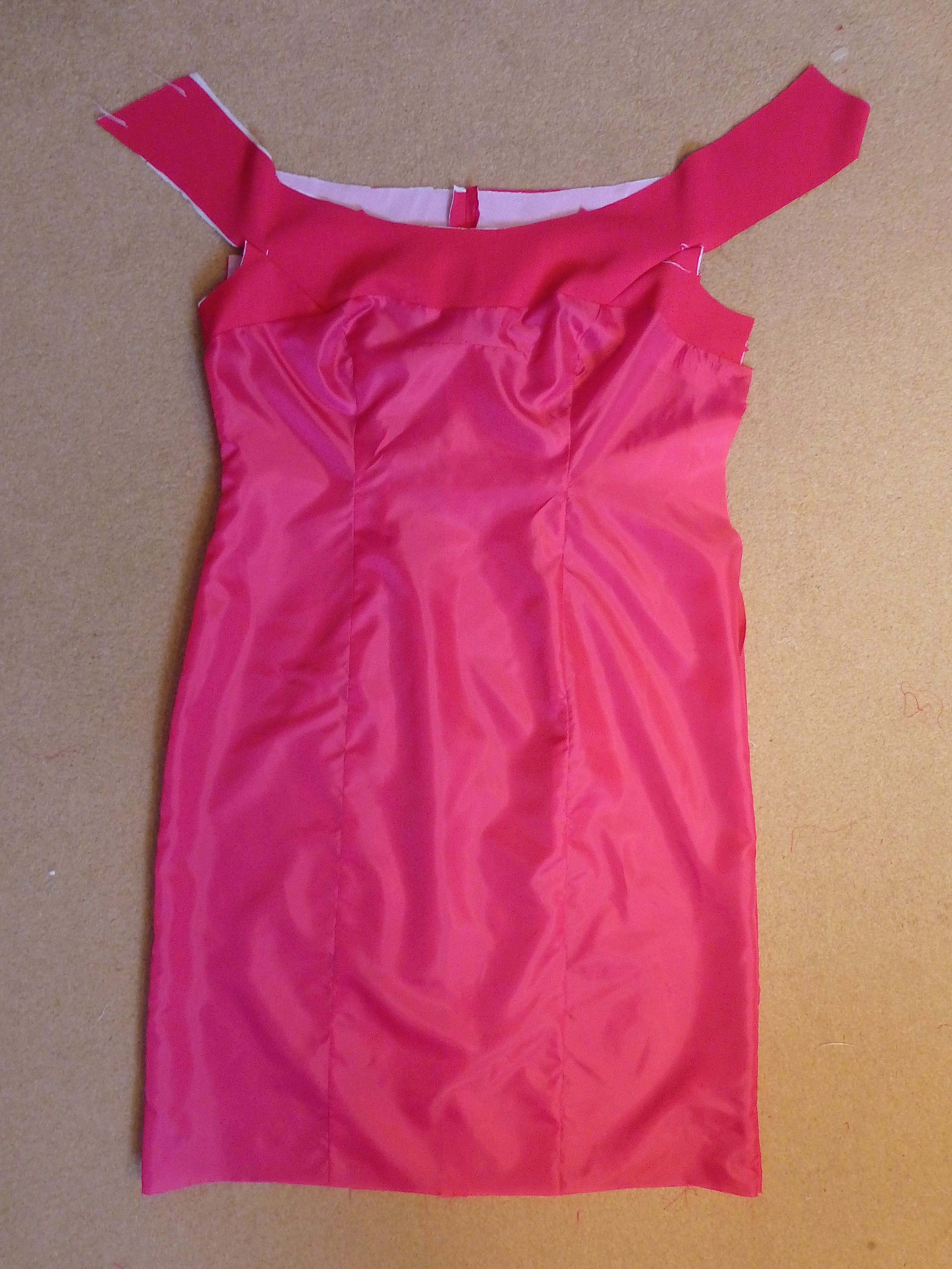
Lining completed.

P1050644

The lining is slipped over the dress and foundation and sewn right sides together around the neckline and armhole edges.

P1050646

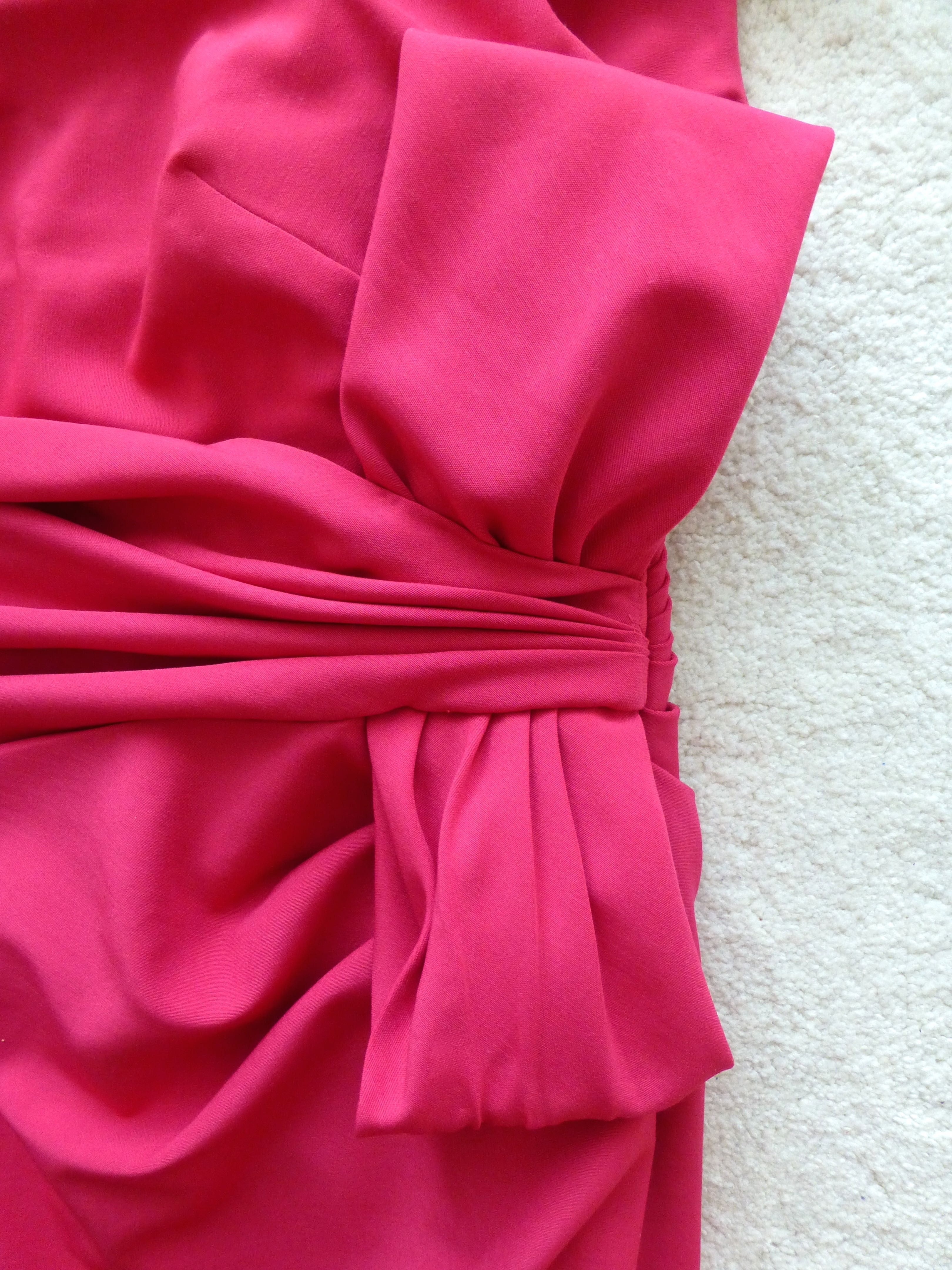
The bow, which is stiffened with organza, was made and secured in place amongst the pleats.

P1050666

The hem was faced with organza and turned up with herringbone stitch.

P1050649

The lining was slip stitched to the hem, leaving a folded pleat as ease.

P1050665

Looking at the inside when finished, you’d have no idea of what it’s hiding underneath!

P1050664

The quality of the fabrics is amazing – the bengaline handles beautifully and has a discreet watermark to it.

The polyester habotai was chosen as an alternative to china silk for the foundation and looks and feels superb – such a shame it’s hidden!

This dress does not photograph well on the hanger – all those pleats only sit properly on a real body.

P1050671

Oops – better press the hemline before Ascot!

P1050670

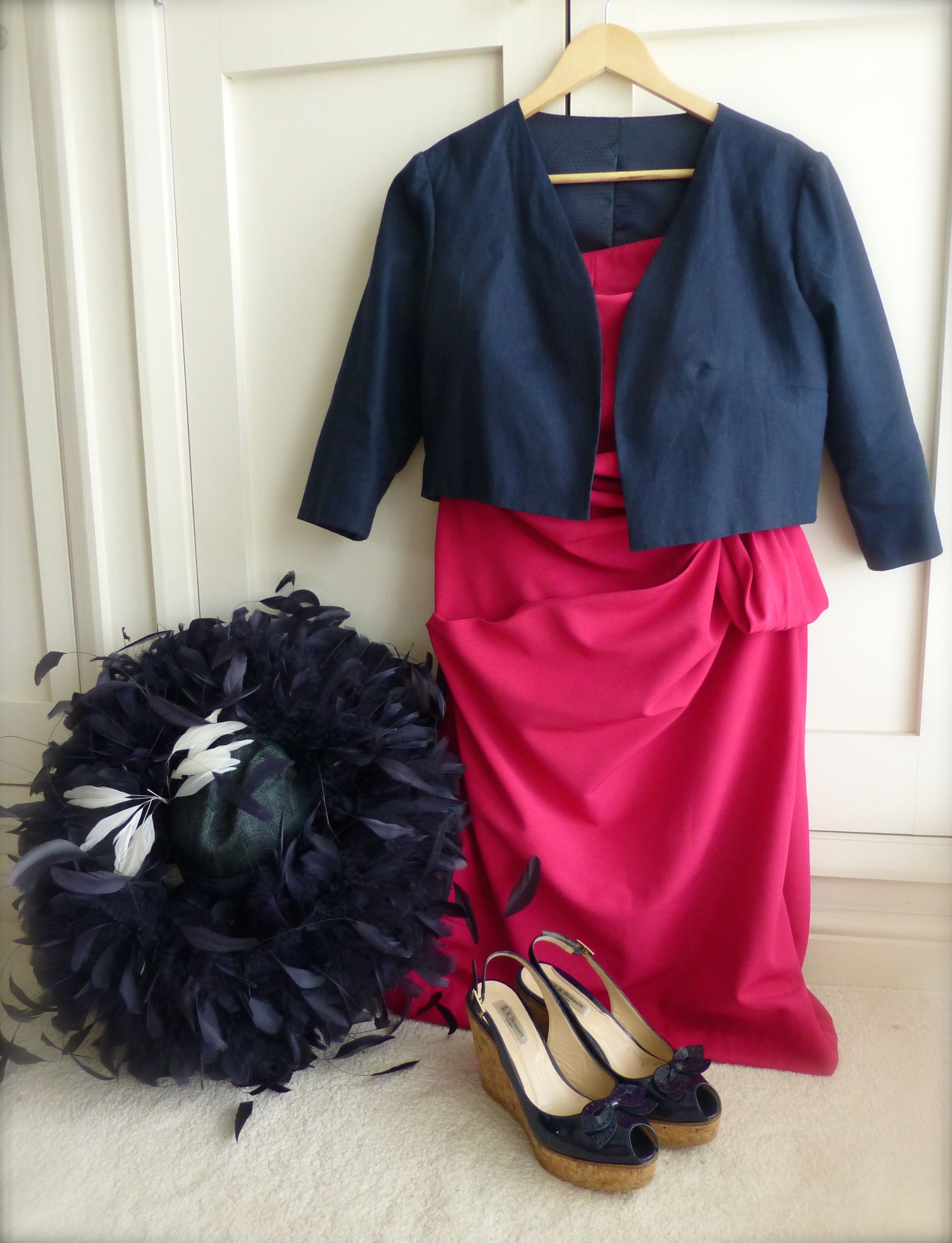
So, what will I accessorize with?

I made two jackets for Ascot last year  – this is the other one (see last year’s post).

P1050669

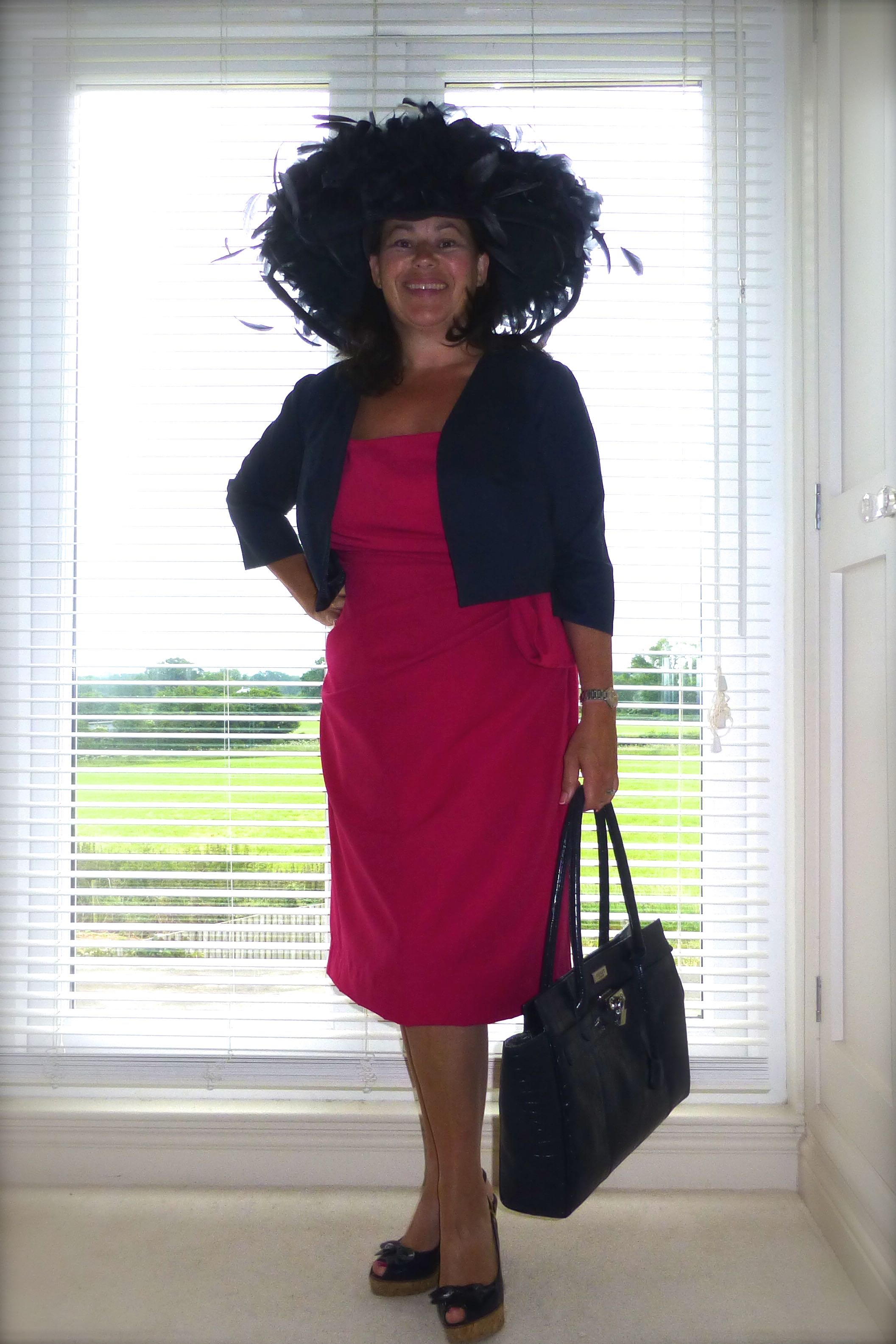
The boning means I shouldn’t have to wear a bra but, looking at this photo I definitely do. My bust is too heavy and is dragging the front down causing it to gape – a strapless bra will do the trick.

P1050657

So this is me, all ready for Ladies Day on Thursday and there’s just one more thing left to do…..

P1050662

…. get my French manicure redone – it’s all stained from handling all that pink fabric!!

P1050672


31 Comments

More Holiday Dressmaking

Ah, the wonders of technology – I’m probably sat around the pool in Andalucia, sunning myself with a cheeky G&T for company as you read this, as I planned ahead and scheduled this post in advance!

If you saw my post ‘Holiday Sewing’, you’ll know that I wanted to make a few new things to wear, so this is the second in the series, so to speak.

You may have noticed over the past year of my blogging journey, that colour is a recurring theme – and lots of it, preferably clashing.

The wackier the print, the more likely I am to want it and, as The High Street doesn’t often float my boat, I source fabrics online to conjure up my own creations.

As a member of the Minerva Crafts Blogging Network, I received this cheery package for this month’s make: –

IMG_1725

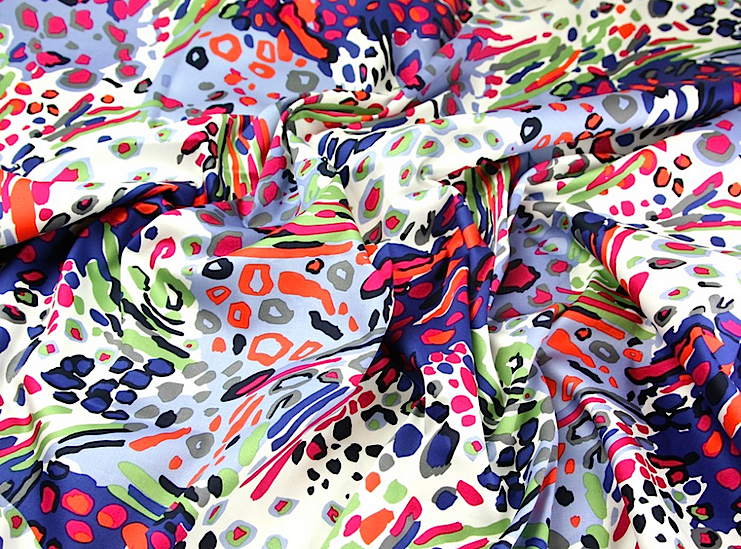
“Where have I seen that wacky animal print before?” I hear you all cry.

Well, unbeknown to me at the time, Lucie of Love,Lucie had also fallen for its charms and has since used it to make a stunning Summer dress (click here to see the Wow! dress).

It’s a supremely soft textured Stretch Cotton Sateen which has proved so popular that Minerva are having to restock!

fabric

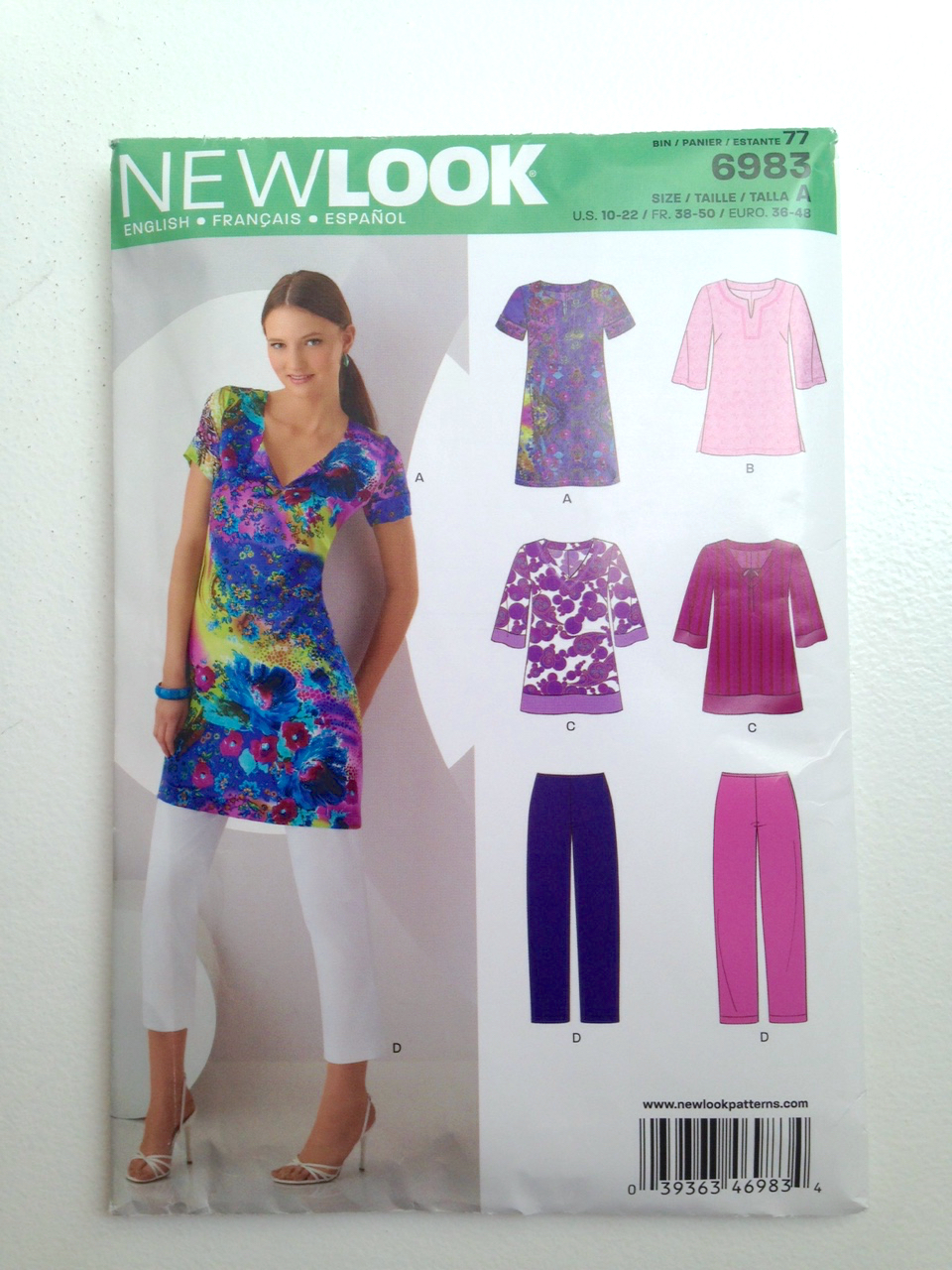
The pattern is New Look 6983 and includes cropped trousers as well as variations on a tunic.

IMG_1726

Liking the look of a bold print tunic worn with a pair of Daz-white three-quarter lengths, I also ordered some of the same fabric in plain white.

white

So, onto the construction of the top which consisted of three basic pieces – a front, back (with facings) and sleeves. Shaping was in the form of two bust darts so, really, it couldn’t be simpler for even a beginner to do.

After putting together the basic shape, including the darts, I always try garments on inside out. This way you get a better idea of how well/badly it actually fits without being distracted by the pattern, and you can also pin any adjustments that need to be made.

Obviously a dressform would be ideal, but I outgrew my old one while I was pregnant ten years ago and have decided the two stone of baby weight is here to stay:)

IMG_1730

Again, being a UK size 14, I cut out the US equivalent of size 18.

This time, it really was too big by quite a long way and I ended up taking it in all the way by a whole dress size.

IMG_1728

The pattern is very straightforward but included nice details like understitching of the neck facing to create a neater, flatter finish.

IMG_1733

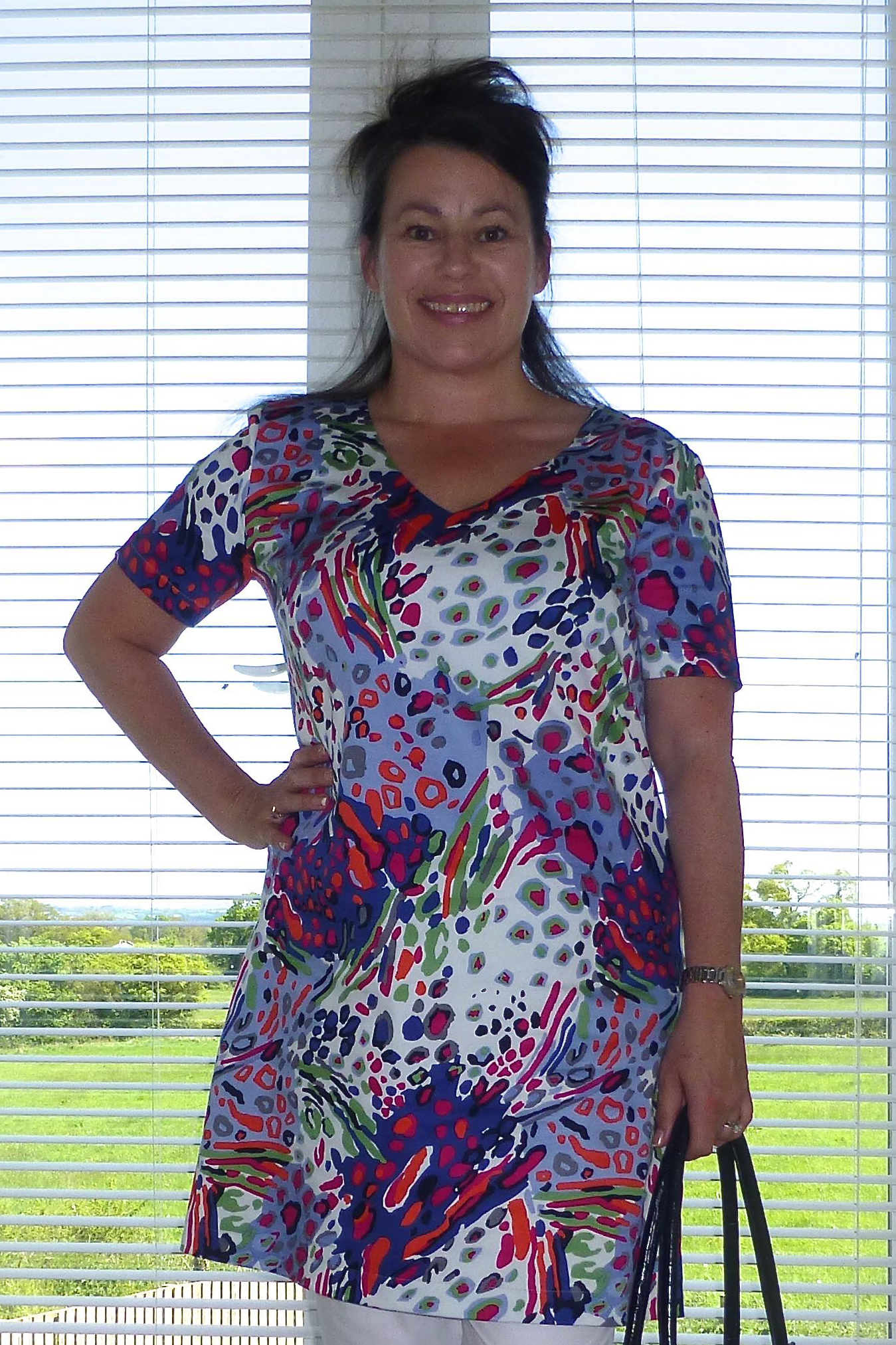
I’m really pleased with the way it turned out – it has already attracted many comments:)

P1050281v2

The cropped trousers (well, they weren’t until I shortened them by three inches at the “lengthen/shorthen here” mark!) were also too big initially, so I took them in by a whole dress size too.

There was no waistband for a change, just a facing of petersham ribbon-type tape which lends a clean, minimal look to the trousers and also makes them super comfortable to wear.

P1050273

The lapped zip is always a neat addition when inserting into a side seam.

P1050271

A tip is to reinforce at the bottom with several lines of stitching though, as I’ve done here.

P1050272

They fit well and the stretch in the cotton means that they will be a pleasure to wear – and somewhat smarter than the white leggings that I usually favour!

P1050298

So, how does the outfit look as a whole?

Just as I had hoped, actually and feels even better due to the stretch in both fabrics.

P1050300

The New Look pattern was easy to understand and the instructions simple to follow.

The cotton sateen is heavy enough to add structure and the stretch makes for incredible comfort.

P1050281

Sunnies on and I’m ready to go!

P1050293

Why not pop over to Minerva Crafts to find your own piece of fabric heaven?


51 Comments

Accessorise Your Pooch!

We Brits are a nation of animal lovers, particularly cats and dogs and, generally, we look after them well and love to pamper them just a little.

There inevitably comes a time when we have to say farewell to our loyal companions and, whilst I have lost many a pet over the years, it doesn’t get any easier.

They say the best way to mend a broken heart is to find a new love and certainly the arrival of a new puppy in the family does wonders to heal the gaping hole left by the loss of an old dog.

P1020014

They also say that a puppy breathes new life into an elderly dog so, when our Yorkshire Terrier reached eleven years, we thought it would be a good time to introduce a puppy.

Yorkies have a life expectancy of 12-15 years so Fifi, who is now 12 1/2, is enjoying her old age with a new spring in her step with the companionship of a younger dog. Tess, who is now an 18 month Yorkie x Chihuahua, has benefited enormously from her older, wiser, calmer and well behaved mentor. When Fifi goes, we will have the comfort of having a dog in the family still. It’s a win-win-win.

Tess has the boundless energy found in one so young and they both enjoy long walks in the country, but recently Fifi has started showing her age. She often turns around and walks back home if we are in the fields behind the house and, if we are doing a lane walk, she plods along slowly unable to keep pace after a couple of miles.

I now get to the point of this story; I wanted to make a dog carrier to take with me on our walks so that Fifi could climb in and  rest her weary bones as and when she feels like it and, yes, she does tell us when she wants a carry!

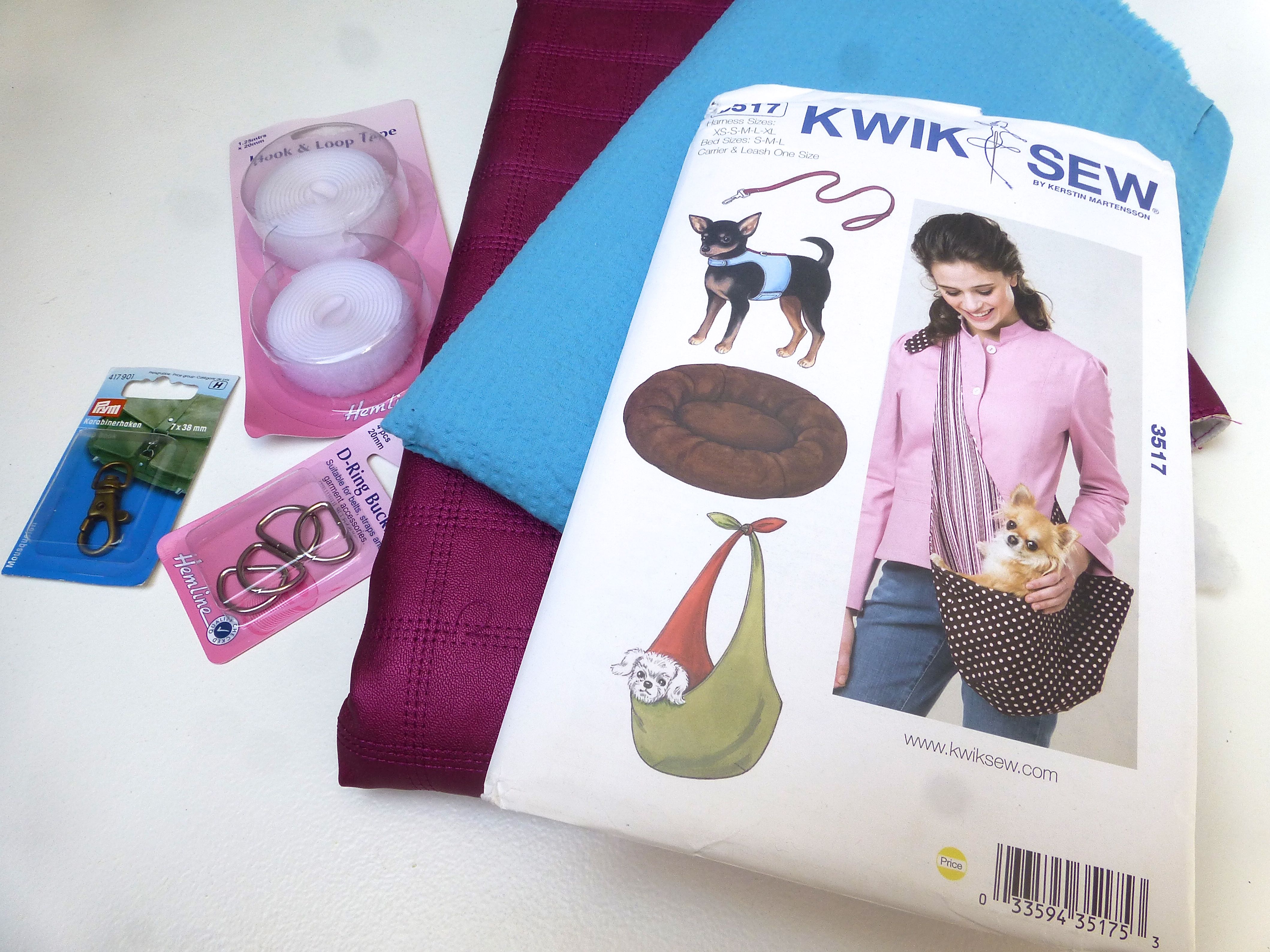
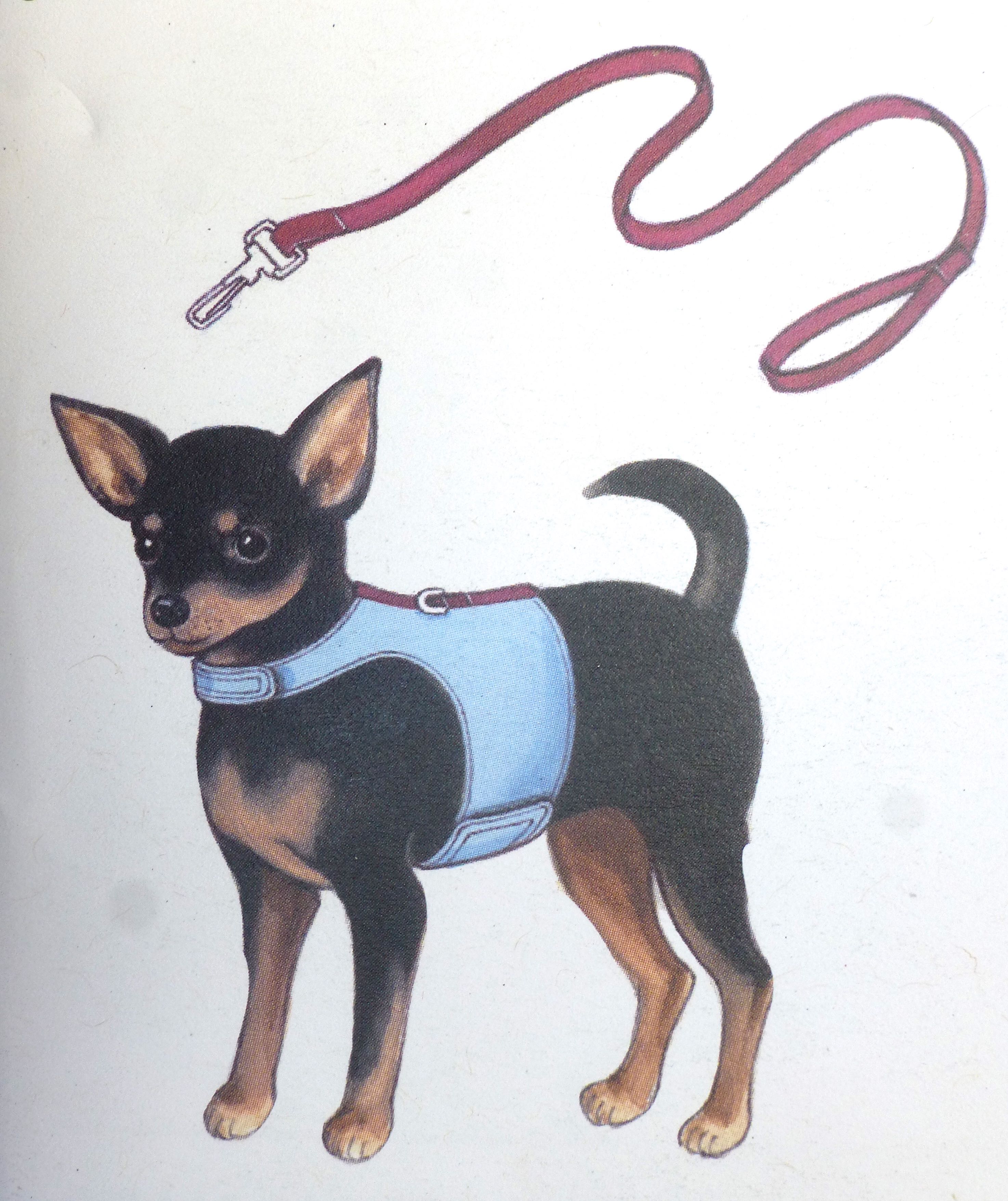
Minerva Crafts had the perfect pattern (Kwik Sew 3517) and fabrics for both a dog carrier and a harness and lead, so I got cracking and decided to make a matching set!

This is the parcel that arrived: –

P1040947

The carrier is lined and padded so is both comfortable for the dog and for you to wear across the body.

It incorporates a swivel clip to secure the dog to the inside of the carrier, but I chose not to include this as Fifi is an old dog and wouldn’t even consider jumping out – being restrained would make her nervous.

P1040949

I saw the matching accessories and just had to make those too!  The swivel clip could be used on the lead instead.

P1040948

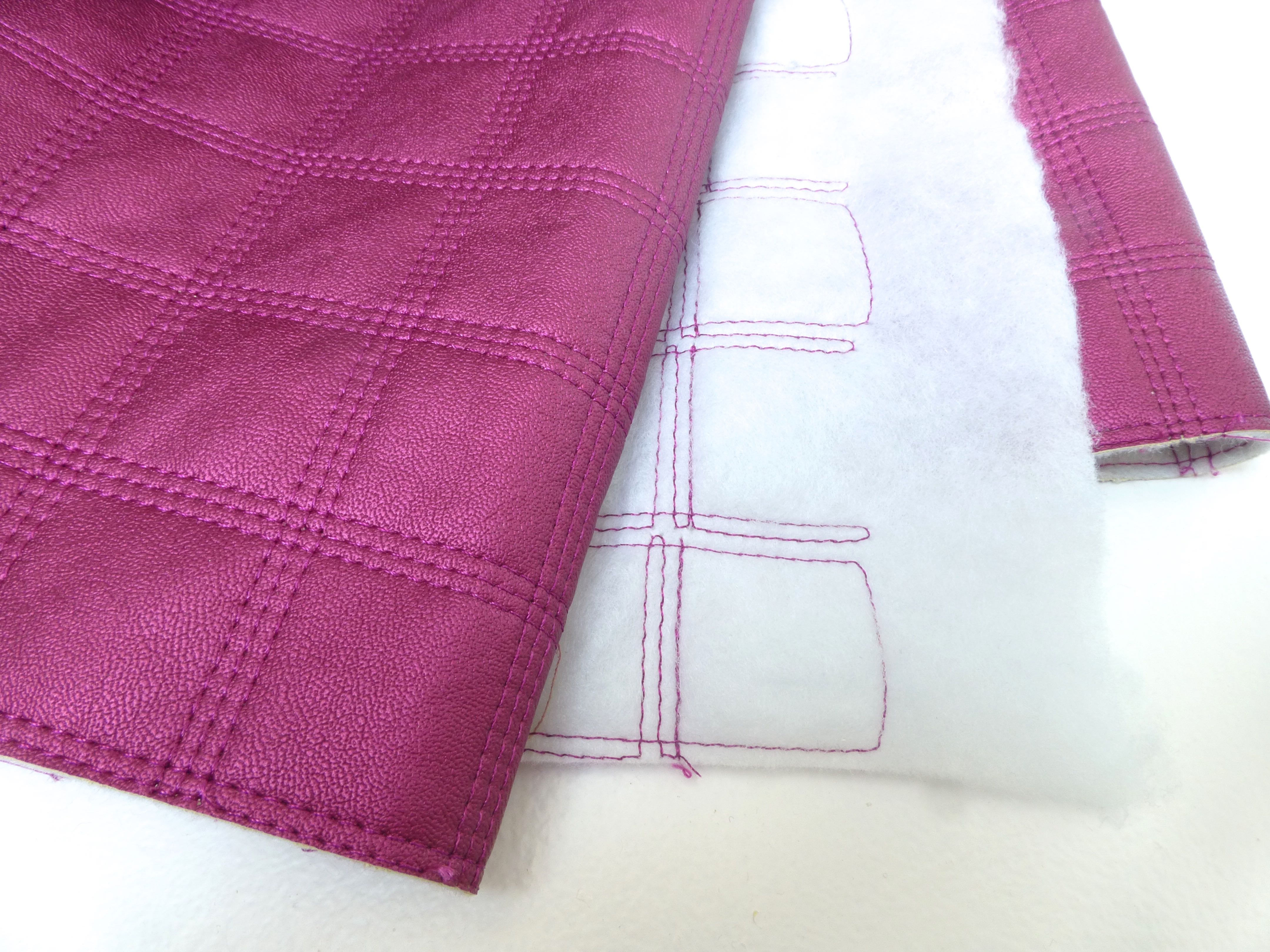
I chose a ready-quilted fabric in a raspberry coloured faux leather which incorporated a layer of wadding so would be the perfect choice, adding structure and warmth to the carrier and harness, yet is also wipeable for practicality.

It also meant that I didn’t need to add the layer of fleece that the pattern called for as the wadding was padding enough.

P1040950

This Turquoise Blue crinkle textured cotton was the ideal fabric for the lining, adding a pop of bright colour.

P1040951

There was just one single pattern piece for the carrier which made it very simple to cut out.

I have to mention that I was extremely impressed with the quality of the paper used for the pattern – can you get an idea of how sturdy it is from this photo before I ironed it? It’s not transparent or flimsy and therefore doesn’t tear accidentally, unlike the usual brown tissue paper type.

P1040953

Always iron your pattern pieces!

P1040954

The carrier made up like a dream – the instructions were simple and easy to follow. You’re required to press at every stage which I couldn’t do with the faux leather in case it melted. When top stitching, it wasn’t a problem just rolling the faux leather out slightly over the cotton to get a crisp edge so being unable to iron it didn’t matter.

Here is the finished carrier….

P1040987

….and here’s Fifi trying it for size!

P1040994

She may look a little reticent in this photo, but she actually curled up happily and let me snap away until I got the pics I needed.

Then onto the harness.

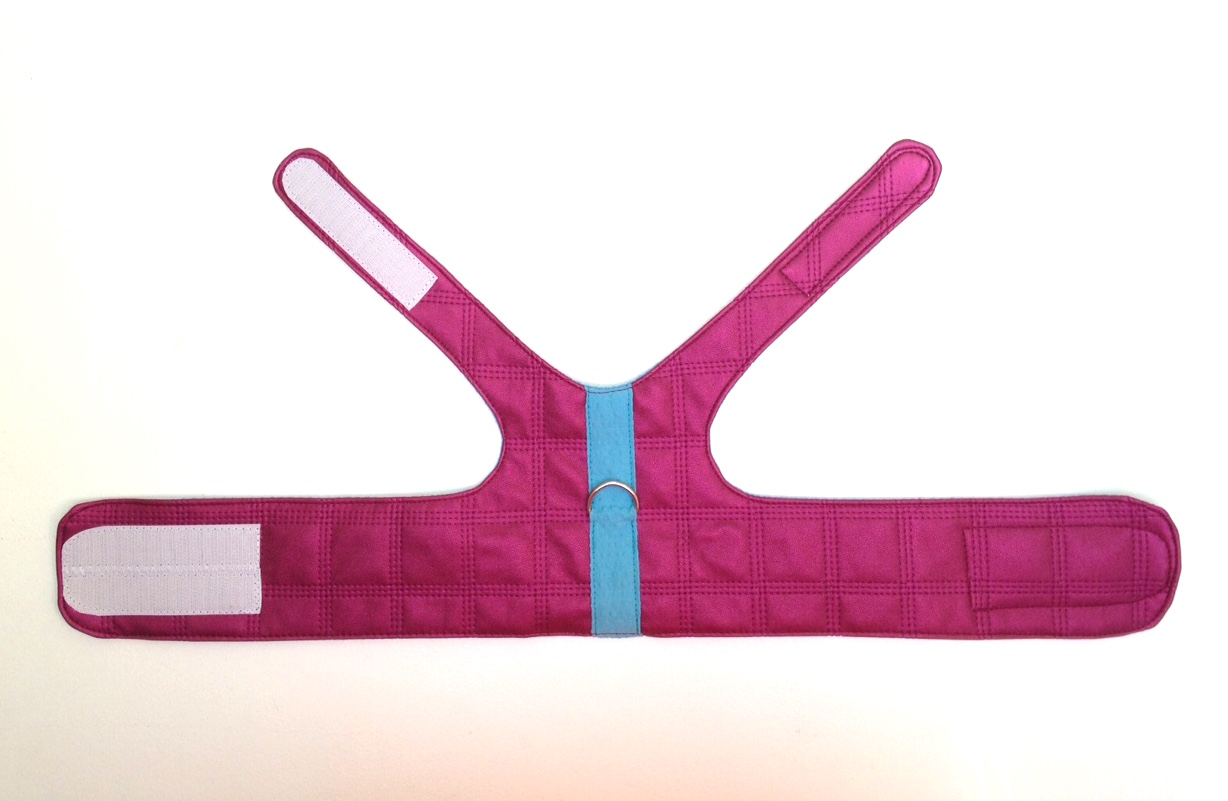
Again, just one main pattern piece (plus a piece for a strap for the D-ring) so the lining and main fabric were simply sewn right sides together before being turned through a gap in the stitching.

Simples:)

IMG_1652

Sew the scratchy side of the velcro to the outside….

IMG_1657

…and the soft side to the inside lining. We don’t want friction causing any nasty sores, do we?

IMG_1656

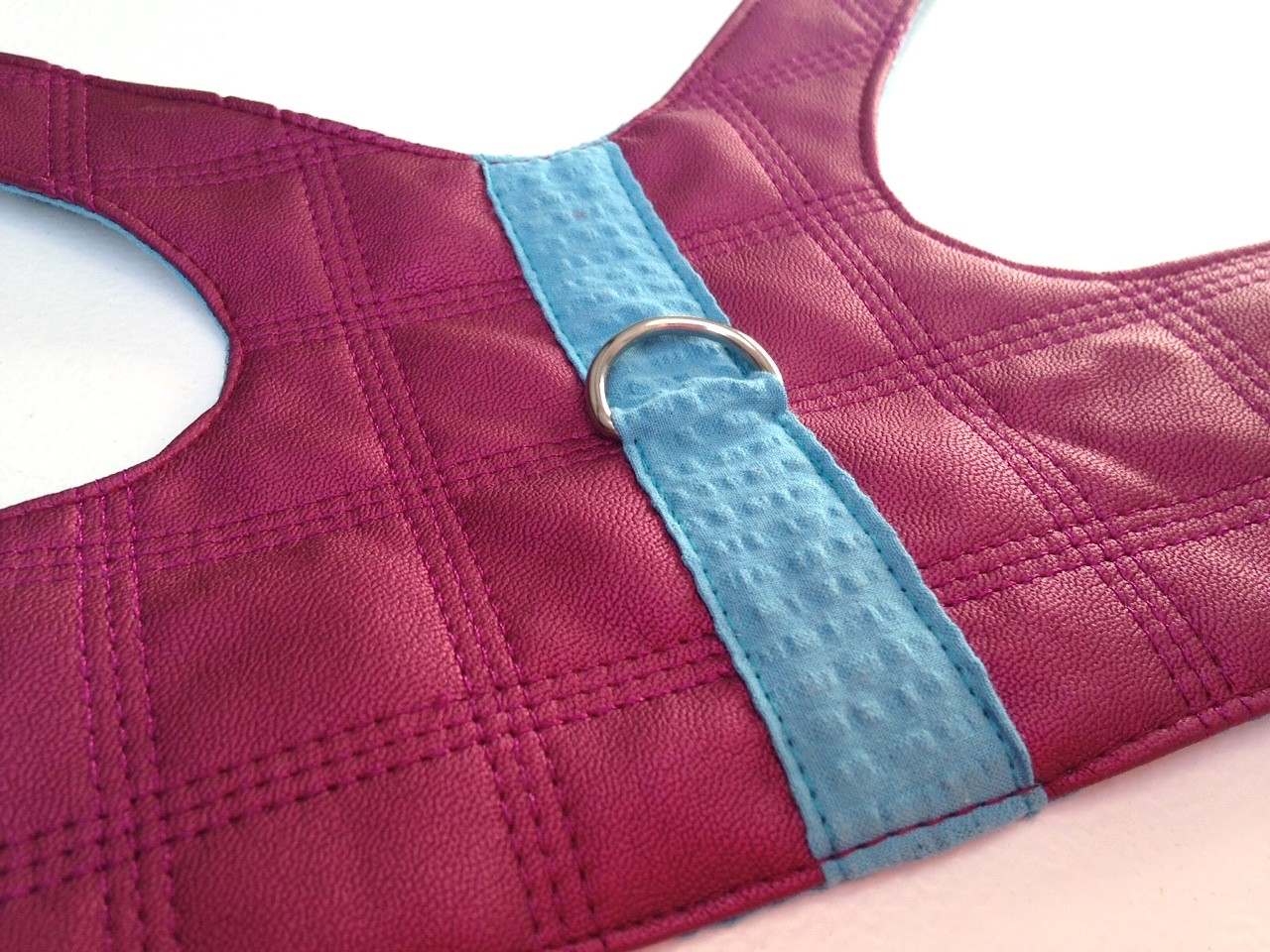
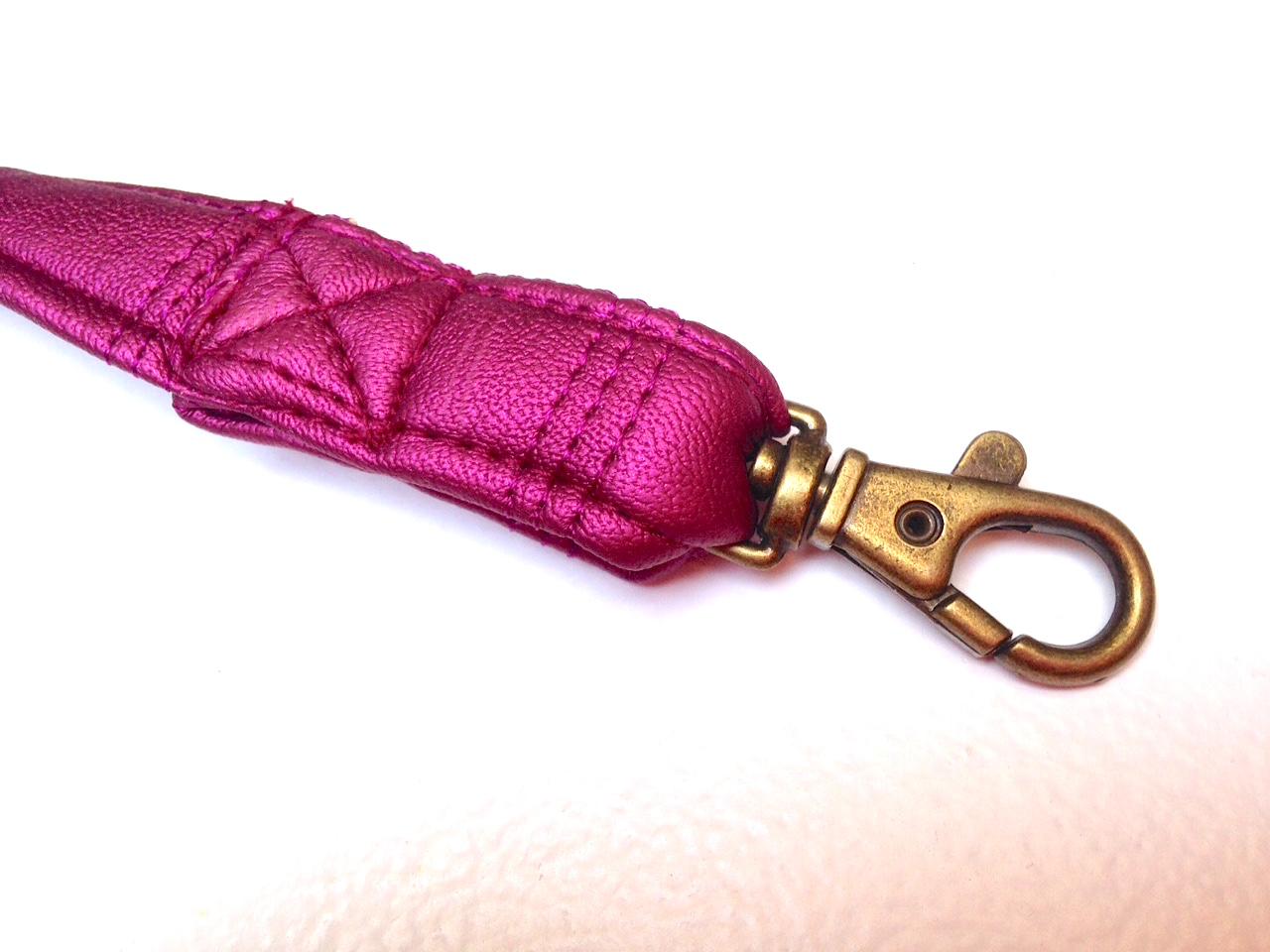
I used the lining fabric as a contrast for the D-ring strap which was top stitched on securely.

Different coloured thread was used for the bobbin for a ‘blend in’ effect but opposite colours would work equally well if you prefer a contrast – turquoise on the magenta and vice versa.

How ‘Designer’ does that look, eh?

IMG_1654

I almost plumped for the turquoise cotton to make the lead, but in the end thought the quilted fabric looked more luxurious.

IMG_1658

It was a bit of a pig to fold and top stitch such a narrow, thick strip of fabric though, the cotton would have been a piece of cake to press and stitch but you can’t iron faux leather….

IMG_1659

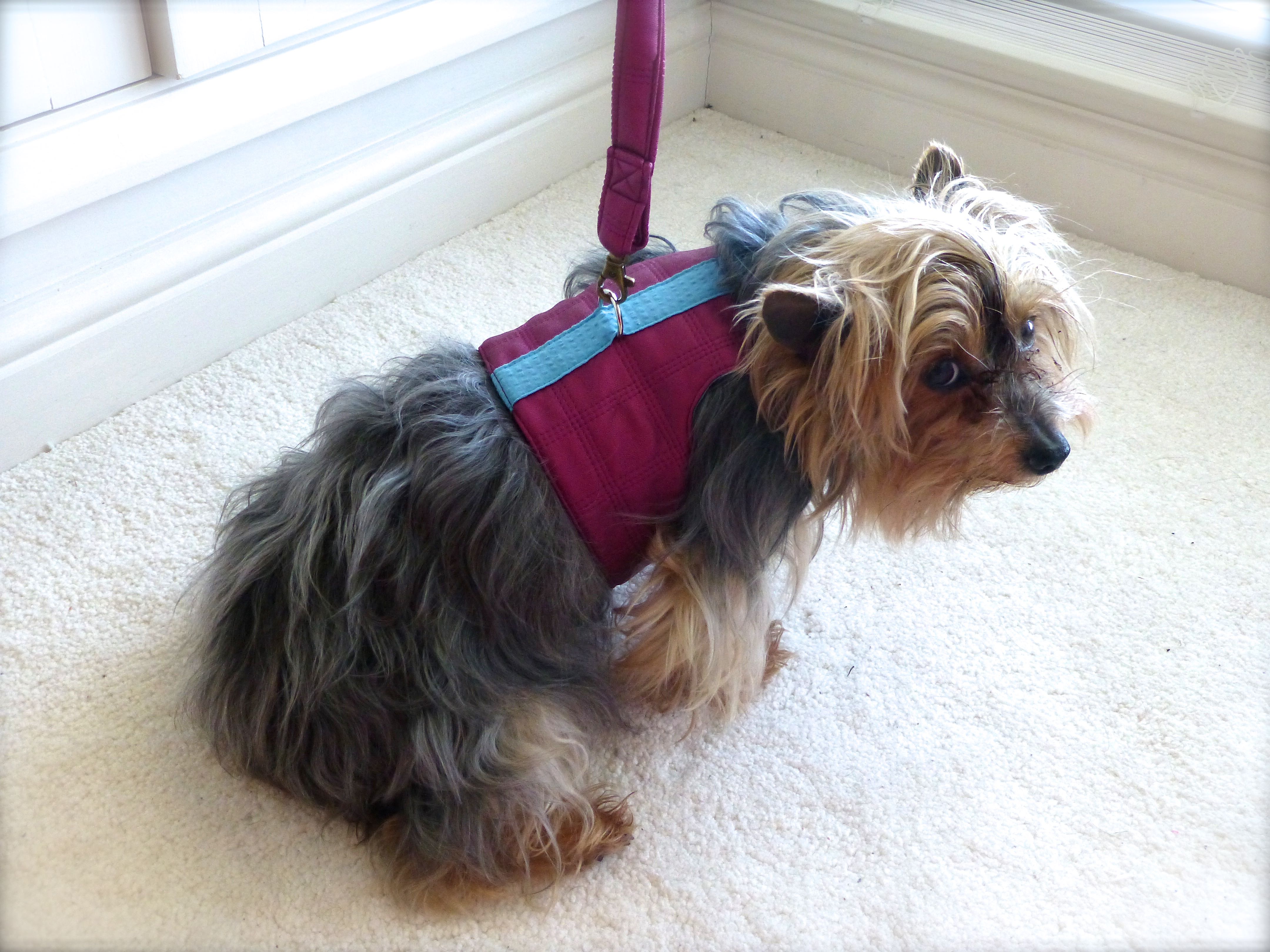
Just look at Fifi’s hang-dog expression! She was itching to come to me but I wanted a photo from the back to show off the harness to best effect, so this is her being patient with me.

I sewed the ‘Large’ size harness believe it or not (Fifi only weighs six pounds!), but there was one larger and three smaller sizes on this multi-sized pattern. I’m guessing the variation in sizes would probably fit from a Chihuahua to a Westie.

P1040991

Here we all are, ready to go for a ‘walk’.

P1040997

I think I’ll tie it up a bit higher as I usually carry her under my arm and this feels a little low.

Fifi loved it though – she was almost asleep by the time No.3 Son had finished taking photos!

P1040996

Thanks go to Minerva Crafts for providing all the materials for these items – why not pop over to visit the others on the Blogger Network and see what they’ve been up to lately?


40 Comments

Weekend/Overnight Bag In Chinese Brocade

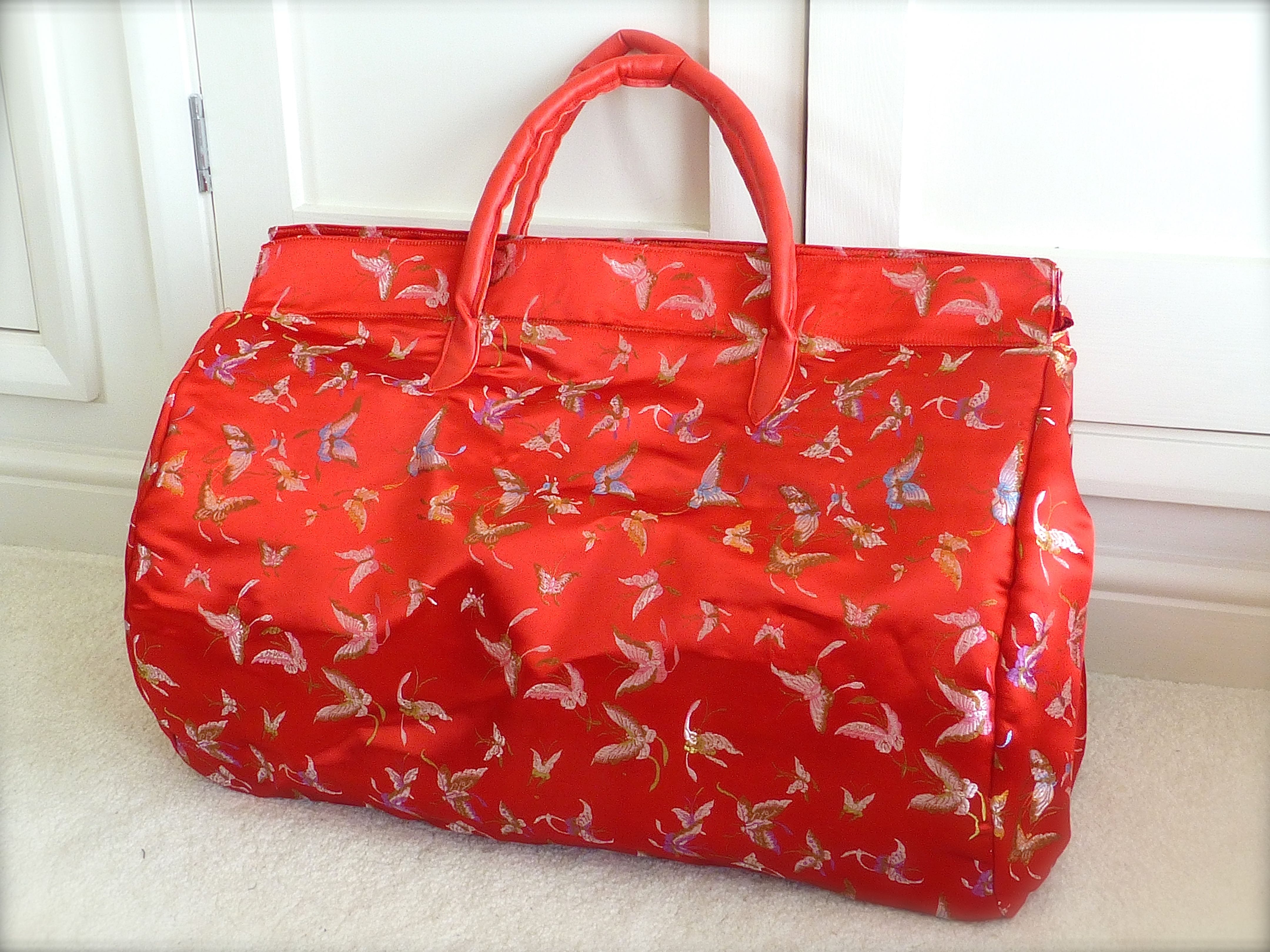
I’m really excited about my Minerva Bloggers project this month especially so because of the totally fabulous Chinese Brocade that I have used.  The colour is a vibrant Pillar Box Red and the motif is a repeating butterfly pattern which shimmers in the light due to the metallic thread running through the medium-heavy weight satin.

It can never be said that I’m afraid of colour!

Chinese brocade

As soon as I saw this fabric I was desperate to use it – I had considered a kimono style dressing gown as kimonos are very ‘in’ at the moment and it would make a very decadent one, but I don’t need another.

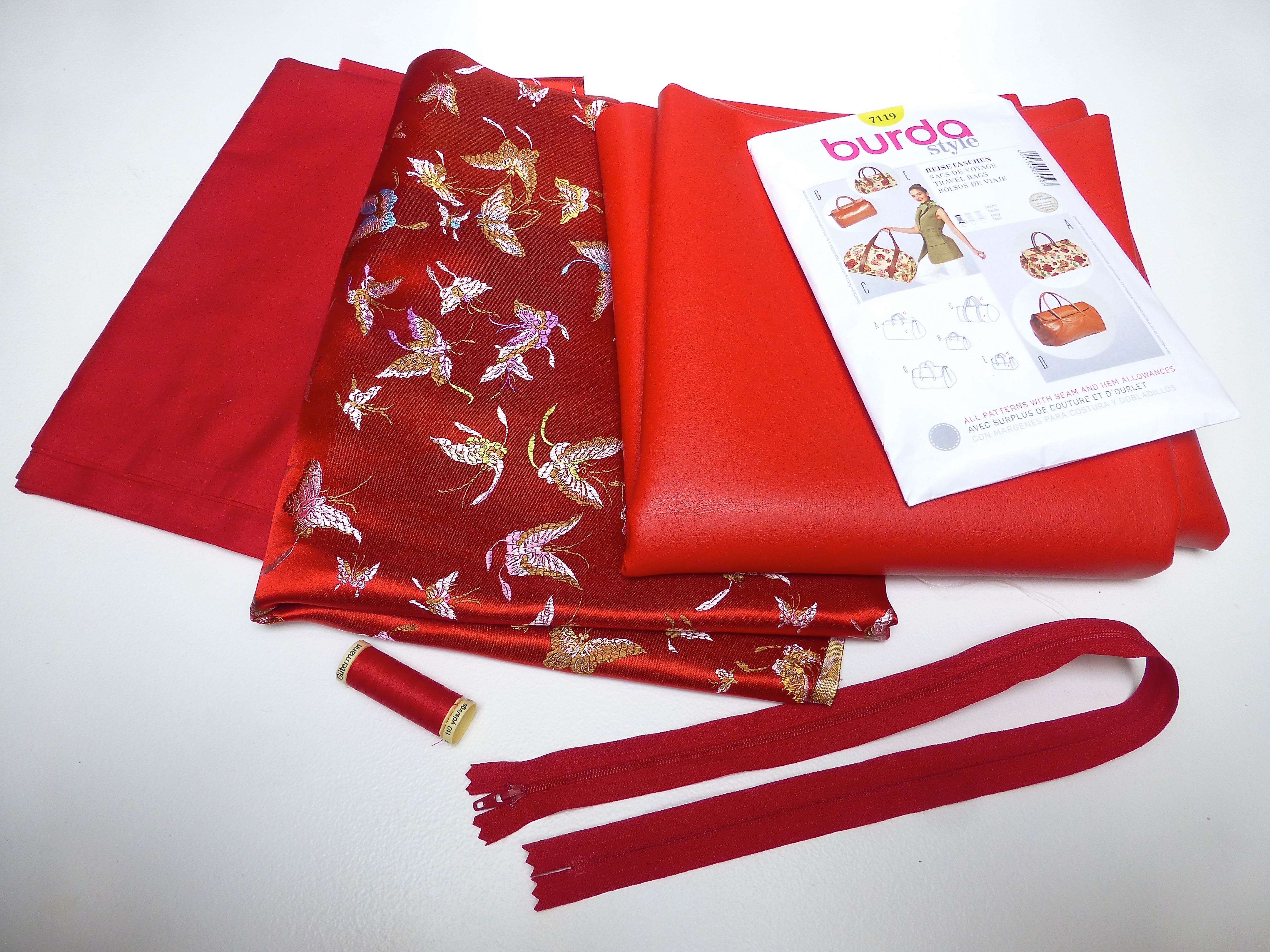
I do, however, need a new weekend bag as my old faithful is falling apart at the seams and looking extremely tatty. I wanted a pattern that wasn’t too fussy or detracted from the beautiful fabric which needs a starring rôle, so I was delighted when I stumbled upon Burda Style 7119.

Burda

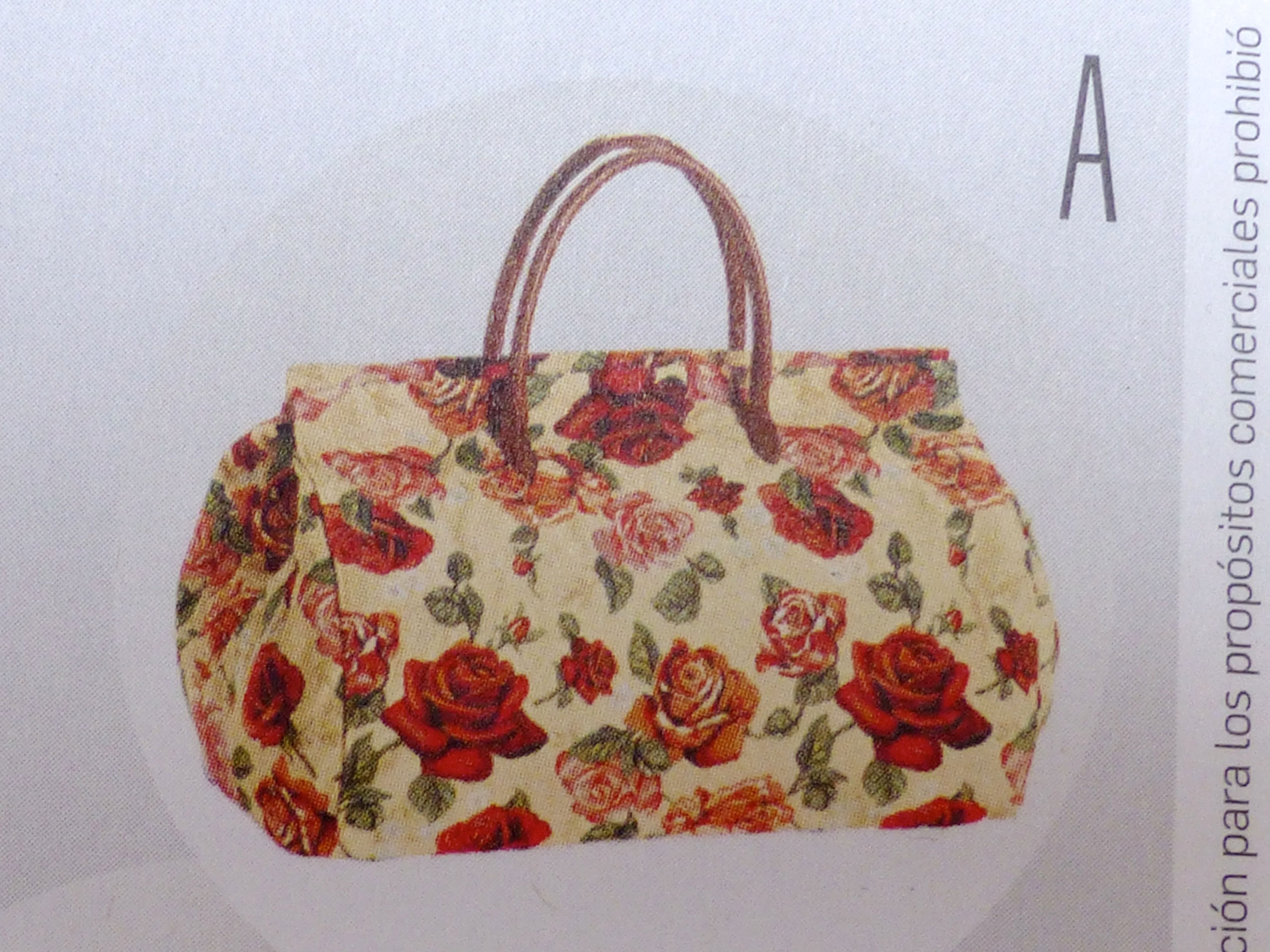
I chose view ‘A’ which reminds me of the old Doctors’ bags or carpet bags.

carpet bag

The pattern has been classed as “Easy” by Burda and I have to agree, although the handles may prove fiddly for the absolute beginner.

easy beginners bag pattern

It has been commented that I like a more roomy bag (see my “Sew Retro” bag) and this one is no exception. My fabric choice makes it a softly structured option but I can see it working even better in a leatherette or vinyl.

In fact, although I ordered a metre of bright red leatherette, I only used a tiny amount to make the handles so there is plenty left to make up a smaller version. Maybe a wash bag with waterproof lining?

These are the supplies, including matching red cotton lining, zip and thread. What a happy photo – red makes me want to shout out loud!

P1040568

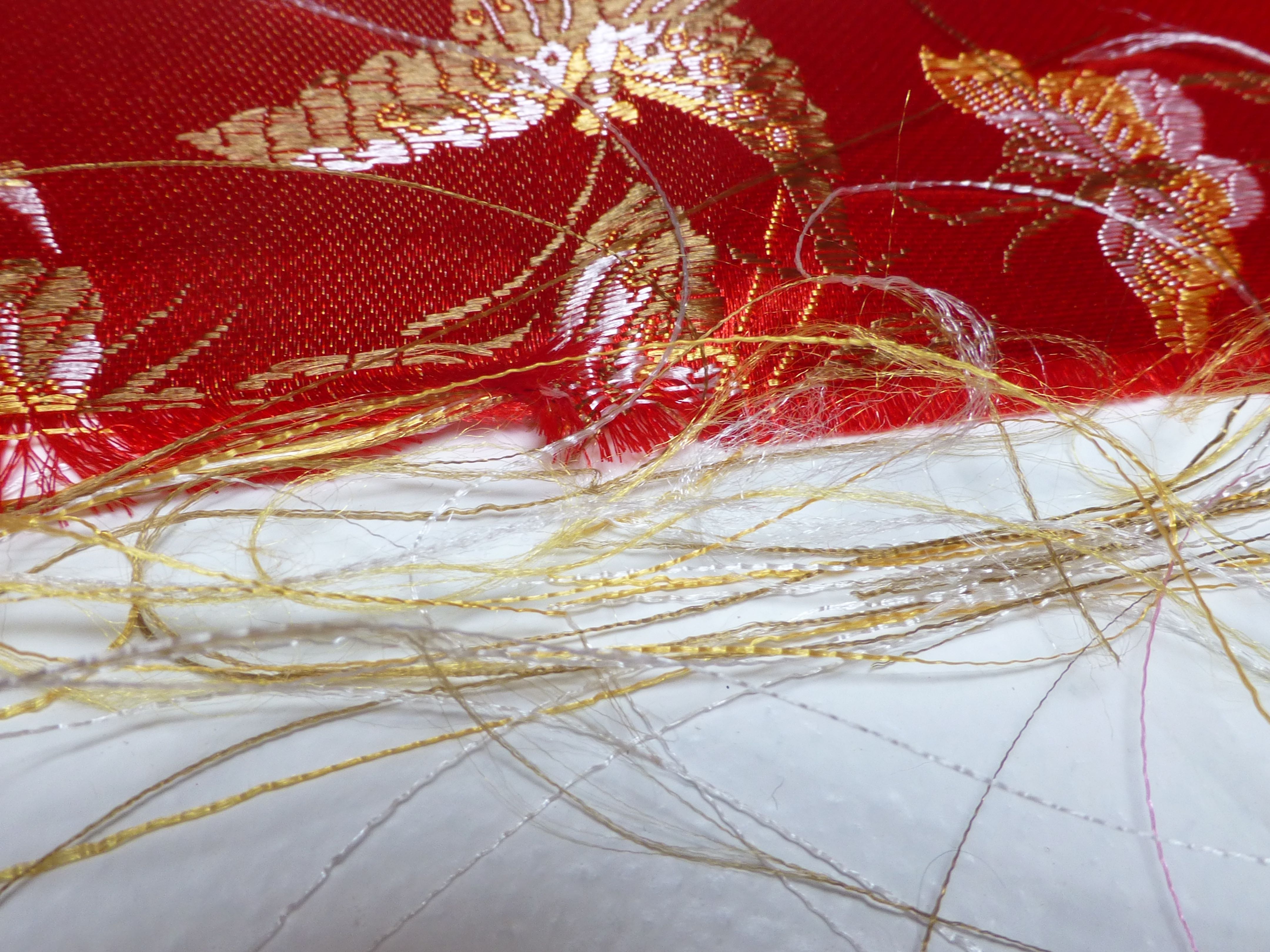
The downside to using brocade is that it frays extremely easily. The pattern is not printed onto the fabric, it is woven with shimmery, metallic threads which are so beautiful (the photographs do not do it justice!) but which slide out at the slightest touch.

P1040581

To prevent the fraying and to make sewing a much easier experience, I overlocked every single raw edge which I wouldn’t normally do when the edges are encased within a lining.

That’s better!

P1040583

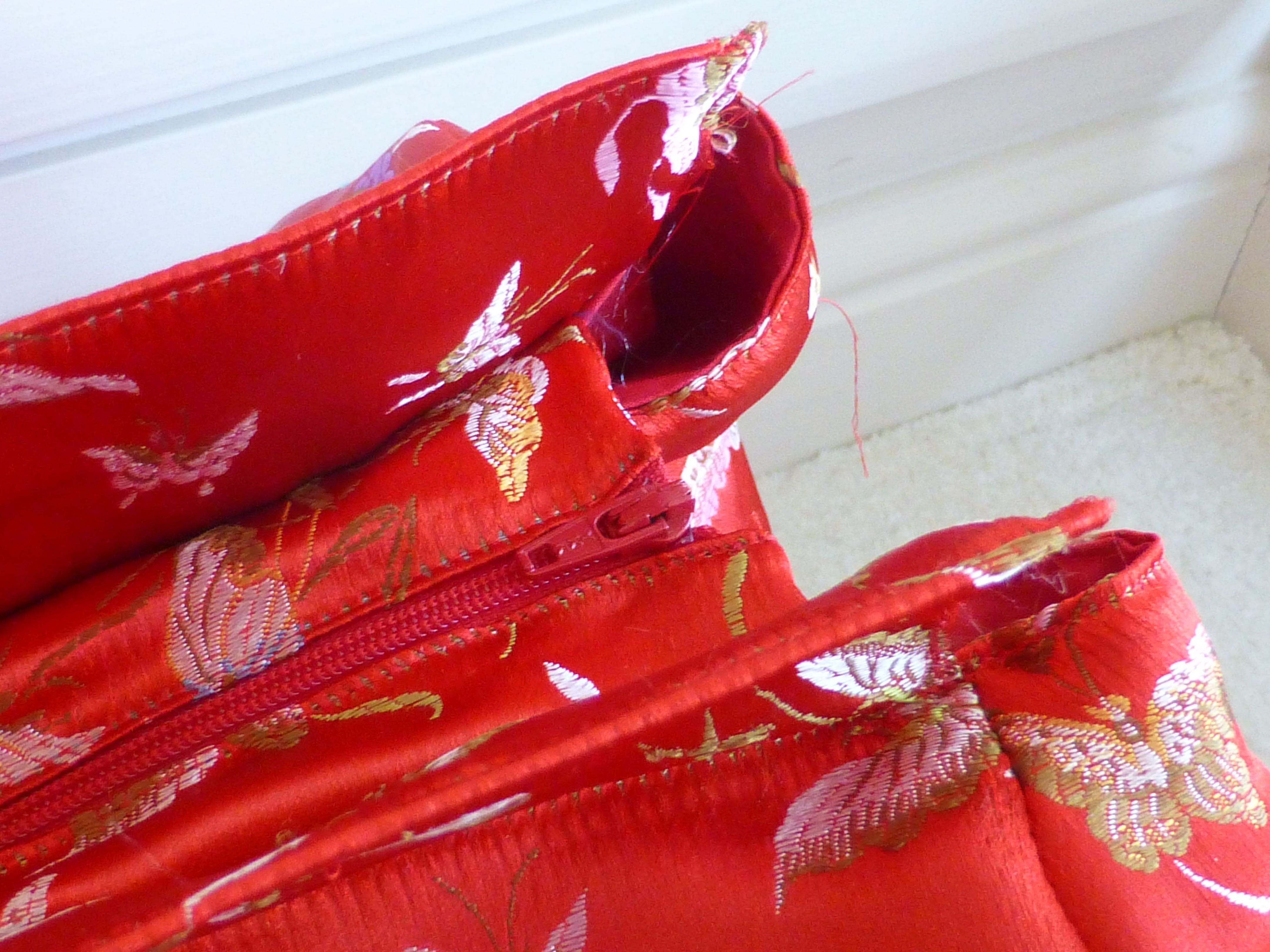
The zip went in easily enough and the placement makes a pleasant change from the norm.

P1040634

The zip extends past the end of the bag by a few inches and I liked the leatherette detail as a stop tab.

P1040635

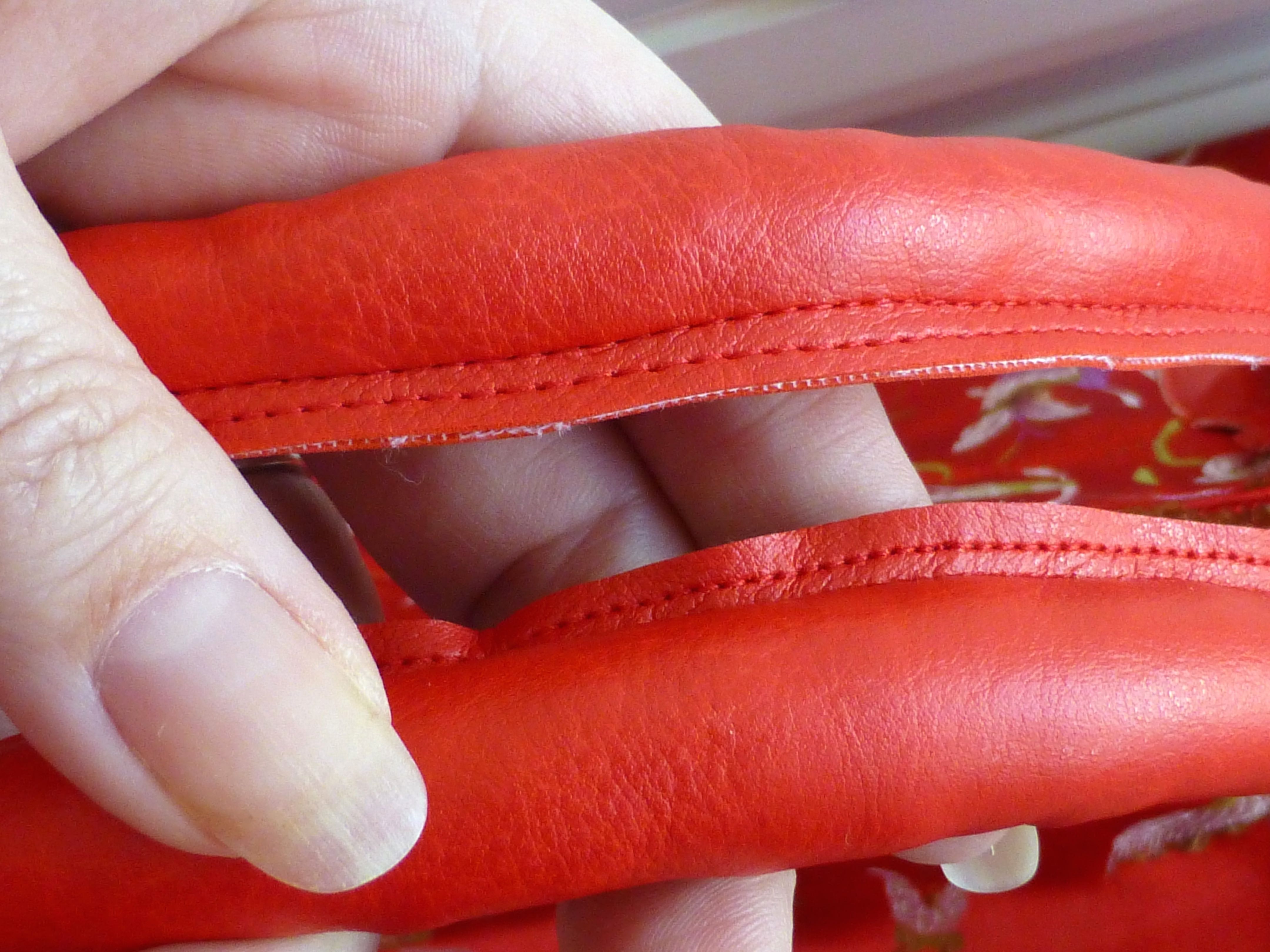
When it came to making the handles, I altered the pattern slightly.

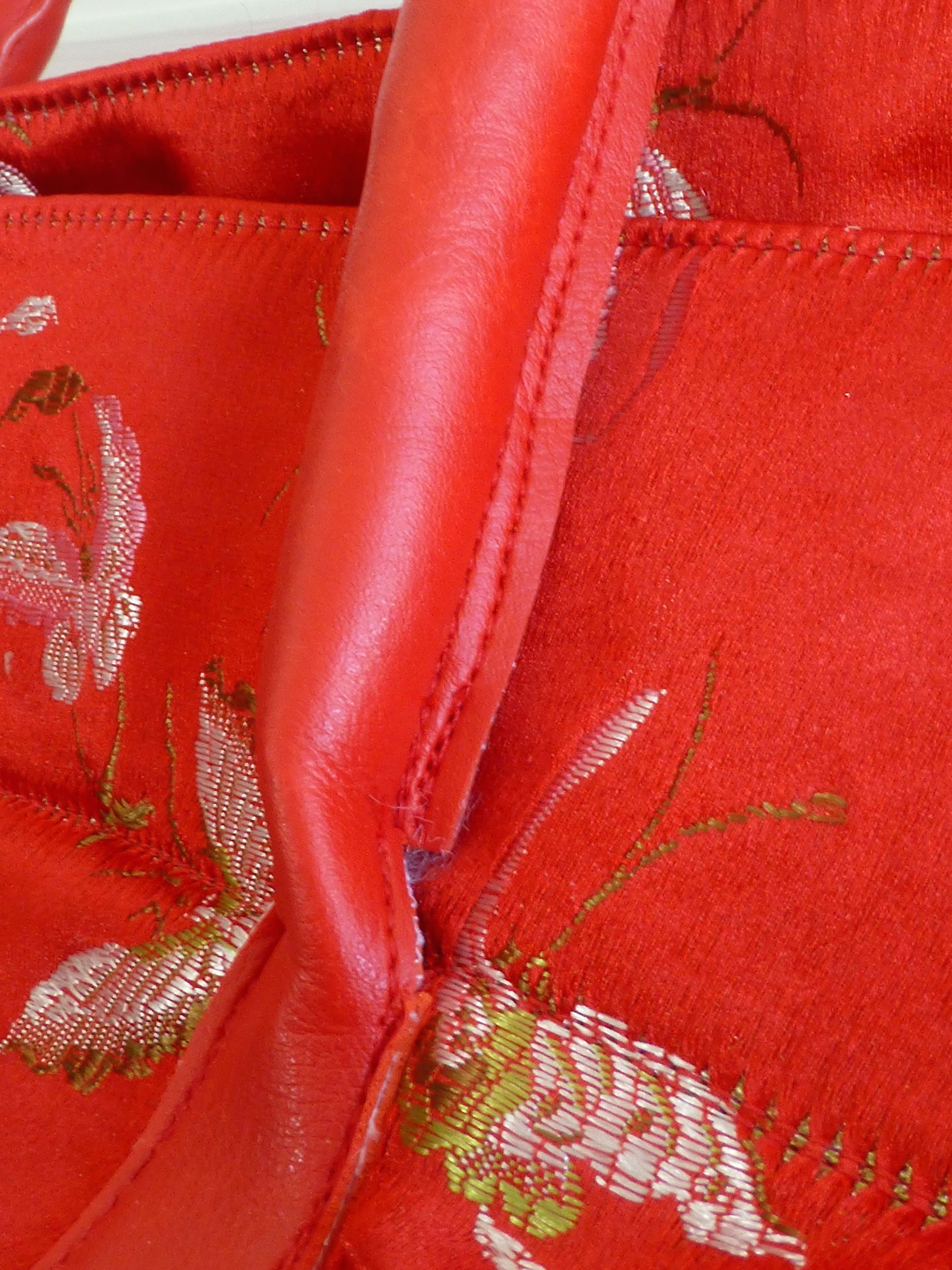
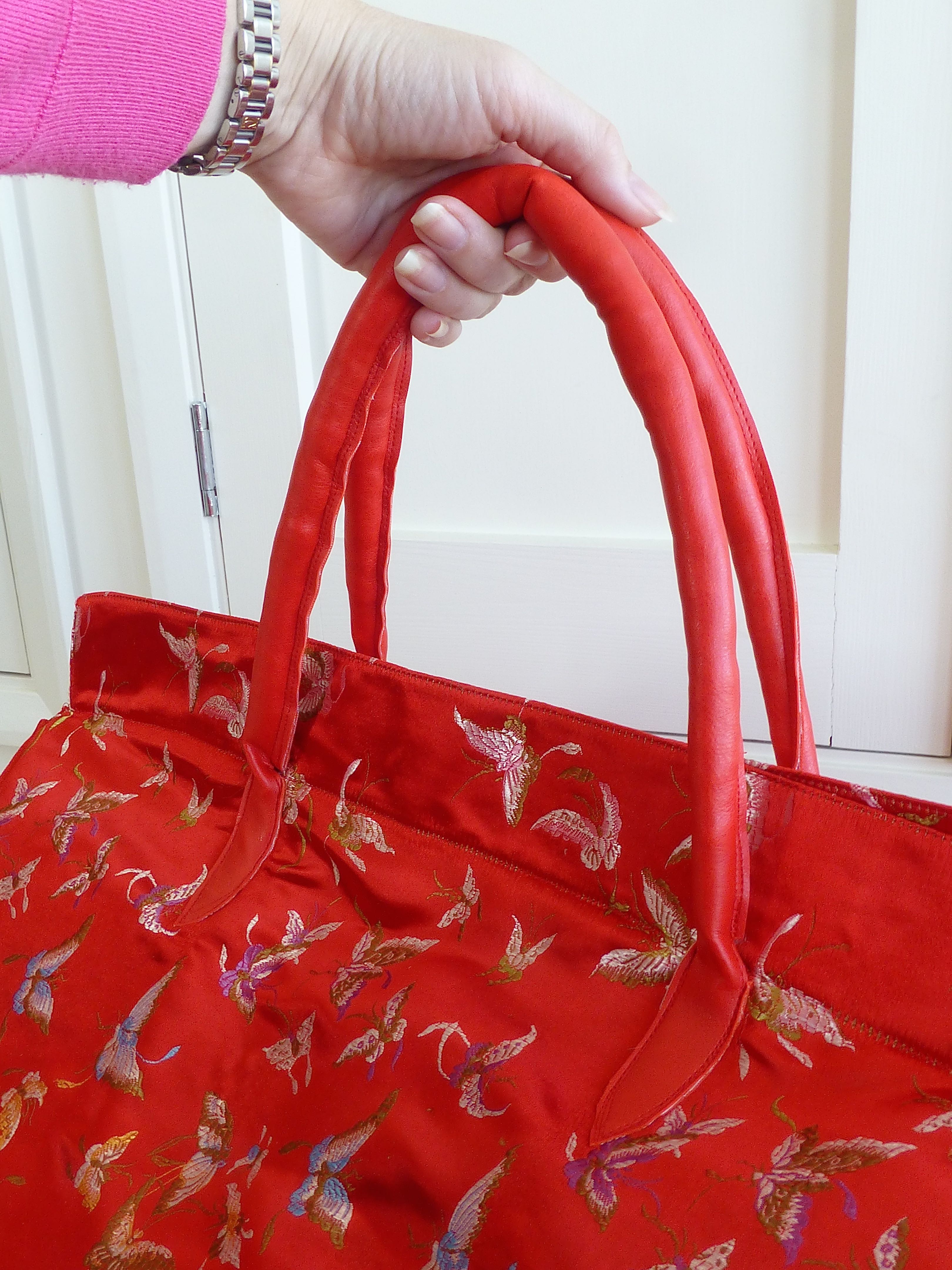
The design called for a tube to be sewn right sides together, turned inside out and tubes of handle wadding to be threaded through. I couldn’t source this anywhere so I improvised. I sewed the handles wrong sides together with two rows of stitching for strength and decoration, then poked some polyester toy wadding all the way through with a knitting needle.

leatherette bag handles

Three rows of stitching adds strength to where the handles join the bag.

P1040625 P1040633

The padded handles are really soft and comfortable too, an important consideration which is often overlooked.

P1040632

The amount of interior space is quite impressive and I love that the lining is just as cheery a colour as the outside!

P1040627

As I said, it’s a little floppy unless it’s stuffed full of clothes but the benefit is that it folds away neatly when stored. I’m not averse to the less structured look anyway.

P1040629

P1040624

Tadah!

I love it!

All in all it was a great pattern with easy to understand instructions and the fabric was a dream to work with after the fraying issue had been dealt with.

I can’t wait to use it – luckily we’ve got several overnight trips planned over the Easter break so it will get plenty of use. My husband has also planned our second wedding anniversary trip somewhere secret so it’s sure to get lots of second glances at the airport – it’s definitely a bag that stands out from the crowd.

It makes a lovely change from the generic overnight bags that you get in the shops and just proves the theory that hand made is best!

Weekend Bag

If you haven’t checked out Minerva Crafts yet, do hop over and have a look – the fabric selection alone is enormous and worth browsing over a cup of tea:)


44 Comments

One-Hour Poncho!

This is my first post as part of the Minerva Crafts Bloggers Network, and this is what I chose for my first make – a bold print Poncho with a cosy cowl neck, perfect for this time of year.

poncho3

If you’re anything like me, you’ve probably got your fingers in several pies and have lots of projects on the go at any one time, many of which are time-heavy and are completed over the course of weeks or even months.

Occasionally, just occasionally, I get impatient and don’t want to add yet another row to a seemingly unending WIP.

Once in a while I feel the need to make something quickly, to achieve something within a couple of hours, to finish something.

Well this is just such a project. In fact it is such a satisfyingly speedy make that it can be whipped up in just one hour!

No, really – look!

one hour poncho

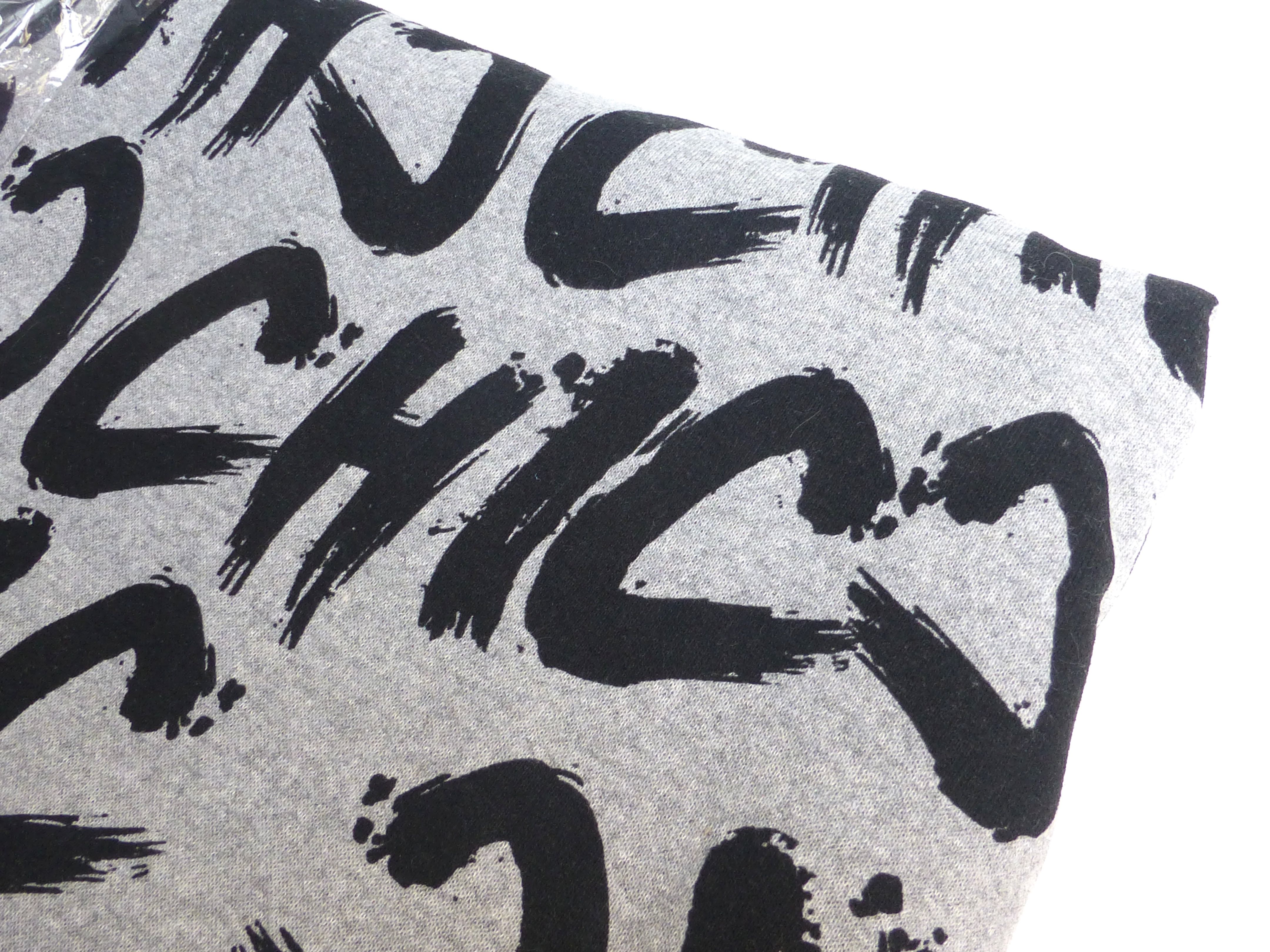
Other than speed, the inspiration for the poncho came from browsing the huge range of fabrics available at Minerva, and happening upon this bold “Chic” print which I thought had a touch of the Parisienne about it – isn’t it fantastic?

P1040557

The fabric is described as “….sweatshirt jersey fabric, a lovely heavy weight with a soft fuzzy-textured backing. The print is a fantastic bold design with the word ‘Chic’ printed randomly across the surface….great for making hoodies and comfy jackets”

Please don’t be put off by the word ‘sweatshirt’ – it’s such good quality that it looks deceptively like wool from a distance, the benefits being that it is cheaper and easier to wash.

If you like it, you’d better be quick as it’s on clearance and there are only limited stocks:)

fabric

I’m not a hoodie kind of gal, so I searched for a poncho pattern and found McCall’s 6209 which is half price at the moment, and decided to make view ‘E’ with a cowl neck to keep those chilly winds out.

poncho pattern envelope

I’ve actually got a knit poncho that looks exactly like the one illustrated and I wear it all the time in place of a jumper. It’s not substantial enough to replace a coat though, so I wanted to choose a warmer fabric which drapes loosely for comfort and the jersey does just that.

poncho pattern

I made the cowl up as per the instructions. The fabric has a lovely weight to it that stops it flopping too much.

poncho cowl neck

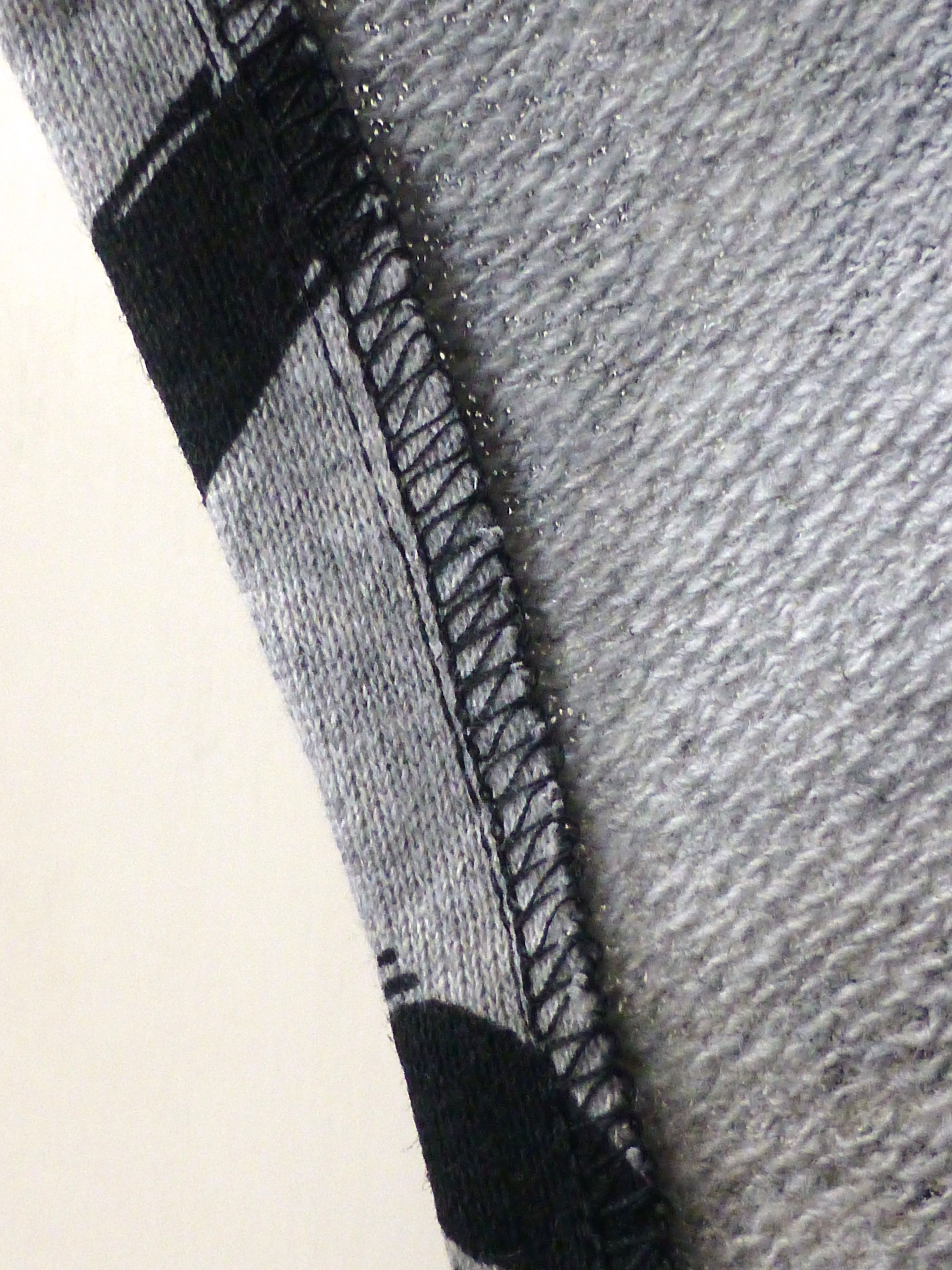
The top stitching around the neck edge looked so nice that I decided to stray from the directions a little and top stitch from the shoulder to the arm too, on either side of the seams.

poncho top stitching

I overlocked the raw edges before hemming them as a double-turned hem would have been too bulky in this fabric.

poncho overlocked edges

I meandered a little further from the instructions when I also decided to add some satin bias binding all around the lower hem.

This addition creates a more professional finish and the sheen of the satin adds a luxury edge to the poncho.

poncho binding detail

poncho binding

I’m so pleased with the bias binding, I wish I’d ordered more and done the armhole edges too, instead of hemming them.

poncho bias binding

So, one and a half hours later (due to the extra embellishments) all it needed was a cold, windy day to test it out and, being in good old Blighty we are not short of those!

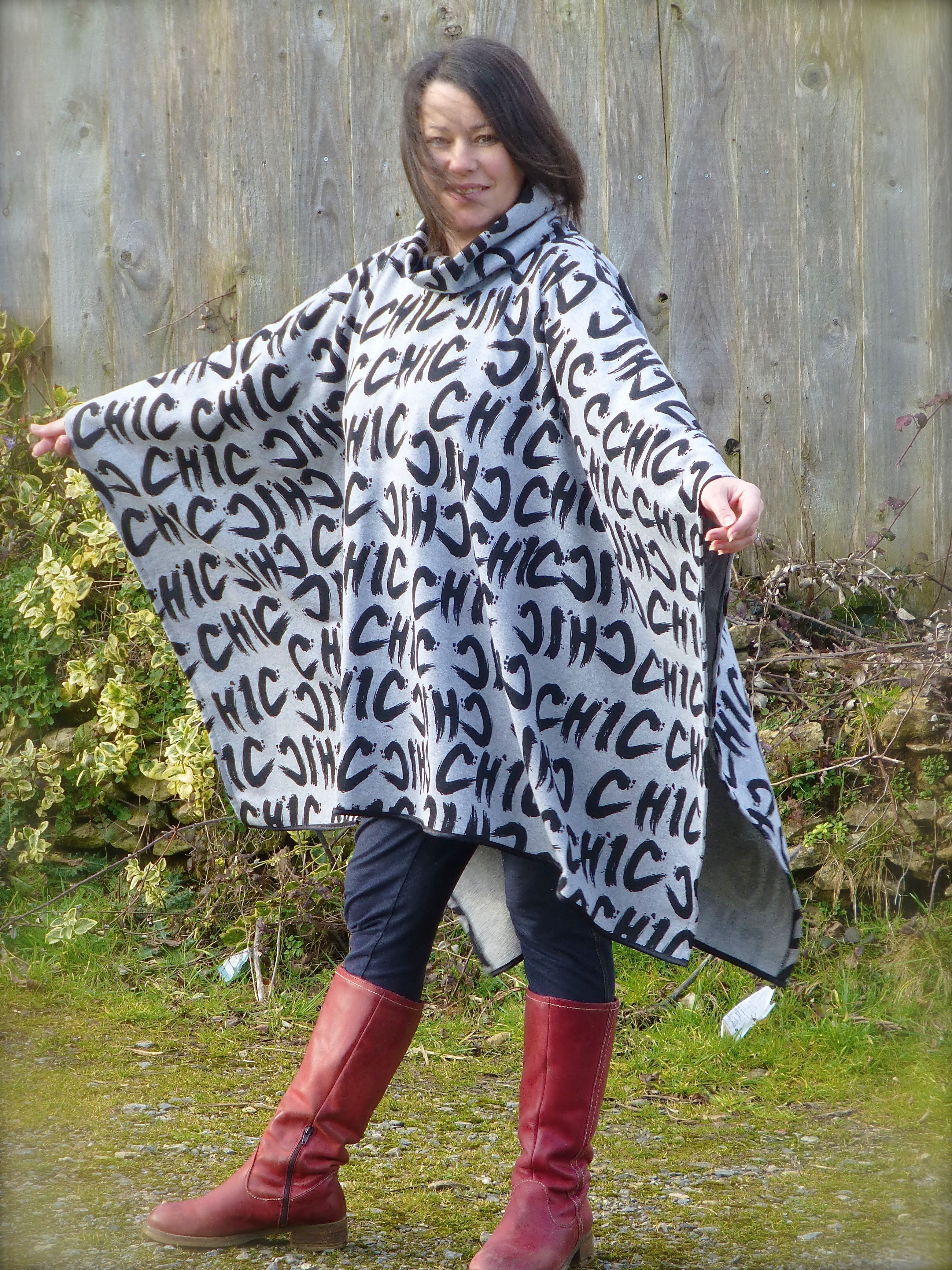
chic poncho

I had no idea the poncho would cause such a stir though and I’ve already had loads of compliments. I suppose it is pretty unique and that in itself will draw comments.

Do you ever get the urge for a quick make?

What have you created in just a couple of hours?